Results by title
9 books match the query 'Serial Killers'

Blood Ties
Sex, Scandal, and Serial Murder at the Turn of the Twentieth CenturyHarold Schechter
University of Iowa Press, 2027
Confession of a Serial Killer
The Untold Story of Dennis Rader, the BTK KillerKatherine Ramsland
University Press of New England, 2017
Deadly Charm
The Story of a Deaf Serial KillerMcCay Vernon
Gallaudet University Press, 2010
From the day he was born, Patrick McCullough faced hardships and reacted with untempered anger. His mother, a soon-to-be-divorced military wife, was late to realize that he was deaf and never learned how to handle his outbursts. Eventually, she abandoned him by petitioning for him to be a ward of the state. Stints in mental institutions and dismissals from several schools punctuated the rest of McCullough’s early years. Despite this severe childhood, no one could have predicted the outcome of his life described in Deadly Charm: The Story of a Deaf Serial Killer.
Authors McCay and Marie Vernon present a compelling story about McCullough, a strikingly handsome man with a winning personality. His charm was endearing, but his incendiary temper resulted in increasing aggression and abuse. Eventually, he was convicted for the murder of two men. Yet, McCullough ingratiated himself with the court and served only seven years in prison. Once free again, he resumed his pattern of sweetness and mayhem. He beguiled sympathetic women whom he then abused and stalked. Finally, his rage culminated in a crescendo of destruction. Deadly Charm depicts a deaf serial killer driven by frustration and violence and leaves much to consider. Did McCullough’s deafness exacerbate his lethally violent nature? Perhaps his vicious impulses could have been constrained if his time in mental institutions had been more productive than his time in prison.
Killer on the Road
Violence and the American InterstateBy Ginger Strand
University of Texas Press, 2012
Starting in the 1950s, Americans eagerly built the planet’s largest public work: the 42,795-mile National System of Interstate and Defense Highways. Before the concrete was dry on the new roads, however, a specter began haunting them—the highway killer. He went by many names: the “Hitcher,” the “Freeway Killer,” the “Killer on the Road,” the “I-5 Strangler,” and the “Beltway Sniper.” Some of these criminals were imagined, but many were real. The nation’s murder rate shot up as its expressways were built. America became more violent and more mobile at the same time.
Killer on the Road tells the entwined stories of America’s highways and its highway killers. There’s the hot-rodding juvenile delinquent who led the National Guard on a multistate manhunt; the wannabe highway patrolman who murdered hitchhiking coeds; the record promoter who preyed on “ghetto kids” in a city reshaped by freeways; the nondescript married man who stalked the interstates seeking women with car trouble; and the trucker who delivered death with his cargo. Thudding away behind these grisly crime sprees is the story of the interstates—how they were sold, how they were built, how they reshaped the nation, and how we came to equate them with violence.
Through the stories of highway killers, we see how the “killer on the road,” like the train robber, the gangster, and the mobster, entered the cast of American outlaws, and how the freeway—conceived as a road to utopia—came to be feared as a highway to hell.
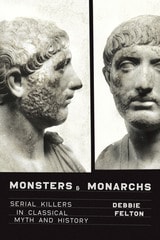
Monsters and Monarchs
Serial Killers in Classical Myth and HistoryBy Debbie Felton
University of Texas Press, 2021
Jack the Ripper. Jeffrey Dahmer. John Wayne Gacy. Locusta of Gaul. If that last name doesn’t seem to fit with the others, it’s likely because our modern society largely believes that serial killers are a recent phenomenon. Not so, argues Debbie Felton—in fact, there’s ample evidence to show that serial killers stalked the ancient world just as they do the modern one.
Felton brings this evidence to light in Monsters and Monarchs, and in doing so, forces us to rethink the assumption that serial killers arise from problems unique to modern society. Exploring a trove of stories from classical antiquity, she uncovers mythological monsters and human criminals that fit many serial killer profiles: the highway killers confronted by the Greek hero Theseus, such as Procrustes, who tortured and mutilated their victims; the Sphinx, or “strangler,” from the story of Oedipus; child-killing demons and witches, which could explain abnormal infant deaths; and historical figures such as Locusta of Gaul, the most notorious poisoner in the early Roman Empire. Redefining our understanding of serial killers and their origins, Monsters and Monarchs changes how we view both ancient Greek and Roman society and the modern-day killers whose stories still captivate the public today.

Natural Born Celebrities
Serial Killers in American CultureDavid Schmid
University of Chicago Press, 2005
David Schmid provides a historical account of how serial killers became famous and how that fame has been used in popular media and the corridors of the FBI alike. Ranging from H. H. Holmes, whose killing spree during the 1893 Chicago World's Fair inspired The Devil in the White City, right up to Aileen Wuornos, the lesbian prostitute whose vicious murder of seven men would serve as the basis for the hit film Monster, Schmid unveils a new understanding of serial killers by emphasizing both the social dimensions of their crimes and their susceptibility to multiple interpretations and uses. He also explores why serial killers have become endemic in popular culture, from their depiction in The Silence of the Lambs and The X-Files to their becoming the stuff of trading cards and even Web sites where you can buy their hair and nail clippings.
Bringing his fascinating history right up to the present, Schmid ultimately argues that America needs the perversely familiar figure of the serial killer now more than ever to manage the fear posed by Osama bin Laden since September 11.
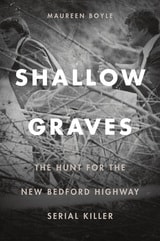
Shallow Graves
The Hunt for the New Bedford Highway Serial KillerMaureen Boyle
University Press of New England, 2017
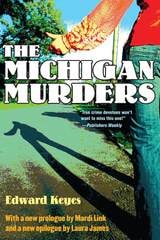
The Michigan Murders
Edward Keyes
University of Michigan Press, 2010
"True crime devotees won't want to miss this one!"
---Publishers Weekly
"Very engrossing . . . in the finest you can't put it down tradition."
---Hartford Courant
"This factual account of each murder, through the conviction of the killer, has all the excitement of a first-rate work of fiction, and is told straight, without the usual sociological jargon. Keyes collaborated with Robin Moore on The French Connection; The Michigan Murders is his first solo effort, and it is a good one."
---Miami Herald
"The Michigan Murders is the ultimate True Crime classic, unfolding like great mystery fiction while still delivering the powerful charge of real life."
---Jamie Agnew, Aunt Agatha's Mystery Bookshop
With a new prologue by Mardi Link and a new epilogue by Laura James
The true story of the savage coed killings---by the boy who could have lived next door!
Southeastern Michigan was rocked in the late 1960s by the terrifying serial murders of young women, whose bodies were dumped in Ann Arbor and Ypsilanti. In each case, few clues were left at the scene, and six separate police agencies were unable to end the horror. Then, almost by accident, a break came. The suspect: John Norman Collins, a young, quiet, all-American boy.
Collins was caught, went to trial, and, on August 19, 1970, was found guilty and sentenced to life imprisonment with no possibility of parole. He is now in his sixties and is serving his sentence in Marquette, Michigan.
Collins was one of the first serial killers exposed in the region, and his crimes had many in the area locking their doors for the first time. Edward Keyes's harrowing The Michigan Murders covers every step of the case. It fell out of print for more than a decade before being revived for this special edition.
Mardi Link, author of the new prologue, is the author of two regionally best-selling true crime books based in northern Michigan, When Evil Came to Good Hart and Isadore's Secret.
Laura James, author of the new epilogue, is a trial lawyer, crime historian, and true crime author who blogs about the true crime genre at her Web site CLEWS (www.laurajames.com).
Edward Keyes, now deceased, spent several years in the early 1970s investigating the Michigan murders. He also authored the works Double Dare and Cocoanut Grove. The Michigan Murders was a finalist for the Edgar Allan Poe Award for Best Fact Crime in 1977.
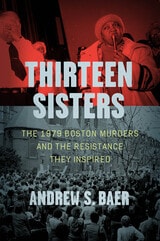
Thirteen Sisters
The 1979 Boston Murders and the Resistance They InspiredAndrew S. Baer
University of Chicago Press, 2027
The murder of thirteen women and girls in 1979 and the social movement they launched.
In four terrifying months in 1979, thirteen women and girls—twelve Black, one white—were murdered in Boston. All were found in or near Roxbury, a predominantly Black neighborhood in a city famously beset by racial strife and division. Fears of a serial killer spread within Black communities. But the authorities wouldn’t hear of it: these were just ordinary, everyday murders of unimportant people, killed by men they knew. The police said Black residents had nothing to fear—and the media implied that white people could safely ignore the carnage.
Yet Black feminists refused to accept the murders of Black women and girls. The real serial killers, they argued, were chronic racism, sexism, poverty, and domestic violence, including violence committed by Black men. Something had to be done.
Thirteen Sisters tells the gripping stories of the women who died—their lives, their brutal deaths, the attempts to solve them—and the renowned Combahee River Collective, whose activism in the wake of the murders brought national attention to the overlapping oppressions that made Black women and girls so vulnerable to violence. Historian Andrew S. Baer interviews family members and activists to introduce readers to the victims as complete people and investigate the events surrounding their deaths, unspooling a fast-paced and urgent narrative about crime, race, and marginalization. Baer also pays tribute to the Black feminists who saw the social roots of this violence and called for radical change, demands that remain all too relevant today.
Riveting, enraging, and humane, Thirteen Sisters is an indictment of the neglectful institutions that have failed Black women and a testament to the activists who transformed how we understand systemic oppression.