Results by title
12 books match the query 'Serres, Michel'

Biogea
Michel Serres
University of Minnesota Press, 2012
Biogea is a mixture of poetry, philosophy, science, and biography exemplary of the style that has made Michel Serres one of the most extraordinary thinkers of his age. His philosophical and poetic inquiry sings in praise of earth and life, what he names singularly as Biogea. In these times when species are disappearing, when catastrophic events such as earthquakes and tsunamis impale the earth, Serres wonders if anyone “worries about the death pangs of the rivers.” And for Serres, one can ask the same question of philosophy as the humanities increasingly find themselves in need of defenders. Today, all living organisms discover themselves part of this Biogea. “Today we have other neighbors, constituents of the Biogea: the sea, my lover; our mother, the Earth, becomes our daughter; this beautiful breeze which inspires the spirit, a spiritual mistress; our light friends, the fresh and flowing waters.”

Conversations on Science, Culture, and Time
Michel Serres with Bruno LatourMichel Serres
University of Michigan Press, 1995

Genesis
Michel Serres
University of Michigan Press, 1997
Serres draws on a vast knowledge of such diverse disciplines as anthropology, classical history, music, theology, art history, information theory, physics, biology, dance and athletics, and Western metaphysics, and a range of cultural material that includes the writings of Plato, Kant, August Comte, Balzac, and Shakespeare, to name a few. He argues that although philosophy has been instrumental in the past in establishing laws of logic and rationality that have been crucial to our understanding of ourselves and our universe, one of the most pressing tasks of thought today is to recognize that such pockets of unity are islands of order in a sea of multiplicity--a sea which cannot really be conceived, but which perhaps can still be sensed, felt, and heard raging in chaos beneath the momentary crests of order imposed by human civilization.
Philosophy of science or prose poetry, a classical meditation on metaphysics or a stream-of-consciousness polemic and veiled invective, Serres mounts a quirky, at times rhapsodical, but above all a "noisy" critique of traditional and current models in social theory, historiography, and aesthetics. The result is a work that is at once provocative, poetic, deeply personal, and ultimately religious--an apocalyptic call for the rebirth of philosophy as the art of thinking the unthinkable.
About the Book:
"An intensely beautiful and rigourous meditation on the birth of forms amid chaos and multiplicity from a major philosopher who is also an exquisite craftsman of the written word." --William Paulson, University of Michigan
"Serres exhibits a rare, raw tendentiousness refreshing in its vitriol . . . it's the sort of light-hearted, perverse, and basically liberal tirade one hears too infrequently of late." --Word
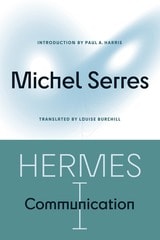
Hermes I
CommunicationMichel Serres
University of Minnesota Press, 2023
For the first time in English, the introductory volume in a major French philosopher’s groundbreaking series of poetic transdisciplinary works
Michel Serres is recognized as one of the giants of postwar French philosophy of knowledge, along with Gilles Deleuze, Jacques Derrida, Michel Foucault, and Gilbert Simondon. His early five-volume series Hermes, which appeared in the 1960s and 1970s, was an intellectual supernova in its proposition that culture and science shared the same mythic and narrative structures. Hermes I: Communication marks the start of a major publishing endeavor to introduce this foundational series into English.
Building on the figure of the Greek god Hermes, who presides over the realms of communication and interpretation, Hermes I embarks on a reflection concerning the history of mathematics via Descartes and Leibniz and culminates by way of a Bachelardian logoanalytic reading of Homer, Dumas, Molière, Verne, and the story of Cinderella. We observe a singular poetic philosopher seeking to bridge the gap between the liberal arts and the sciences through a profound mathematical and poetic fable regarding information theory, history, and art, establishing a new way to think about the production of knowledge during the late twentieth century. In these pages, students and scholars of philosophy will discover an extraordinary project of thought as vital to critical reflection today as it was fifty years ago.
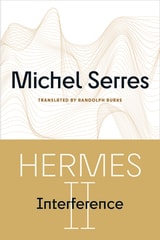
Hermes II
InterferenceMichel Serres
University of Minnesota Press, 2025
Unveiling the hidden connections in the network of knowledge
Hermes II: Interference is the second in a series of works by philosopher Michel Serres using Hermes, god of communication, as an archetypal symbolic figure for reflecting on philosophy and the arts and sciences. Serres delves into the concept of interreferentiality, proposing that every node—whether it be knowledge, objects, or people—exists within a network where it both receives and transmits information. He argues against the existence of a dominant center or pole within these networks, emphasizing that each node can temporarily serve as a focal point depending on context.
Serres presents unique insights into topics such as the nature of knowledge, the world of objects, intersubjectivity, the origins of geometry, the interplay of music and background noise, and empiricism. By identifying parallel structures across these areas, Serres unifies them into a comprehensive theoretical framework, revealing hidden connections and potential future influences. Additionally, this work includes a critique of Gaston Bachelard’s The Formation of the Scientific Mind and concludes with an analysis of communication in Hergé’s The Castafiore Emerald.
Hermes II is a unique blend of ancient and modern perspectives, combining rigorous analysis with an optimistic outlook and highlighting the interconnectedness of knowledge and its implications for fostering peaceful relations within the network of life.
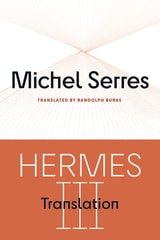
Hermes III
TranslationMichel Serres
University of Minnesota Press, 2026
Unlocking the hidden patterns of knowledge—where science, art, and philosophy speak a common language
Hermes III: Translation is the third volume in Michel Serres’s renowned Hermes series, an ambitious exploration of the deep interconnections among disparate fields of knowledge. While Hermes II: Interference traced the overlapping echoes of ideas across realms, Hermes III moves to translate the structural logics of one field—be it genetics, painting, or philosophy—into the language of another. Revealing how the humanities, science, and art share hidden combinatory architectures, Serres exposes the underlying unity of knowledge systems typically thought distinct.
Through an array of examples—from Monod’s Chance and Necessity to works by Descartes, Leibniz, Comte, Turner, and Roumain—Serres shows how translation uncovers informational and mathematical patterns that shape both ancient and modern thought. This illuminating methodology leads Serres to issue a stark warning: when knowledge is detached from its guiding purpose, it becomes vulnerable to appropriation by destructive political forces.
Yet Serres’s vision remains ultimately hopeful. By tracing knowledge systems back to their mythic and structural roots, Hermes III: Translation gestures toward more harmonious relationships between fields. A rare synthesis of philosophy, science, art, and literature, this work will engage readers interested in the interdependence of disciplines and the possibilities for a more unified, humane understanding of knowledge.
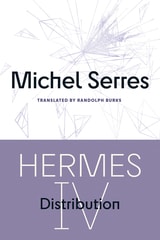
Hermes IV
DistributionMichel Serres
University of Minnesota Press, 2026
How order, meaning, and knowledge emerge from noise across science, literature, and philosophy
Hermes IV: Distribution is the fourth and penultimate volume in Michel Serres’s landmark series on knowledge and communication across disciplines. This collection of essays investigates how order emerges from noise, using thermodynamics and information theory as structural models applicable to science, literature, and culture alike. Moving beyond the themes of interference and translation developed in earlier volumes, Serres focuses on distribution: the processes by which systems take shape, endure, and eventually disperse.
At the core of the book is a dynamic vision of knowledge as an unstable formation. Systems arise from chance encounters or deviations that, through repetition, harden into law. They resist entropy by remaining open to external inputs, forming temporary pockets of negentropy within a wider field of chaos. Space, time, energy, language, and meaning are all shown to emerge from such conditions of mixture and imbalance.
Serres develops his argument through a striking range of materials, including fables, myths, literary texts, philosophy, and the history of science. The result is an uncommon synthesis of hard science and the humanities that reveals shared structures across domains while affirming the irreducible plurality of their laws and methods.
Retail e-book files for this title are screen-reader friendly with images accompanied by short alt text and/or extended descriptions.
Mapping Michel Serres
Niran Abbas, Editor
University of Michigan Press, 2005
---Robert Harrison, Stanford University [blurb from review pending permission]
The work of Michel Serres---including the books Hermes, The Parasite, The Natural Contract, Genesis, The Troubadour of Knowledge, and Conversations on Science, Culture, and Time---has stimulated readers for years, as it challenges the boundaries of science, literature, culture, language, and epistemology. The essays in Mapping Michel Serres, written by the leading interpreters of his work, offer perspectives from a range of disciplinary positions, including literature, language studies, and cultural theory. Contributors include Maria Assad, Hanjo Berressem, Stephen Clucas, Steven Connor, Andrew Gibson, René Girard, Paul Harris, Marcel Hénaff, William Johnsen, William Paulson, Marjorie Perloff, Philipp Schweighauser, Isabella Winkler, and Julian Yates.
Porous Becomings
Anthropological Engagements with Michel SerresAndreas Bandak and Daniel M. Knight, editors
Duke University Press, 2024
Contributors. Andreas Bandak, Jane Bennett, Tom Boylston, Steven D. Brown, Matei Candea, Alberto Corsín Jiménez, David Henig, Michael Jackson, Daniel M. Knight, Celia Lowe, Morten Nielsen, Stavroula Pipyrou, Elizabeth Povinelli, Andrew Shryock, Arpad Szakolczai

The Natural Contract
Michel Serres
University of Michigan Press, 1995
World history is often referred to as the story of human conflict. Those struggles that are seen as our history must now include the uncontrolled violence that humanity perpetrates upon the earth, and the uncontrollable menace to human life posed by the earth in reaction to this violence. Just as a social contract once brought order to human relations, Serres believes that we must now sign a "natural contract" with the earth to bring balance and reciprocity to our relations with the planet that gives us life. Our survival depends on the extent to which humans join together and act globally, on an earth now conceived as an entity.
Tracing the ancient beginnings of modernity, Serres examines the origins and possibilities of a natural contract through an extended meditation on the contractual foundations of law and science. By invoking a nonhuman, physical world, Serres asserts, science frees us from the oppressive confines of a purely social existence, but threatens to become a totalitarian order in its own right. The new legislator of the natural contract must bring science and law into balance.
Serres ends his meditation by retelling the story of the natural contract as a series of parables. He sees humanity as a spacecraft that with the help of science and technology has cast off from familiar moorings. In place of the ties that modernity and analytic reason have severed, we find a network of relations both stranger and stronger than any we once knew, binding us to one another and to the world. The philosopher's harrowing and joyous task, Serres tells us, is that of comprehending and experiencing the bonds of violence and love that unite us in our spacewalk to the spaceship Mother Earth.
"Wise, rich and poetic . . . not simply a philosophical study of the Environment, or an ecological questioning of Philosophy . . . Nature is acknowledged as an inside force which breaks [the philosopher's] discourse, and opens it up to a vigilant poetic meditation."--Substance: A Review of Theory and Literary Criticism

The Troubadour of Knowledge
Michel Serres
University of Michigan Press, 1997

Variations on the Body
Michel Serres
University of Minnesota Press, 2015
World-renowned philosopher, Michel Serres writes a text in praise of the body and movement, in praise of teachers of physical education, coaches, mountain guides, athletes, dancers, mimes, clowns, artisans, and artists. This work describes the variations, the admirable metamorphoses that the body can accomplish. While animals lack such a variety of gestures, postures, and movements, the fluidity of the human body mimics the leisure of living beings and things; what’s more, it creates signs. Already here, within its movements and metamorphoses, the mind is born. The five senses are not the only source of knowledge: it emerges, in large part, from the imitations the plasticity of the body allows. In it, with it, by it knowledge begins.