Results by title
6 books match the query 'Seventeenth - Century England'
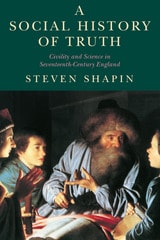
A Social History of Truth
Civility and Science in Seventeenth-Century EnglandSteven Shapin
University of Chicago Press, 1994
In A Social History of Truth, Shapin engages these universal questions through an elegant recreation of a crucial period in the history of early modern science: the social world of gentlemen-philosophers in seventeenth-century England. Steven Shapin paints a vivid picture of the relations between gentlemanly culture and scientific practice. He argues that problems of credibility in science were practically solved through the codes and conventions of genteel conduct: trust, civility, honor, and integrity. These codes formed, and arguably still form, an important basis for securing reliable knowledge about the natural world.
Shapin uses detailed historical narrative to argue about the establishment of factual knowledge both in science and in everyday practice. Accounts of the mores and manners of gentlemen-philosophers are used to illustrate Shapin's broad claim that trust is imperative for constituting every kind of knowledge. Knowledge-making is always a collective enterprise: people have to know whom to trust in order to know something about the natural world.
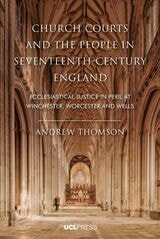
Church Courts and the People in Seventeenth-Century England
Ecclesiastical Justice in Peril at Winchester, Worcester and WellsAndrew Thomson
University College London, 2022
Religion meant far more in early modern England than church on Sundays, a baptism, a funeral, or a wedding ceremony. The Church was fully enmeshed in the everyday lives of the people, their morals, and religious observance. It imposed comprehensive regulations on its flock focused on such issues as sex before marriage, adultery, and receiving the sacrament, and it employed an army of informers and bureaucrats, headed by a diocesan chancellor, to enable its courts to enforce the rules. Church courts lay, thus, at the very intersection of Church and people. This book offers a detailed survey of three dioceses across the whole of the century, examining key aspects such as attendance at court, completion of business, and, crucially, the scale of guilt to test the performance of the courts. For students and researchers of the seventeenth century, it provides a full account of court operations, measuring the extent of control, challenging orthodoxies about ex-communication, penance, and juries, contextualizing ecclesiastical justice within major societal issues of the times, and, ultimately, presents powerful evidence for a “church in danger” by the end of the century.
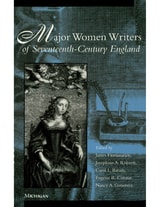
Major Women Writers of Seventeenth-Century England
James Fitzmaurice, Josephine A. Roberts, Carol L. Barash, Eugene R. Cunnar, and Nancy A. Gutierrez, Editors
University of Michigan Press, 1997

Reading, Gender and Identity in Seventeenth-Century England
Hannah Jeans
University of London Press, 2025
This ambitious and interdisciplinary book redraws the history of early modern Englishwomen’s reading, exploring the connections between gender, reading habits, and genre throughout the seventeenth century. Reading, Gender and Identity in Seventeenth-Century England challenges accepted historiographical narratives about reading that have privileged male experience and the impact of the Civil War; the book highlights the multiplicity and complexity of women’s reading practices, focusing on how women used reading in constructing their gender identity. Reading was a gendered act in the early modern period; across genres, women were depicted negotiating a range of gendered behavioral norms. From religious texts, romances, and cookbooks, to news, household records, and scientific and medical treatises, Jeans draws on archival sources across a wide range of writing types to offer a more complete picture of women’s reading experiences, ultimately questioning the accepted notion of the woman reader itself.
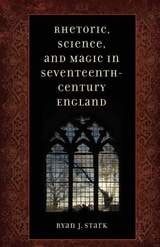
Rhetoric, Science, and Magic in Seventeenth-century England
Ryan J. Stark
Catholic University of America Press, 2009
The Culture and Commerce of Texts
Scribal Publication in Seventeenth-Century EnglandHarold Love
University of Massachusetts Press, 1998
Long after the establishment of printing in England, many writers and composers still preferred to publish their work through handwritten copies. Texts so transmitted included some of the most distinguished poetry and music of the seventeenth century, along with a rich variety of political, scientific, antiquarian, and philosophical writings. While censorship was one reason for this persistence of the older practice, scribal publication remained the norm for texts that were required only in small numbers, or whose authors wished to avoid the “stigma” of print.
This is the first book to consider the trade in manuscripts as an important supplement to that in printed books, and to describe the agencies that met the need for rapid duplication of key texts.