Results by title
13 books match the query 'Seventeenth Century'
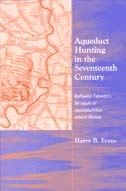
Aqueduct Hunting in the Seventeenth Century
Raffaele Fabretti's De aquis et aquaeductibus veteris RomaeHarry B. Evans
University of Michigan Press, 2002
Fabretti's treatise, De aquis et aquaeductibus veteris Romae dissertationes tres, is cited as a matter of course by all later scholars working in the area of Roman topography. Its findings--while updated and supplemented by more recent archaeological efforts--have never been fully superseded. Yet despite its enormous importance and impact on scholarly efforts, the De aquis has never yet been translated from the original Latin. Aqueduct Hunting in the Seventeenth Century provides a full translation of and commentary on Fabretti's writings, making them accessible to a broad audience and carefully assessing their scholarly contributions.
Harry B. Evans offers his reader an introduction to Fabretti and his scholarly world. A complete translation and a commentary that focuses primarily on the topographical problems and Fabretti's contribution to our understanding of them are also provided. Evans also assesses the contributions and corrections of later archaeologists and topographers and places the De aquis in the history of aqueduct studies.
Evans demonstrates that Fabretti's conclusions, while far from definitive, are indeed significant and merit wider attention than they have received to date. This book will appeal to classicists and classical archaeologists, ancient historians, and readers interested in the history of technology, archaeology, and Rome and Italy in the seventeenth century.
Harry B. Evans is Professor of Classics, Fordham University.
Fictions of the Cosmos
Science and Literature in the Seventeenth CenturyFrédérique Aït-Touati
University of Chicago Press, 2011
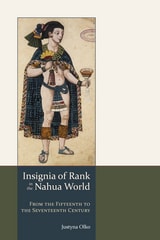
Insignia of Rank in the Nahua World
From the Fifteenth to the Seventeenth CenturyJustyna Olko
University Press of Colorado, 2014
This significant work reconstructs the repertory of insignia of rank and the contexts and symbolic meanings of their use, along with their original terminology, among the Nahuatl-speaking communities of Mesoamerica from the fifteenth through the seventeenth centuries. Attributes of rank carried profound symbolic meaning, encoding subtle messages about political and social status, ethnic and gender identity, regional origin, individual and community history, and claims to privilege.
Olko engages with and builds upon extensive worldwide scholarship and skillfully illuminates this complex topic, creating a vital contribution to the fields of pre-Columbian and colonial Mexican studies. It is the first book to integrate pre- and post-contact perspectives, uniting concepts and epochs usually studied separately. A wealth of illustrations accompanies the contextual analysis and provides essential depth to this critical work. Insignia of Rank in the Nahua World substantially expands and elaborates on the themes of Olko's Turquoise Diadems and Staffs of Office, originally published in Poland and never released in North America.
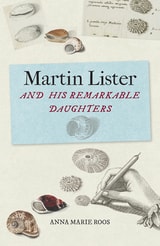
Martin Lister and his Remarkable Daughters
The Art of Science in the Seventeenth CenturyAnna Marie Roos
Bodleian Library Publishing, 2018
Susanna and Anna portrayed the shells of this collection not only as curious and beautiful objects, but also as specimens of natural history, rendering them with sensitivity and keen scientific empiricism. Beautiful in their own right, their illustrations and engravings reveal the early techniques behind scientific illustration and offer fascinating insight into the often hidden role of women in the scientific revolution.
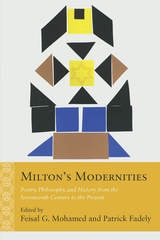
Milton's Modernities
Poetry, Philosophy, and History from the Seventeenth Century to the PresentEdited by Feisal G. Mohamed and Patrick Fadely
Northwestern University Press, 2017
Bristling with insights on Milton’s major works, Milton’s Modernities offers fresh perspectives on the thinkers central to our theorizations of modernity: from Lucretius and Spinoza, Hegel and Kant, to Benjamin and Deleuze. At the volume's core is an embrace of the possibilities unleashed by current trends in philosophy, variously styled as the return to ethics, or metaphysics, or religion. These make all the more visible Milton’s dialogues with later modernity, dialogues that promise to generate much critical discussion in early modern studies and beyond.
Such approaches necessarily challenge many prevailing assumptions that have guided recent Milton criticism—assumptions about context and periodization, for instance. In this way, Milton’s Modernities powerfully broadens the historical archive beyond the materiality of events and things, incorporating as well intellectual currents, hybrids, and insights.

Native American Slavery in the Seventeenth Century
Arne Bialuschewski, special issue editor
Duke University Press, 2017
Contributors. Carolyn Arena, Arne Bialuschewski, Linford D. Fisher, George Edward Milne, Andrés Reséndez
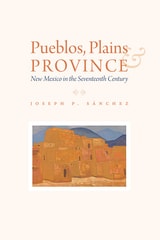
Pueblos, Plains, and Province
New Mexico in the Seventeenth CenturyJoseph P. Sánchez
University Press of Colorado, 2024
In Pueblos, Plains, and Province Joseph P. Sánchez offers an in-depth examination of sociopolitical conflict in seventeenth-century New Mexico, detailing the effects of Spanish colonial policies on settlers’, missionaries’, and Indigenous peoples’ struggle for economic and cultural control of the region. Sánchez explores the rich archival documentation that provides cultural, linguistic, and legal perspectives of the values of the period.
Spanish dual Indian policies for Pueblo and Plains tribes challenged Indigenous political and social systems to conform to the imperial structure for pacification purposes. Meanwhile, missionary efforts to supplant Indigenous religious beliefs with a Christian worldview resulted, in part, in a syncretism of the two worlds. Indigenous resentment of these policies reflected the contentious disagreements between Spanish clergymen and civil authorities, who feuded over Indigenous labor and encroachment on tribal sovereignties with demands for sworn loyalty to Spanish governance. The little-studied “starvation period” adversely affected Spanish-Pueblo relationships for the remainder of the century and contributed significantly to the battle at Acoma, the Jumano War, and the Pueblo Revolt of 1680.
Pueblos, Plains, and Province shows how history, culture, and tradition in New Mexico shaped the heritage shared by Spain, Mexico, the United States, and Native American tribes and will be of interest to scholars and students of Indigenous, colonial, and borderlands history.
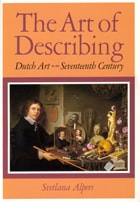
The Art of Describing
Dutch Art in the Seventeenth CenturySvetlana Alpers
University of Chicago Press, 1984
"There is no doubt that thanks to Alpers's highly original book the study of the Dutch masters of the seventeenth century will be thoroughly reformed and rejuvenated. . . . She herself has the verve, the knowledge, and the sensitivity to make us see familiar sights in a new light."—E. H. Gombrich, New York Review of Books

The Continental Model
Selected French Critical Essays of the Seventeenth Century in English TranslationScott Elledge and Donald Schier, Editors
University of Minnesota Press, 1960
The Continental Model was first published in 1960. Minnesota Archive Editions uses digital technology to make long-unavailable books once again accessible, and are published unaltered from the original University of Minnesota Press editions.
The pervasive influence of seventeenth-century French criticism upon eighteenth-century English criticism makes it important for students of English and comparative literature to be familiar with the most important of the French works. Professors Elledge and Schier bring together here, in translation, some of the best examples of the French essays. They have chosen particularly works that are not otherwise available in translation.
Some of the translations are by contemporaries of the period. These are of works by d'Aubignac, Saint-Evremond, Huet, Rapin, Le Bossu, Bouhours, La Bruyere, and Fontenelle. Other selections have been translated by Professor Schier, and these include works of Chapelain, Sarasin, Scudery, Corneille, Bouhours, and Fontenelle.
The editors provide brief and pertinent comment on each writer and his place in literary history. They have also annotated the essays in order to save time for the reader who encounters references to other literatures not immediately clear to him. The volume as a whole provides a comprehensive and balanced selection of critical texts which were known to, used by, and significant in their influence upon writers such as Dryden, Dennis, Addison, Swift, Pope, and others.

The Domestic Herbal
Plants for the Home in the Seventeenth CenturyMargaret Willes
Bodleian Library Publishing, 2020
In the seventeenth century most English households had gardens. These gardens were not merely ornamental; even the most elaborate and fashionable gardens had areas set aside for growing herbs, fruit, vegetables, and flowers for domestic use. Meanwhile, more modest households considered a functional garden to be a vital tool for the survival of the house and family. The seventeenth century was also a period of exciting introductions of plants from overseas, which could be used in all manner of recipes.
Using manuscript household manuals, recipe books, and printed herbals, The Domestic Herbal takes the reader on a tour of the productive garden and of the various parts of the house—kitchens and service rooms, living rooms and bedrooms—to show how these plants were used for cooking and brewing, medicines and cosmetics, in the making and care of clothes, and to keep rooms fresh, fragrant, and decorated. Recipes used by seventeenth-century households for preparations such as flower syrups, snail water, and wormwood ale are also included. A brief herbal gives descriptions of plants both familiar and less known to today’s readers, including the herbs used for common tasks like dyeing and brewing, and those that held a particular cultural importance in the seventeenth century. Featuring exquisite colored illustrations from John Gerard’s herbal book of 1597 as well as prints, archival material, and manuscripts, this book provides an intriguing and original focus on the domestic history of Stuart England.
The Ice Broken, volume I
Puritan Influences on the Netherlands in the Seventeenth CenturyCentral European University Press, 2026
The Ice Broken, volume II
Puritan Influences on the Netherlands in the Seventeenth CenturyCentral European University Press, 2026
The North Atlantic World in the Seventeenth Century
K.G. Davies
University of Minnesota Press, 1976
The North Atlantic World in the Seventeenth Century was first published in 1974. Minnesota Archive Editions uses digital technology to make long-unavailable books once again accessible, and are published unaltered from the original University of Minnesota Press editions.
In his preface the author writes: "Europe's style was both courageous and ignoble, Europe's achievement both magnificent and appalling. There is less need now that Europe's hegemony is over, for pride or shame to color historical judgments." In that candid vein Mr. Davies provides a balanced and impartial history of British, French, and Dutch beginnings in North America, the Caribbean, and West Africa to the end of the seventeenth century. He contrasts two styles of empire: the planting of trading posts in order to gather fur, fish, and slaves; and the planting of people in colonies of settlement to grow tobacco and sugar. He shows that the first style, involving little outlay of capital, was favored by European merchants; the second, by rulers and landlords. In his conclusion he examines the impact made by the Europeans on the people they traded with and expropriated, and assesses the diplomatic, economic, and cultural repercussions of the North Atlantic on Europe itself.
"Should provide valuable supplementary reading in courses in British imperial and American colonial history, as well as a source of information for those who teach them." –History.