Results by title

6 books match the query 'Seventies'

cover of AntoloGaia: Queering the Seventies, A Radical Trans Memoir

AntoloGaia

Queering the Seventies, A Radical Trans Memoir

Porpora Marcasciano

Rutgers University Press, 2024

2024 Award for the English Translation of an Italian Book-Length Literary Work from the American Association of Italian Studies

In this stirring memoir by a member of the first generation of LGBTQ+ activists in Italy, Porpora Marcasciano tells her story and shares the struggles and accomplishments of her fellow activists who achieved so much in the 1970s yet suffered devastating losses during the AIDS epidemic of the 1980s. AntoloGaia offers an insider’s look at the beginnings of the gay liberation movement in Italy and reveals how it was intimately intertwined with other forms of left-wing activism. At the same time, it powerfully conveys the queer joy of a young person from a small village first encountering the vibrant sexual minority communities of Naples, Bologna, and Rome. As Marcasciano starts to embrace her trans identity, she meets the famous anthropologist Pino Simonelli, who introduces her to Naples’s unique femminielli subculture and gives her the name Porporino, which she later shortens to Porpora. In keeping with this story of gender, sexual, and political discovery, AntoloGaia is the first piece of Italian life-writing to use gender-neutral and mixed-gender language.

 
[more]
cover of Krautrock: German Music in the Seventies

Krautrock

German Music in the Seventies

Ulrich Adelt

University of Michigan Press, 2016

Krautrock is a catch-all term for the music of various white German rock groups of the 1970s that blended influences of African American and Anglo-American music with the experimental and electronic music of European composers. Groups such as Can, Popol Vuh, Faust, and Tangerine Dream arose out of the German student movement of 1968 and connected leftist political activism with experimental rock music and, later, electronic sounds. Since the 1970s, American and British popular genres such as indie, post-rock, techno, and hip-hop have drawn heavily on krautrock, ironically reversing a flow of influence krautrock originally set out to disrupt.
 
Among other topics, individual chapters of the book focus on the redefinition of German identity in the music of Kraftwerk, Can, and Neu!; on community and conflict in the music of Amon Düül, Faust, and Ton Steine Scherben; on “cosmic music” and New Age; and on Donna Summer’s and David Bowie’s connections to Germany. Rather than providing a purely musicological or historical account, Krautrock discusses the music as being constructed through performance and articulated through various forms of expressive culture, including communal living, spirituality, and sound.
 
[more]
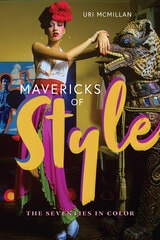
cover of Mavericks of Style: The Seventies in Color

Mavericks of Style

The Seventies in Color

Uri McMillan

Duke University Press, 2025
In Mavericks of Style, Uri McMillan tells the story of New York City’s downtown art and fashion scene of the 1970s through the lives and careers of experimental Black and Brown artists. McMillan focuses on model and musician Grace Jones, fashion illustrator Antonio Lopez, fashion designer Stephen Burrows, and their orbit of friends, showing how they restlessly moved across genres and disciplines, transgressing boundaries between the commercial and the avant-garde. Bypassing the exclusive art world and cultivating uniquely personal styles, these artists thrived on friendship and collaboration in their experimental use of bold color, gold lamé, and Instamatic photography. McMillan transports readers to the spaces Jones, Lopez, and Burrows frequented and worked in, from hair salons, nondescript artist studios, and buzzy boutiques to funky discos and high fashion runways. By foregrounding their impact on the decade’s aesthetics, McMillan complicates and expands the understanding of these artists, offering a new vision of New York’s art world in sultry, bombastic color.
[more]
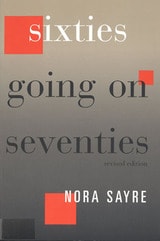
cover of Sixties Going on Seventies

Sixties Going on Seventies

Sayre, Nora

Rutgers University Press, 1996

Nora Sayre guides us through our nation’s transformation during an explosive decade. She explores the landscapes of the era--student strikes at Harvard and Yale, anti-war veterans, John Birchers, Timothy Leary, Yippies and Aquarians, utopias gone wrong, George McGovern, Spiro Agnew, Richard Nixon, George Wallace, black anger in Watts, the media at work, policemen in college, off-off Broadway, the 1972 Democratic and Republican Conventions, and the rebirth of feminism. Sixties Going on Seventies, nominated for a 1974 National Book Award, is also a chronicle of the shattering of cities, the problems of the left, the momentum of the right--and above all, the authentic voices of the people concerned. Sayre recorded all of these events and personalities in exhilarating prose; her witty observations are remarkably fresh today.

Now back in print, this revised edition contains the best of the original volume and brings the commentary up to date, allowing us to view the period with hindsight from the nineties.

[more]
cover of The Argentine Silent Majority: Middle Classes, Politics, Violence, and Memory in the Seventies

The Argentine Silent Majority

Middle Classes, Politics, Violence, and Memory in the Seventies

Sebastián Carassai

Duke University Press, 2014

In The Argentine Silent Majority, Sebastián Carassai focuses on middle-class culture and politics in Argentina from the end of the 1960s. By considering the memories and ideologies of middle-class Argentines who did not get involved in political struggles, he expands thinking about the era to the larger society that activists and direct victims of state terror were part of and claimed to represent. Carassai conducted interviews with 200 people, mostly middle-class non-activists, but also journalists, politicians, scholars, and artists who were politically active during the 1970s. To account for local differences, he interviewed people from three sites: Buenos Aires; Tucumán, a provincial capital rocked by political turbulence; and Correa, a small town which did not experience great upheaval. He showed the middle-class non-activists a documentary featuring images and audio of popular culture and events from the 1970s. In the end Carassai concludes that, during the years of la violencia, members of the middle-class silent majority at times found themselves in agreement with radical sectors as they too opposed military authoritarianism but they never embraced a revolutionary program such as that put forward by the guerrilla groups or the most militant sectors of the labor movement.
[more]
cover of The Journey is Everything: A Journal of the Seventies

The Journey is Everything

A Journal of the Seventies

Helen Bevington

Duke University Press, 1983

“What does one learn by taking a journey, any journey?” Helen Bevington asks. “I’ve taken a shaky trip through a decade (to Russia, to the mailbox, to bed) to the end of the 1970s, about which uncomplimentary and increasingly anxious remarks were made by us all--you, me, and the media.”
This is a book of journeys, to places--Russia, Hawaii, Italy, Yugoslavia, Greece, the South Seas, the Rhine, Australia, New Zealand, New Mexico--and to the classroom at Duke University where she was Professor of English until her retirement in 1976. Since everything is a journey, the book is concerned with travel of all kinds, in books, in memories, in people living and dead, a lighthearted search for Eden on this planet but a more serious search for survival in the troubled decade of the 1970s.
[more]