Results by title
18 books match the query 'Sex (Psychology)'
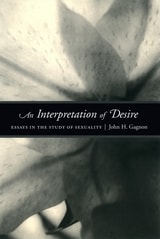
An Interpretation of Desire
Essays in the Study of SexualityJohn Gagnon
University of Chicago Press, 2003
Gagnon may be best known as the coauthor of Sexual Conduct—a book that introduced the seminal concept of sexual scripting—and as one of the coauthors of The Social Organization of Sexuality, a foundational work that is widely considered to be the most important study of human sexual behavior since the Kinsey report. The essays collected here first trace the influence of scripting theory on Gagnon, outlining the radical departure he took from the dominant biological and psychiatric models of sex research. The volume then turns to more recent essays that consider such vexed issues as homosexuality, the theories of Sigmund Freud, HIV, hazardous sex, and the social aspects of sexually transmitted diseases.
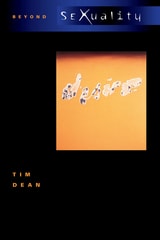
Beyond Sexuality
Tim Dean
University of Chicago Press, 2000
Dean shows how the Lacanian unconscious "deheterosexualizes" desire, and along the way he reveals how psychoanalytic thinkers as well as queer theorists have failed to exploit the full potential of this conception of desire. The book elaborates this by investigating social fantasies about homosexuality and AIDS, including gay men's own fantasies about sex and promiscuity, in an attempt to illuminate the challenges facing safe-sex education. Taking on many shibboleths in contemporary psychoanalysis and queer theory—and taking no prisoners—Beyond Sexuality offers an antidote to hagiographical strains in recent work on psychoanalysis, Foucault, and sexuality.
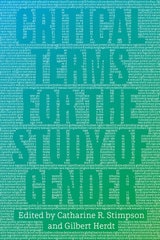
Critical Terms for the Study of Gender
Edited by Catharine R. Stimpson and Gilbert Herdt
University of Chicago Press, 2014
So write women’s studies pioneer Catharine R. Stimpson and anthropologist Gilbert Herdt in their introduction to Critical Terms for the Study of Gender, laying out the wide-ranging nature of this interdisciplinary and rapidly changing field. The sixth in the series of “Critical Terms” books, this volume provides an indispensable introduction to the study of gender through an exploration of key terms that are a part of everyday discourse in this vital subject.
Following Stimpson and Herdt’s careful account of the evolution of gender studies and its relation to women’s and sexuality studies, the twenty-one essays here cast an appropriately broad net, spanning the study of gender and sexuality across the humanities and social sciences. Written by a distinguished group of scholars, each essay presents students with a history of a given term—from bodies to utopia—and explains the conceptual baggage it carries and the kinds of critical work it can be made to do. The contributors offer incisive discussions of topics ranging from desire, identity, justice, and kinship to love, race, and religion that suggest new directions for the understanding of gender studies. The result is an essential reference addressed to students studying gender in very different disciplinary contexts.
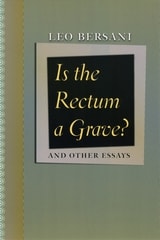
Is the Rectum a Grave?
and Other EssaysLeo Bersani
University of Chicago Press, 2009
Over the course of a distinguished career, critic Leo Bersani has tackled a range of issues in his writing, and this collection gathers together some of his finest work. Beginning with one of the foundations of queer theory—his famous meditation on how sex leads to a shattering of the self, “Is the Rectum a Grave?”—this volume charts the inspired connections Bersani has made between sexuality, psychoanalysis, and aesthetics.
Over the course of these essays, Bersani grapples with thinkers ranging from Plato to Descartes to Georg Simmel. Foucault and Freud recur as key figures, and although Foucault rejected psychoanalysis, Bersani contends that by considering his ideas alongside Freud’s, one gains a clearer understanding of human identity and how we relate to one another. For Bersani, art represents a crucial guide for conceiving new ways of connecting to the world, and so, in many of these essays, he stresses the importance of aesthetics, analyzing works by Genet, Caravaggio, Proust, Almodóvar, and Godard.
Documenting over two decades in the life of one of the best minds working in the humanities today, Is the Rectum a Grave? and Other Essays is a unique opportunity to explore the fruitful career of a formidable intellect.
Masculinity and Femininity in the MMPI-2 and MMPI-A
Hale Martin
University of Minnesota Press, 2010
Martin and Finn consider the factor structure and correlates of masculinity and femininity in the MMPI in multiple samples. Through their analyses, they are able to address such questions as: Is there such a thing as masculinity/femininity? If so, are masculinity and femininity separate constructs, or are they opposite ends of a bipolar dimension? What are the core aspects of masculinity and femininity? Are they the same for men and women? Do the meanings of masculinity and femininity vary across the human life span and in different cultures? To what extent are masculinity and femininity biologically or socially determined? Can masculinity and femininity be adequately measured by the MMPI-2 and MMPI-A?
This insightful work uses solid empirical methods to clarify significant constructs. It will be an essential resource for researchers in the areas of personality, psychological assessment, and gender studies, as well as for clinicians working with clients who have nontraditional gender identities.

Newly Born Woman
Helene Cixous
University of Minnesota Press, 1986
Performance All the Way Down
Genes, Development, and Sexual DifferenceRichard O. Prum
University of Chicago Press, 2023
The idea that gender is a performance—a tenet of queer feminist theory since the nineties—has spread from college classrooms to popular culture. This transformative concept has sparked reappraisals of social expectations as well as debate over not just gender, but sex: what it is, what it means, and how we know it. Most scientific and biomedical research over the past seventy years has assumed and reinforced a binary concept of biological sex, though some scientists point out that male and female are just two outcomes in a world rich in sexual diversity.
In Performance All the Way Down, MacArthur Fellow and Pulitzer Prize finalist Richard O. Prum brings feminist thought into conversation with biology, arguing that the sexual binary is not essential to human genes, chromosomes, or embryos. Our genomes are not blueprints, algorithms, or recipes for the physical representation of our individual sexual essences or fates. In accessible language, Prum shows that when we look closely at the science, we see that gene expression is a material action in the world, a performance through which the individual regulates and achieves its own becoming. A fertilized zygote matures into an organism with tissues and organs, neurological control, immune defenses, psychological mechanisms, and gender and sexual behavior through a performative continuum. This complex hierarchy of self-enactment reflects the evolved agency of individual genes, molecules, cells, and tissues.
Rejecting the notion of an intractable divide between the humanities and the sciences, Prum proves that the contributions of queer and feminist theorists can help scientists understand the human body in new ways, yielding key insights into genetics, developmental biology, physiology. Sure to inspire discussion, Performance All the Way Down is a book about biology for feminists, a book about feminist theory for biologists, and a book for anyone curious about how our sexual bodies grow.
Queer Livability
German Sexual Sciences and Life WritingIna Linge
University of Michigan Press, 2023
Finalist: Waterloo Centre for German Studies Book Prize | December 10, 2024
This book brings together an exciting new archive of queer and trans voices from the history of sexual sciences in the German-speaking world. A new language to express possibilities of gender and sexuality emerged at the turn of the twentieth century, from Sigmund Freud’s theories of homosexuality in Vienna to Magnus Hirschfeld’s “third sex” in Berlin. Together, they provided a language of sex and sexuality that is still recognizable today. Queer Livability: German Sexual Sciences and Life Writing shows that individual voices of trans and queer writers had a significant impact on the production of knowledge about gender and sexuality during this time and introduces lesser known texts to a new readership. It shows the remarkable power of queer life writing in imagining and creating the possibilities of a livable life in the face of restrictive legal, medical, and social frameworks.
Queer Livability: German Sexual Sciences and Life Writing will be of interest to anyone who wants to learn more about LGBTQ+ history and literature. It also provides a fascinating insight into the historical roots for our thinking about gender and sexuality today. The book will be of relevance to an academic readership of students and faculty in German studies, literary studies, European history, and the interdisciplinary fields of gender and sexuality studies, medical humanities, and the history of sexuality.
Receptive Bodies
Leo Bersani
University of Chicago Press, 2018
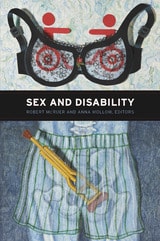
Sex and Disability
Robert McRuer and Anna Mollow, eds.
Duke University Press, 2012
Contributors. Chris Bell, Michael Davidson, Lennard J. Davis, Michel Desjardins, Lezlie Frye, Rachael Groner, Kristen Harmon, Michelle Jarman, Alison Kafer, Riva Lehrer, Nicole Markotić, Robert McRuer, Anna Mollow, Rachel O’Connell, Russell Shuttleworth, David Serlin, Tobin Siebers, Abby L. Wilkerson

Sex between Body and Mind
Psychoanalysis and Sexology in the German-speaking World, 1890s-1930sKatie Sutton
University of Michigan Press, 2019
This is the first book to closely examine vital encounters among this era’s German-speaking researchers across their emerging professional and disciplinary boundaries. Although psychoanalysis was often considered part of a broader “sexual science,” sexologists increasingly distanced themselves from its mysterious concepts and clinical methods. Instead, they turned to more pragmatic, interventionist therapies—in particular, to the burgeoning field of hormone research, which they saw as crucial to establishing their own professional relevance. As sexology and psychoanalysis diverged, heated debates arose around concerns such as the sexual life of the child, the origins and treatment of homosexuality and transgender phenomena, and female frigidity. This new story of the emergence of two separate approaches to the study of sex demonstrates that the distinctions between them were always part of a dialogic and competitive process. It fundamentally revises our understanding of the production of modern sexual subjects.
Sex, Identity, Aesthetics
The Work of Tobin Siebers and Disability StudiesJina B. Kim, Joshua Kupetz, Crystal Yin Lie, and Cynthia Wu, Editors
University of Michigan Press, 2021
Sexual Cultures and the Construction of Adolescent Identities
edited by Janice M. Irvine
Temple University Press, 1994
This rich collection of essays presents a new vision of adolescent sexuality shaped by a variety of social factors: race and ethnicity, gender, sexual identity, physical ability, and cultural messages propagated in films, books, and within families. The contributors consider the full range of cultural influences that form a teenager's sexual identity and argue that education must include more than its current overriding message of denial hinged on warnings of HIV and AIDS infection and teenage pregnancy. Examining the sexual experiences, feelings, and development of Asians, Latinos, African Americans, gay man and lesbians, and disabled women, this book provides a new understanding of adolescent sexuality that goes beyond the biological approach all too often simplified as "surging hormones."
In the series Health, Society, and Policy, edited by Sheryl Ruzek and Irving Kenneth Zola.
Sexuality, Disability, and Aging
Queer Temporalities of the PhallusJane Gallop
Duke University Press, 2019

Social Structure and Testosterone
Explorations in the Socio-Bio-Social ChainKemper, Theodore D
Rutgers University Press, 1990

Swooning Beauty
A Memoir Of PleasureJoanna Frueh
University of Nevada Press, 2006
When her parents died and her marriage disintegrated within the span of a few months, art historian and performance artist Joanna Frueh entered a painful period of grief and mourning. This book is about how she healed herself and in the process explored the range of her potential as a woman.Swooning Beauty is an intimate memoir of discovery and healing. Frueh’s path to recovery lay through a profound examination of her intuitions, desires, fantasies, dreams, and emotions, her capacity for pleasure—visual, sensual, intellectual, gastronomic, and erotic—and her sense of her own heroic female identity. Hers is the passionate voice of a creative, intelligent woman scrutinizing the nature of love in all its forms and the ways of being that make us free, flexible, more fully real and more fully human. The result is an engaging view into the rich and colorful inner life of a woman at the threshold of middle age, of the blossoming of mind and spirit that comes after suffering and self-realization. Pleasure, she concludes, “is the absence of lack. Self-love is a necessary plenitude. Vigilance in love brings us freedom. Freedom is not an absolute whose attainment is humanly impossible. Yogis say that the self that is not ego is free. That self is the spacious heart, the spacious mind.” Frueh offers us wisdom and comfort for the journey into middle age, and the deep pleasure of encountering a generous, lively spirit and a remarkably spacious mind.
The Sexual Self
The Construction of Sexual ScriptsMichael Kimmel
Vanderbilt University Press, 2007
What Do Gay Men Want?
An Essay on Sex, Risk, and SubjectivityDavid M. Halperin
University of Michigan Press, 2010
“Compelling, timely, and provocative. The writing is sleek and exhilarating. It doesn’t waste time telling us what it will do or what it has just done—it just does it.”
—Don Kulick, Professor of Anthropology, New York University
How we can talk about sex and risk in the age of barebacking—or condomless sex—without invoking the usual bogus and punitive clichés about gay men’s alleged low self-esteem, lack of self-control, and other psychological “deficits”? Are there queer alternatives to psychology for thinking about the inner life of homosexuality? What Do Gay Men Want? explores some of the possibilities.
Unlike most writers on the topic of gay men and risky sex, David Halperin liberates gay male subjectivity from psychology, demonstrating the insidious ways in which psychology’s defining opposition between the normal and the pathological subjects homosexuality to medical reasoning and revives a whole set of unexamined moral assumptions about “good” sex and “bad” sex.
In particular, Halperin champions neglected traditions of queer thought, including both literary and popular discourses, by drawing on the work of well-known figures like Jean Genet and neglected ones like Marcel Jouhandeau. He shows how the long history of of gay men’s uses of “abjection” can offer an alternative, nonmoralistic model for thinking about gay male subjectivity, something which is urgently needed in the age of barebacking.
Anyone searching for nondisciplinary ways to slow the spread of HIV/AIDS among gay men—or interested in new modes of thinking about gay male subjectivity—should read this book.
David M. Halperin is W. H. Auden Collegiate Professor of the History and Theory of Sexuality, Professor of English, Professor of Women’s Studies, Professor of Comparative Literature, and Adjunct Professor of Classical Studies at the University of Michigan.