Results by title
3 books match the query 'Sex discrimination in criminal justice administration'

Gendered Justice in the American West
Women Prisoners in Men's PenitentiariesAnne M. Butler
University of Illinois Press, 1997
Drawing on prison records and the words of the women themselves, Gendered Justice in the American West places the injustices women prisoners endured in the context of the structures of male authority and female powerlessness that pervaded all of American society. Butler's poignant cross-cultural account explores how nineteenth-century criminologists constructed the "criminal woman"; how the women's age, race, class, and gender influenced their court proceedings; and what kinds of violence women inmates encountered. She also examines the prisoners' diet, illnesses, and experiences with pregnancy and child-bearing, as well as their survival strategies.
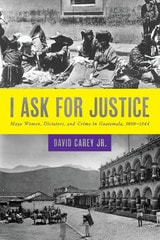
I Ask for Justice
Maya Women, Dictators, and Crime in Guatemala, 1898–1944By David Carey Jr.
University of Texas Press, 2013
This study of the Guatemalan legal system during the regimes of two of Latin America’s most repressive dictators reveals the surprising extent to which Maya women used the courts to air their grievances and defend their human rights.
Winner, Bryce Wood Book Award, Latin American Studies Association, 2015
Given Guatemala’s record of human rights abuses, its legal system has often been portrayed as illegitimate and anemic. I Ask for Justice challenges that perception by demonstrating that even though the legal system was not always just, rural Guatemalans considered it a legitimate arbiter of their grievances and an important tool for advancing their agendas. As both a mirror and an instrument of the state, the judicial system simultaneously illuminates the limits of state rule and the state’s ability to co-opt Guatemalans by hearing their voices in court.
Against the backdrop of two of Latin America’s most oppressive regimes—the dictatorships of Manuel Estrada Cabrera (1898–1920) and General Jorge Ubico (1931–1944)—David Carey Jr. explores the ways in which indigenous people, women, and the poor used Guatemala’s legal system to manipulate the boundaries between legality and criminality. Using court records that are surprisingly rich in Maya women’s voices, he analyzes how bootleggers, cross-dressers, and other litigants crafted their narratives to defend their human rights. Revealing how nuances of power, gender, ethnicity, class, and morality were constructed and contested, this history of crime and criminality demonstrates how Maya men and women attempted to improve their socioeconomic positions and to press for their rights with strategies that ranged from the pursuit of illicit activities to the deployment of the legal system.

The War on Sex
David M. Halperin and Trevor Hoppe, editors
Duke University Press, 2017