Results by title
5 books match the query 'Sex discrimination in education'
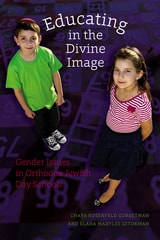
Educating in the Divine Image
Gender Issues in Orthodox Jewish Day SchoolsChaya Rosenfeld Gorsetman and Elana Maryles Sztokman
Brandeis University Press, 2013
Gender Equity in Education
An Annotated BibliographyBeverly Stitt
Southern Illinois University Press, 1994
Recent studies show that, either consciously or unconsciously, teachers are not practicing gender equity in the classroom. Boys are called on more in class than girls and are encouraged to pursue careers from which girls are excluded because they are thought to be less capable.
Serious questions arise for educators and counselors in this time of increasing awareness of the implications of gender bias, such as what comprises a gender-fair education and how can gender equity become part of the classroom curriculum? Guidance counselors and teachers share an important responsibility in seeking answers to these questions in order to avoid limiting students’ potential because of gender.
To achieve this end, Beverly A. Stitt has compiled an annotated bibliography of hundreds of books, articles, videos, classroom activities, and curriculum and workshop guides to help provide the tools needed for educators to become more gender conscious and to develop a gender–fair educational system.
The bibliography is divided into twenty-three categories under the headings of Agriculture and Industry, Business, Career Guidance, Communications, Computers, Discrimination, Displaced Homemakers/Reentry Women, Elementary Education, Family and Work Issues, Gender Role Stereotyping, History, Home Economics, In-service Training, Legislation, Male Focus, Math and Science, Nontraditional Careers, Pregnant and Parenting Teens, Recruitment, Special Needs, Teaching, Vocational Education, and Women’s Studies.
Each entry’s annotation provides a short description of the content, the age group to which the resource applies, and ordering information. The book concludes with an index in which entries are cross-referenced under various categories to further aid the reader’s research.
Gender Roles and Faculty Lives in Rhetoric and Composition
Theresa Enos
Southern Illinois University Press, 1997
Combining anecdotal evidence (the personal stories of rhetoric and composition teachers) with hard data, Theresa Enos offers documentation for what many have long suspected to be true: lower-division writing courses in colleges and universities are staffed primarily by women who receive minimal pay, little prestige, and lessened job security in comparison to their male counterparts. Male writing faculty, however, also are affected by factors such as low salaries because of the undervaluation of a field considered feminized. As Enos notes in her preface: "The rhetoric of our institutional lives is connected especially to the negotiations of gender roles in rhetoric and composition."
Enos describes and classifies narratives gathered from surveys, interviews, and campus visits and interweaves these narratives with statistical data gathered from national surveys that show gendered experiences in the profession. Enos discusses the ways in which these experiences affect the working conditions of writing teachers and administrators in various programs at different types of institutions.
Enos points out that fields in which women excel—and are acknowledged—receive less prestige than other fields. On the university level, those genres in which women have demonstrated competence are not taken as seriously as those dominated by men. In practical terms, academia affords more glory for teaching literature than for teaching rhetoric and composition.
Within the field of rhetoric and composition, however, Enos finds it difficult to determine why the accomplishments of women receive less credit than those of men. She speculates as to whether it is part of the larger pattern in society—and in academia—to value men more than women or something in the field itself that keeps women from real power, even though women make up the majority of composition and rhetoric teachers.
Enos provides fascinating personal histories of composition and rhetoric teachers whose work has been largely disregarded. She also provides information about writing programs, teaching, administrative responsibilities, ranks among teachers, ages, salary, tenure status, distribution of research, service responsibilities, records of publication, and promotion and tenure guidelines.

Investment in Women's Human Capital
Edited by T. Paul Schultz
University of Chicago Press, 1995
Section I considers the experiences of high-income countries, examining the limitations of industrialization for the advancement of women; returns to secondary education for women; and state control of women's education and labor market productivity through the design of tax systems and the public subsidy of children.
The remaining four sections investigate health, education, household structure and labor markets, and measurement issues in low-income countries, including the effect of technological change on transfers of wealth to and from children in India; women's and men's responses to the costs of medical care in Kenya; the effects of birth order and sex on educational attainment in Taiwan; wage returns to schooling in Indonesia and in Cote d'Ivoire; and the increasing prevalence of female-headed households and the correlates of gender differences in wages in Brazil.
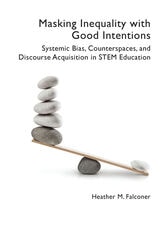
Masking Inequality with Good Intentions
Systemic Bias, Counterspies, and Discourse Acquisition in STEM EducationHeather M. Falconer
University Press of Colorado, 2023
In Masking Inequality with Good Intentions, Heather M. Falconer examines the impact of systemic bias on disciplinary discourse acquisition and identity development by asking “How do the norms and expectations of higher education and STEM, specifically, impact the development of scientific identity and discursive skill?” and “What role do societal markers like race and gender play in the negotiation of identity in STEM learning environments?”
Drawing on the experiences and writings of six students from historically underrepresented backgrounds in STEM, each participating in an undergraduate research program, Falconer discusses how programmatic and pedagogical choices can work to either further marginalize students and disrupt their writing and identity development as scientists or create counterspaces—spaces where students can thrive and push back against dominant, oppressive forces. Practical applications for pedagogy, curriculum, and program design are included.