Results by title

9 books match the query 'Sex offenders'

cover of Democracy and Deliberation: The Law and Politics of Sex Offender Legislation

Democracy and Deliberation

The Law and Politics of Sex Offender Legislation

Cary Federman

University of Michigan Press, 2021

Sex offender laws include residency restrictions, registration and notification requirements, and post-conviction civil commitment. These laws and regulations impose serious restrictions on the movements of convicted sex offenders. This is controversial because these laws and regulations occur after the sex offender has completed his time in prison. These laws and regulations are intended to have both a deterrent and therapeutic effect. Residency restrictions seek to prevent sex offenders from re-committing their crimes and civil commitment provides psychological services while incarcerated in a forensic facility. Most works on this subject are deeply critical of these laws.

Cary Federman takes a more sympathetic approach to sex offender legislation. He focuses on the deliberative intentions of legislators, exploring the limits of judicial review and the rights of interested parties to influence lawmaking. Leaders of these interested parties are usually the parents of children who have been sexually violated and murdered. Critics of sex offender legislation tend to focus on the convicted parties, arguing that their rights have been violated. The Law and Politics of Sex Offender Legislation asserts that these laws are expressions of the deliberative intentions of lawmakers concerned about public safety—they are thus constitutional, if not always wise.

[more]
cover of Everything I Never Wanted to Know

Everything I Never Wanted to Know

Christine Hume

The Ohio State University Press, 2023

“A dauntless and harrowing indictment of patriarchal violence.” —Publishers Weekly

In Everything I Never Wanted to Know, Christine Hume confronts the stigma and vulnerability of women’s bodies in the US. She explores bodily autonomy and sexual assault alongside the National Sex Offender Registry in order to invoke not solutions but a willingness to complicate our ideas of justice and defend every human’s right to be treated like a member of the community. Feminist autobiography threads into historical narrative and cultural criticism about the Victorian-era Frozen Charlotte doll; the Nylon Riots of the 1940s; the movie Halloween; Larry Nassar, who practiced in Hume’s home state of Michigan; and other material. In these reflections on sexuality, gender, criminality, and violence, Hume asks readers to reconsider what we have collectively normalized and how we are each complicit, writing through the darkness of what we don’t want to see, what we’d rather not believe, and what some of us have long tried to forget.
[more]
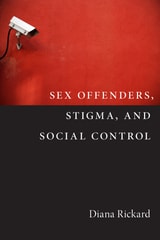
cover of Sex Offenders, Stigma, and Social Control

Sex Offenders, Stigma, and Social Control

Rickard, Diana

Rutgers University Press, 2016
The 1990s witnessed a flurry of legislative initiatives—most notably, “Megan’s Law”—designed to control a population of sex offenders (child abusers) widely reviled as sick, evil, and incurable. In Sex Offenders, Stigma, and Social Control, Diana Rickard provides the reader with an in-depth view of six such men, exploring how they manage to cope with their highly stigmatized role as social outcasts. 
 
The six men discussed in the book are typical convicted sex offenders—neither serial pedophiles nor individuals convicted of the type of brutal act that looms large in public perceptions about sex crimes. Sex Offenders, Stigma, and Social Control explores how these individuals, who have been cast as social pariahs, construct their sense of self. How does being labeled in this way and controlled by measures such as Megan’s Law affect one’s identity and sense of social being?  Unlike traditional criminological and psychological studies of this population, this book frames their experiences in concepts of both deviance and identity, asking how men so highly stigmatized cope with the most extreme form of social marginality. Placing their stories within the context of the current culture of mass incarceration and zero-tolerance, Rickard provides a deeper understanding of the complex relationship between public policy and lived experience, as well as an understanding of the social challenges faced by this population, whose re-integration into society is far from simple or assured.  
 
Sex Offenders, Stigma, and Social Control makes a significant contribution to our understanding of sex offenders, offering a unique window into how individuals make meaning out of their experiences and present a viable—not monstrous—social self to themselves and others. 
 
[more]
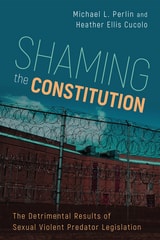
cover of Shaming the Constitution: The Detrimental Results of Sexual Violent Predator Legislation

Shaming the Constitution

The Detrimental Results of Sexual Violent Predator Legislation

Michael L. Perlin

Temple University Press, 2017

Convicted sexually violent predators are more vilified, more subject to media misrepresentation, and more likely to be denied basic human rights than any other population. Shaming the Constitution authors Michael Perlin and Heather Cucolo question the intentions of sex offender laws, offering new approaches to this most complex (and controversial) area of law and social policy.

The authors assert that sex offender laws and policies are unconstitutional and counter-productive. The legislation largely fails to add to public safety—even ruining lives for what are, in some cases, trivial infractions. Shaming the Constitution draws on law, behavioral sciences, and other disciplines to show that many of the “solutions” to penalizing sexually violent predators are “wrong,” as they create the most repressive and useless laws.

In addition to tracing the history of sex offender laws, the authors address the case of Jesse Timmendequas, whose crime begat “Megan’s Law;” the media’s role in creating a “moral panic;” recidivism statistics and treatments, as well as international human rights laws. Ultimately, they call attention to the flaws in the system so we can find solutions that contribute to public safety in ways that do not mock Constitutional principles.

[more]
cover of Sodomy's Solicitations: A Right to Queerness

Sodomy's Solicitations

A Right to Queerness

Joseph J. Fischel

Temple University Press, 2025

Joseph Fischel’s provocative book, Sodomy’s Solicitations, builds out a politics of sexual justice that challenges state sex exceptionalism. By tracing several twenty-first century contestations around Louisiana anti-sodomy laws, Fischel examines patterns and practices of sexual injustice that are too easily eclipsed by our collective focus on marginalized identities.
 
The political stories narrated in Sodomy’s Solicitations are undoubtedly stories of racism, sexism, homophobia, and transphobia, but they are also stories of other political problems—and political possibilities. Fischel indicts U.S. sex offender regulatory regimes as state-sponsored sexual violence; offers a qualified defense for sexual expression in public; and argues that animal sexual abuse laws, with their exemptions for industrial agricultural practices, authorize the suffering they were enacted to deter. He also makes the case that laws criminalizing the exchange of sex for money are unconstitutional, and proposes that the best way to protect trans and queer children might just be to enfranchise them.

Sodomy’s Solicitations champions a right to queerness across rather than within identity formations—a right to relatively unpoliced gender, sexual, and intimate pluralism.

In the series Sexuality Studies
[more]
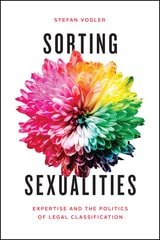
cover of Sorting Sexualities: Expertise and the Politics of Legal Classification

Sorting Sexualities

Expertise and the Politics of Legal Classification

Stefan Vogler

University of Chicago Press, 2021

In Sorting Sexualities, Stefan Vogler deftly unpacks the politics of the techno-legal classification of sexuality in the United States. His study focuses specifically on state classification practices around LGBTQ people seeking asylum in the United States and sexual offenders being evaluated for carceral placement—two situations where state actors must determine individuals’ sexualities. Though these legal settings are diametrically opposed—one a punitive assessment, the other a protective one—they present the same question: how do we know someone’s sexuality?

In this rich ethnographic study, Vogler reveals how different legal arenas take dramatically different approaches to classifying sexuality and use those classifications to legitimate different forms of social control. By delving into the histories behind these diverging classification practices and analyzing their contemporary reverberations, Vogler shows how the science of sexuality is far more central to state power than we realize. 

[more]
cover of The Corrigible and the Incorrigible: Science, Medicine, and the Convict in Twentieth-Century Germany

The Corrigible and the Incorrigible

Science, Medicine, and the Convict in Twentieth-Century Germany

Greg Eghigian

University of Michigan Press, 2015

The Corrigible and the Incorrigible explores the surprising history of efforts aimed at rehabilitating convicts in 20th-century Germany, efforts founded not out of an unbridled optimism about the capacity of people to change, but arising from a chronic anxiety about the potential threats posed by others. Since the 1970s, criminal justice systems on both sides of the Atlantic have increasingly emphasized security, surveillance, and atonement, an approach that contrasts with earlier efforts aimed at scientifically understanding, therapeutically correcting, and socially reintegrating convicts. And while a distinction is often drawn between American and European ways of punishment, the contrast reinforces the longstanding impression that modern punishment has played out as a choice between punitive retribution and correctional rehabilitation. Focusing on developments in nazi, East, and West Germany, The Corrigible and the Incorrigible shows that rehabilitation was considered an extension of, rather than a counterweight to, the hardline emphasis on punishment and security by providing the means to divide those incarcerated into those capable of reform and the irredeemable.
[more]
cover of The War on Sex

The War on Sex

David M. Halperin and Trevor Hoppe, editors

Duke University Press, 2017

The past fifty years are conventionally understood to have witnessed an uninterrupted expansion of sexual rights and liberties in the United States. This state-of-the-art collection tells a different story: while progress has been made in marriage equality, reproductive rights, access to birth control, and other areas, government and civil society are waging a war on stigmatized sex by means of law, surveillance, and social control. The contributors document the history and operation of sex offender registries and the criminalization of HIV, as well as highly punitive measures against sex work that do more to harm women than to combat human trafficking. They reveal that sex crimes are punished more harshly than other crimes, while new legal and administrative regulations drastically restrict who is permitted to have sex. By examining how the ever-intensifying war on sex affects both privileged and marginalized communities, the essays collected here show why sexual liberation is indispensable to social justice and human rights.
 
Contributors. Alexis Agathocleous, Elizabeth Bernstein, J. Wallace Borchert, Mary Anne Case, Owen Daniel-McCarter, Scott De Orio, David M. Halperin, Amber Hollibaugh, Trevor Hoppe, Hans Tao-Ming Huang, Regina Kunzel, Roger N. Lancaster, Judith Levine, Laura Mansnerus, Erica R. Meiners, R. Noll, Melissa Petro, Carol Queen, Penelope Saunders, Sean Strub, Maurice Tomlinson, Gregory Tomso
[more]
cover of Virtual Pedophilia: Sex Offender Profiling and U.S. Security Culture

Virtual Pedophilia

Sex Offender Profiling and U.S. Security Culture

Gillian Harkins

Duke University Press, 2020

In Virtual Pedophilia Gillian Harkins traces how by the end of the twentieth century the pedophile as a social outcast evolved into its contemporary appearance as a virtually normal white male. The pedophile's alleged racial and gender normativity was treated as an exception to dominant racialized modes of criminal or diagnostic profiling. The pedophile was instead profiled as a virtual figure, a potential threat made visible only when information was transformed into predictive image. The virtual pedophile was everywhere and nowhere, slipping through day-to-day life undetected until people learned how to arm themselves with the right combination of visually predictive information. Drawing on television, movies, and documentaries such as Law and Order: SVU, To Catch a Predator, Mystic River, and Capturing the Friedmans, Harkins shows how diverse U.S. audiences have been conscripted and trained to be lay detectives who should always be on the lookout for the pedophile as virtual predator. In this way, the perceived threat of the pedophile legitimated increased surveillance and ramped-up legal strictures that expanded the security apparatus of the carceral state.
[more]