Results by title
5 books match the query 'Sex role in music'
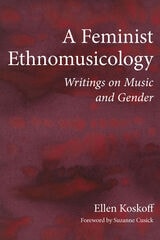
A Feminist Ethnomusicology
Writings on Music and GenderEllen Koskoff
University of Illinois Press, 2014
In this intellectual memoir, Koskoff describes her journey through the maze of social history and scholarship related to her work examining the intersection of music and gender. Koskoff collects new, revised, and hard-to-find published material from mid-1970s through 2010 to trace the evolution of ethnomusicological thinking about women, gender, and music, offering a perspective of how questions emerged and changed in those years, as well as Koskoff's reassessment of the early years and development of the field. Her goal: a personal map of the different paths to understanding she took over the decades, and how each inspired, informed, and clarified her scholarship. For example, Koskoff shows how a preference for face-to-face interactions with living people served her best in her research, and how her now-classic work within Brooklyn's Hasidic community inflamed her feminist consciousness while leading her into ethnomusicological studies.
An uncommon merging of retrospective and rumination, A Feminist Ethnomusicology: Writings on Music and Gender offers a witty and disarmingly frank tour through the formative decades of the field and will be of interest to ethnomusicologists, anthropologists, scholars of the history and development of feminist thought, and those engaged in fieldwork.
Includes a foreword by Suzanne Cusick framing Koskoff's career and an extensive bibliography provided by the author.
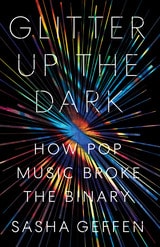
Glitter Up the Dark
How Pop Music Broke the BinaryBy Sasha Geffen
University of Texas Press, 2020
Why has music so often served as an accomplice to transcendent expressions of gender? Why did the query "is he musical?" become code, in the twentieth century, for "is he gay?" Why is music so inherently queer? For Sasha Geffen, the answers lie, in part, in music’s intrinsic quality of subliminal expression, which, through paradox and contradiction, allows rigid gender roles to fall away in a sensual and ambiguous exchange between performer and listener. Glitter Up the Dark traces the history of this gender fluidity in pop music from the early twentieth century to the present day.
Starting with early blues and the Beatles and continuing with performers such as David Bowie, Prince, Missy Elliot, and Frank Ocean, Geffen explores how artists have used music, fashion, language, and technology to break out of the confines mandated by gender essentialism and establish the voice as the primary expression of gender transgression. From glam rock and punk to disco, techno, and hip-hop, music helped set the stage for today’s conversations about trans rights and recognition of nonbinary and third-gender identities. Glitter Up the Dark takes a long look back at the path that led here.
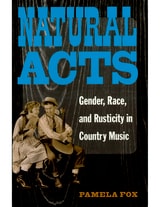
Natural Acts
Gender, Race, and Rusticity in Country MusicPamela Fox
University of Michigan Press, 2009
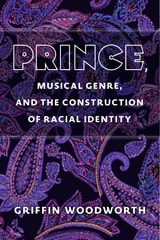
Prince, Musical Genre, and the Construction of Racial Identity
Griffin Woodworth
University of Michigan Press, 2025
Each chapter includes detailed musical analyses and transcriptions of Prince’s songs, focusing on his use of rock guitar, new-wave synthesizers, funk drumming, gospel singing, and R&B horns. By tracking Prince’s transformations of instrumental and vocal idioms derived from specific musical genres, and considering the historical and cultural values embedded within those genres, Griffin Woodworth explores the ways that Prince musically broke down stereotypes of Black masculinity. With its intersectional approach to musical analysis, this book captures the sounds of American racial politics in the 1980s, 90s, and 2000s as heard through the music of one of the era’s most popular artists as he worked to transform and transcend those politics.
The Song Is You
Musical Theatre and the Politics of Bursting into Song and DanceBradley Rogers
University of Iowa Press, 2020
Musicals, it is often said, burst into song and dance when mere words can no longer convey the emotion. This book argues that musicals burst into song and dance when one body can no longer convey the emotion. Rogers shows how the musical’s episodes of burlesque and minstrelsy model the kinds of radical relationships that the genre works to create across the different bodies of its performers, spectators, and creators every time the musical bursts into song. These radical relationships—borne of the musical’s obsessions with “bad” performances of gender and race—are the root of the genre’s progressive play with identity, and thus the source of its subcultural power. However, this leads to an ethical dilemma: Are the musical’s progressive politics thus rooted in its embrace of regressive entertainments like burlesque and minstrelsy?
The Song Is You shows how musicals return again and again to this question, and grapple with a guilt that its joyous pleasures are based on exploiting the laboring bodies of its performers. Rogers argues that the discourse of “integration”—which claims that songs should advance the plot—has functioned to deny the radical work that the musical undertakes every time it transitions into song and dance. Looking at musicals from The Black Crook to Hamilton, Rogers confronts the gendered and racial dynamics that have always under-girded the genre, and asks how we move forward.