Results by title
5 books match the query 'Sexual'
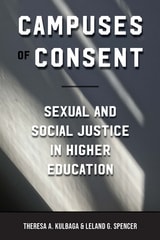
Campuses of Consent
Sexual and Social Justice in Higher EducationTheresa A. Kulbaga and Leland G. Spencer
University of Massachusetts Press, 2019
Winner of the 2020 OSCLG Outstanding Book Award
This new book for scholars and university administrators offers a provocative critique of sexual justice language and policy in higher education around the concept of consent. Complicating the idea that consent is plain common sense, Campuses of Consent shows how normative and inaccurate concepts about gender, gender identity, and sexuality erase queer or trans students' experiences and perpetuate narrow, regressive gender norms and individualist frameworks for understanding violence.
Theresa A. Kulbaga and Leland G. Spencer prove that consent in higher education cannot be meaningfully separated from larger issues of institutional and structural power and oppression. While sexual assault advocacy campaigns, such as It's On Us, federal legislation from Title IX to the Clery Act, and more recent affirmative-consent measures tend to construct consent in individualist terms, as something “given” or “received” by individuals, the authors imagine consent as something that can be constructed systemically and institutionally: in classrooms, campus communication, and shared campus spaces.
Familiar Perversions
The Racial, Sexual, and Economic Politics of LGBT FamiliesMontegary, Liz
Rutgers University Press, 2018
Over the past two decades, same-sex couples raising children have become more visible within US political and popular culture. Thanks to widely circulated images of well-mannered, well-dressed, and well-off two-parent families, a select number of LGBT-identified parents have gained recognition as model American citizens. In Familiar Perversions, Liz Montegary shows how this seemingly progressive view of same-sex parenting has taken shape during a period of growing racial inequality and economic insecurity in the United States. This book evaluates the recent successes of the “family equality” movement, while asking important questions about its relationship to neoliberalism, the policing of sexual cultures, and the broader context of social justice organizing at the turn of the twenty-first century.
Montegary’s investigation of the politics of LGBT family life takes us on a journey that includes not only activist events and the courtrooms where landmark decisions about same-sex families were made, but also parenting workshops, cruise ships, and gay resort towns. Through its sustained historical analysis, Familiar Perversions lays critical groundwork for imagining a queer family movement that can support and strengthen the diverse networks of care, kinship, and intimacy on which our collective survival depends.
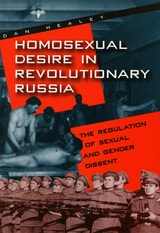
Homosexual Desire in Revolutionary Russia
The Regulation of Sexual and Gender DissentDan Healey
University of Chicago Press, 2001
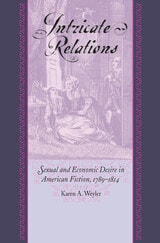
Intricate Relations
Sexual and Economic Desire in American Fiction, 1789-1814Karen A. Weyler
University of Iowa Press, 2005
Intricate Relations charts the development of the novel in and beyond the early republic in relation to these two thematic and intricately connected centers: sexuality and economics. By reading fiction written by Americans between 1789 and 1814 alongside medical theory, political and economic tracts, and pedagogical literature of all kinds, Karen Weyler recreates and illuminates the larger, sometimes opaque, cultural context in which novels were written, published, and read.
In 1799, the novelist Charles Brockden Brown used the evocative phrase “intricate relations” to describe the complex imbrication of sexual and economic relations in the early republic. Exploring these relationships, he argued, is the chief job of the “moral historian,” a label that most novelists of the era embraced. In a republic anxious about burgeoning individualism in the 1790s and the first two decades of the nineteenth century, the novel foregrounded sexual and economic desires and explored ways to regulate the manner in which they were expressed and gratified.
In Intricate Relations, Weyler argues that understanding how these issues underlie the novel as a genre is fundamental to understanding both the novels themselves and their role in American literary culture. Situating fiction amid other popular genres illuminates how novelists such as Charles Brockden Brown, Hannah Foster, Samuel Relf, Susanna Rowson, Rebecca Rush, and Sally Wood synthesized and iterated many of the concerns expressed in other forms of public discourse, a strategy that helped legitimate their chosen genre and make it a viable venue for discussion in the decades following the revolution.
Weyler’s passionate and persuasive study offers new insights into the civic role of fiction in the early republic and will be of great interest to literary theorists and scholars in women’s and American studies.
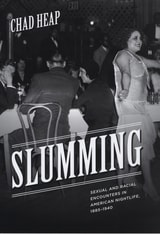
Slumming
Sexual and Racial Encounters in American Nightlife, 1885-1940Chad Heap
University of Chicago Press, 2009