Results by title

6 books match the query 'Sexual Violence'

cover of Conquest: Sexual Violence and American Indian Genocide

Conquest

Sexual Violence and American Indian Genocide

Andrea Smith

Duke University Press, 2005

In this revolutionary text, prominent Native American studies scholar and activist Andrea Smith reveals the connections between different forms of violence—perpetrated by the state and by society at large—and documents their impact on Native women. Beginning with the impact of the abuses inflicted on Native American children at state-sanctioned boarding schools from the 1880s to the 1980s, Smith adroitly expands our conception of violence to include the widespread appropriation of Indian cultural practices by whites and other non-Natives; environmental racism; and population control. Smith deftly connects these and other examples of historical and contemporary colonialism to the high rates of violence against Native American women—the most likely to suffer from poverty-related illness and to survive rape and partner abuse. Smith also outlines radical and innovative strategies for eliminating gendered violence.
 
[more]
cover of Sexual Violence in Asia and Eastern Europe: The Silent Aftermaths of World War II

Sexual Violence in Asia and Eastern Europe

The Silent Aftermaths of World War II

Joohee Kim

Central European University Press, 2027
In the wake of ongoing global concern over conflict-related sexual violence (CRSV), this volume brings together innovative research on the gendered legacies of the Second World War across the “Global Easts.” Focusing on East Asia and the eastern parts of Europe, the book explores how sexual violence—ranging from the Japanese military’s “comfort women” system to the massive assaults committed by German and Soviet forces—has been remembered, silenced, or politicized in the decades that followed. The contributions span four thematic sections: from comparative analyses of wartime violence to postwar justice frameworks, patterns of selective remembrance, and media representations of gendered trauma. Edited by Joohee Kim and Maren Röger, renowned scholars of gender and memory studies in the respective regions, the volume connects these global areas through their shared histories of imperial domination, Cold War divisions, and the belated surfacing of survivors’ voices. By uncovering these entanglements, the book offers a new conceptual and geographical lens on the Global Easts.
[more]
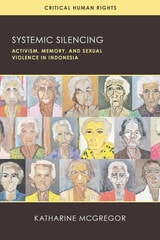
cover of Systemic Silencing: Activism, Memory, and Sexual Violence in Indonesia

Systemic Silencing

Activism, Memory, and Sexual Violence in Indonesia

Katharine E. McGregor

University of Wisconsin Press, 2023
The system of prostitution imposed and enforced by the Japanese military during its wartime occupation of several countries in East and Southeast Asia is today well-known and uniformly condemned. For decades, transnational activist movements have sought to recognize and redress survivors of this World War II–era system, euphemistically known as “comfort women,” with major movements in South Korea, the Philippines, Japan, and elsewhere. However, Indonesian survivors, and even the system’s history in Indonesia to begin with, have largely been sidelined, even within the country itself. Katharine E. McGregor untangles the history of the system during the war and unpacks the context surrounding the slow and faltering efforts to address it. With careful attention to the historical, social, and political conditions surrounding sexual violence in Indonesia, supported by exhaustive research and archival diligence, she uncovers a crucial piece of Indonesian history and the ongoing efforts to bring it to the public eye. Critically, she establishes that the transnational part of activism surrounding victims of the system is both necessary and fraught, a complexity of geopolitics and international relationships on one hand and a question of personal networks, linguistic differences, and cultural challenges on the other.
[more]
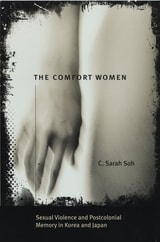
cover of The Comfort Women: Sexual Violence and Postcolonial Memory in Korea and Japan

The Comfort Women

Sexual Violence and Postcolonial Memory in Korea and Japan

C. Sarah Soh

University of Chicago Press, 2008

A powerful debunking of simplistic views of a wartime tragedy

In an era marked by atrocities perpetrated on a grand scale, the tragedy of the so-called comfort women—mostly Korean women forced into prostitution by the Japanese army—endures as one of the darkest events of World War II. These women have usually been labeled victims of a war crime, a simplistic view that makes it easy to pin blame on the policies of imperial Japan and therefore easier to consign the episode to a war-torn past. In this revelatory study, C. Sarah Soh provocatively disputes this master narrative.
            Soh reveals that the forces of Japanese colonialism and Korean patriarchy together shaped the fate of Korean comfort women—a double bind made strikingly apparent in the cases of women cast into sexual slavery after fleeing abuse at home. Other victims were press-ganged into prostitution, sometimes with the help of Korean procurers. Drawing on historical research and interviews with survivors, Soh tells the stories of these women from girlhood through their subjugation and beyond to their efforts to overcome the traumas of their past. Finally, Soh examines the array of factors— from South Korean nationalist politics to the aims of the international women’s human rights movement—that have contributed to the incomplete view of the tragedy that still dominates today.

[more]
cover of The Spectral Wound: Sexual Violence, Public Memories, and the Bangladesh War of 1971

The Spectral Wound

Sexual Violence, Public Memories, and the Bangladesh War of 1971

Nayanika Mookherjee

Duke University Press, 2015

Following the 1971 Bangladesh War, the Bangladesh government publicly designated the thousands of women raped by the Pakistani military and their local collaborators as birangonas, ("brave women”). Nayanika Mookherjee demonstrates that while this celebration of birangonas as heroes keeps them in the public memory, they exist in the public consciousness as what Mookherjee calls a spectral wound. Dominant representations of birangonas as dehumanized victims with disheveled hair, a vacant look, and rejected by their communities create this wound, the effects of which flatten the diversity of their experiences through which birangonas have lived with the violence of wartime rape. In critically examining the pervasiveness of the birangona construction, Mookherjee opens the possibility for a more politico-economic, ethical, and nuanced inquiry into the sexuality of war.
 
[more]
cover of When Time Warps: The Lived Experience of Gender, Race, and Sexual Violence

When Time Warps

The Lived Experience of Gender, Race, and Sexual Violence

Megan Burke

University of Minnesota Press, 2019

An inquiry into the phenomenology of “woman” based in the relationship between lived time and sexual violence

 
Feminist phenomenologists have long understood a woman’s life as inhibited, confined, and constrained by sexual violence. In this important inquiry, author Megan Burke both builds and expands on this legacy by examining the production of normative womanhood through racist tropes and colonial domination. Ultimately, Burke charts a new feminist phenomenology based in the relationship between lived time and sexual violence.

By focusing on time instead of space, When Time Warps places sexualized racism at the center of the way “woman” is lived. Burke transports questions of time and gender outside the realm of the historical, making provocative new insights into how gendered individuals live time, and how their temporal existence is changed through particular experiences.

Providing a potent reexamination of the theory of Simone de Beauvoir—while also bringing to the fore important women of color theorists and engaging in the temporal aspects of #MeToo—When Time Warps makes a necessary, lasting contribution to our understanding of gender, race, and sexual violence.

[more]