Results by title
87 books match the query 'Sexual minorities' and 3 start with a
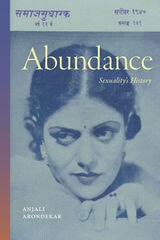
Abundance
Sexuality’s HistoryAnjali Arondekar
Duke University Press, 2023
In Abundance, Anjali Arondekar refuses the historical common sense that archival loss is foundational to a subaltern history of sexuality, and that the deficit of our minoritized pasts can be redeemed through acquisitions of lost pasts. Instead, Arondekar theorizes the radical abundance of sexuality through the archives of the Gomantak Maratha Samaj—a caste-oppressed devadasi collective in South Asia—that are plentiful and quotidian, imaginative and ordinary. For Arondekar, abundance is inextricably linked to the histories of subordinated groups in ways that challenge narratives of their constant devaluation. Summoning abundance over loss upends settled genealogies of historical recuperation and representation and works against the imperative to fix sexuality within wider structures of vulnerability, damage, and precarity. Multigeneric and multilingual, transregional and historically supple, Abundance centers sexuality within area, post/colonial, and anti/caste histories.
[more]

Archive Activism
Memoir of a "Uniquely Nasty" JourneyCharles Francis
University of North Texas Press, 2023
[more]

Asegi Stories
Cherokee Queer and Two-Spirit MemoryQwo-Li Driskill
University of Arizona Press, 2016
In Cherokee Asegi udanto refers to people who either fall outside of men’s and women’s roles or who mix men’s and women’s roles. Asegi, which translates as “strange,” is also used by some Cherokees as a term similar to “queer.” For author Qwo-Li Driskill, asegi provides a means by which to reread Cherokee history in order to listen for those stories rendered “strange” by colonial heteropatriarchy.
As the first full-length work of scholarship to develop a tribally specific Indigenous Queer or Two-Spirit critique, Asegi Stories examines gender and sexuality in Cherokee cultural memory, how they shape the present, and how they can influence the future.
The theoretical and methodological underpinnings of Asegi Stories derive from activist, artistic, and intellectual genealogies, referred to as “dissent lines” by Maori scholar Linda Tuhiwai Smith. Driskill intertwines Cherokee and other Indigenous traditions, women of color feminisms, grassroots activisms, queer and Trans studies and politics, rhetoric, Native studies, and decolonial politics. Drawing from oral histories and archival documents in order to articulate Cherokee-centered Two-Spirit critiques, Driskill contributes to the larger intertribal movements for social justice.
[more]