Results by title
5 books match the query 'Sexual minority youth'

Ambivalent Childhoods
Speculative Futures and the Psychic Life of the ChildJacob Breslow
University of Minnesota Press, 2021
Explores childhood in relation to blackness, transfeminism, queerness, and deportability to interrogate what “the child” makes possible
The concept of childhood contains many contested and ambivalent meanings that have extraordinary implications, particularly for those staking their claim for belonging and justice on the wish for inclusion within it. In Ambivalent Childhoods, Jacob Breslow examines contemporary U.S. social justice movements (including Black Lives Matter, transfeminism, queer youth activism, and antideportation movements) to discover and reveal how childhood operates within and against them.
Ambivalent Childhoods brings together critical race, trans, feminist, queer, critical migration, and psychoanalytic theories to explore the role of childhood in shaping and challenging the disposability of young black life, the steadfastness of the gender binary, the queer life of children’s desires, and the precarious status of migrants. Through an engagement with“the psychic life of the child” that combines theoretical discussions of childhood, blackness, transfeminism, and deportability with critical readings of films, narrative, images, and social justice movements, Breslow demonstrates how childhood requires sustained attention as a complex and ambivalent site for contesting the workings of power, not only for the young.
Ambivalent Childhoods is a forward-thinking and intersectional analysis of how childhood affects activism, national belonging, and the violence directed against queer, trans, and racialized people.

Kids on the Street
Queer Kinship and Religion in San Francisco's TenderloinJoseph Plaster
Duke University Press, 2023

LGBTQAI+ Books for Children and Teens
Providing a Window for AllChristina Dorr
American Library Association, 2018
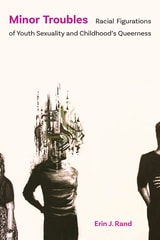
Minor Troubles
Racial Figurations of Youth Sexuality and Childhood's QueernessErin J. Rand
The Ohio State University Press, 2025
In Minor Troubles, Erin J. Rand investigates a series of controversies about youth sexuality and queerness from the early twenty-first century: adult concerns about teen sexting, the bullying and suicides of queer kids, trans youths’ access to gender-segregated bathrooms at school, and sex education. In the public deliberation and mediation of each of these controversies, the imagined qualities of childhood—innocence, vulnerability, nonsexuality, and, crucially, whiteness—are deployed by adults to justify the protection of children. However, these rhetorical figurations of childhood often produce material precarities for actual young people, especially youth of color and queer, trans, and gender-nonconforming youth.
Rand foregrounds the fundamental role of racialization in forming ideas about childhood, arguing that the image of innocent white childhood depends upon the dehumanization of racialized youth. Moreover, the rhetorical process of figuration produces vulnerability and constrains agency for real young people and creates cultural ideas about childhood that come to justify policies, discipline behaviors, regulate identities, control knowledges, and determine interventions that shape children’s lives, bodies, and experiences.

Queer Kinship and Family Change in Taiwan
Brainer, Amy
Rutgers University Press, 2019
Interweaving the narratives of multiple family members, including parents and siblings of her queer and trans informants, Amy Brainer analyzes the strategies that families use to navigate their internal differences. In Queer Kinship and Family Change in Taiwan, Brainer looks across generational cohorts for clues about how larger social, cultural, and political shifts have materialized in people’s everyday lives. Her findings bring light to new parenting and family discourses and enduring inequalities that shape the experiences of queer and heterosexual kin alike.
Brainer’s research takes her from political marches and support group meetings to family dinner tables in cities and small towns across Taiwan. She speaks with parents and siblings who vary in whether and to what extent they have made peace with having a queer or transgender family member, and queer and trans people who vary in what they hope for and expect from their families of origin. Across these diverse life stories, Brainer uses a feminist materialist framework to illuminate struggles for personal and sexual autonomy in the intimate context of family and home.