Results by title
7 books match the query 'Shaker'
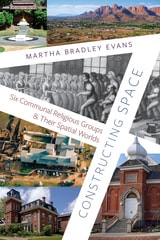
Constructing Space
Six Communal Religious Groups and Their Spatial WorldsMartha Bradley Evans
University of Utah Press, 2025
Religion transforms and inspires specific ways of living in the world. Through architecture and the built environment, members of religious communities communicate intangible beliefs about God, gender and family, the sacred and profane, and more. This captivating volume explores the spatial worlds of six different religious communities— the Latter-day Saints, the Oneida Colony, the Shakers, the Branch Davidians, the FLDS, and Adidam—through the architecture and cultural landscapes they built.
What does the strict order and regularity of a Shaker village tell us about the community’s hierarchies and relationships? How might a temple building site affect an LDS Church member’s daily life? Constructing Space reveals the hidden language of meaning, association, and identity that religious persons speak as they mold their faith into concrete forms, and how they interpret the meanings of those spaces within their practices.
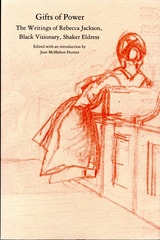
Gifts of Power
The Writings of Rebecca Jackson, Black Visionary, Shaker EldressJean M. Humez
University of Massachusetts Press, 1981
A free black woman in antebellum America, Rebecca Cox Jackson (1795–1871) was an independent itinerant preacher and religious visionary who founded a Shaker community in Philadelphia that survived her death by twenty-five years. Gifts of Power contains her complete extant writings, covering the period 1830 to 1864.

Millennial Praises
A Shaker HymnalChristian Goodwillie
University of Massachusetts Press, 2009

Mother Ann Lee
Morning Star of the ShakersNardi Reeder Campion
Brandeis University Press, 2026
The definitive biography of the founder of the Shaker movement, whose remarkable life is the subject of a new film, The Testament of Ann Lee.
This acclaimed, accessible, and thoroughly researched biography documents the life of Ann Lee, a controversial, religious leader and early feminist figure. Lee established the Shaker movement in 1770 in Manchester, England. The core principles of the Shakers were radical: in an era when wives were the possession of their husband, Lee proclaimed the equality of men and women. The Shakers were dedicated to beliefs in absolute pacifism, equality of the sexes, absolute celibacy, and the cleansing of sin through dancing and chanting to shake away the past.
The Shakers sought inner peace and harmony, but their unusual beliefs, including total abstinence from sex and their exhibitions of mystical ecstasy were considered suspect and led to the imprisonment of Lee and her followers. While jailed, Lee experienced a blinding, soul-splitting vision which reaffirmed her belief in celibacy and named her the second coming of Christ. Seeking religious freedom, she led her followers, known as the United Society of Believers in Christ’s Second Appearing, from England to settle in upstate New York, near Albany.
Mother Ann Lee died in 1784, but her movement continued to grow into the nineteenth century with at least eighteen utopian Shaker communities in Kentucky, Maine, Massachusetts, New Hampshire, New York, and Ohio. Today many of those Shaker settlements are museums. The last remaining Shaker community is at Sabbathday Lake Shaker Village near Poland, Maine. The Testament of Ann Lee, starring Amanda Seyfried, drew on this book among other sources to tell Lee’s story.
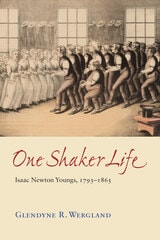
One Shaker Life
Isaac Newton Youngs, 1793-1865Glendyne R. Wergland
University of Massachusetts Press, 2006
A member of the United Society of Believers, better known as the Shakers, Isaac Newton Youngs spent most of his life in New Lebanon, New York, home of the society's central Ministry. As both a private diarist and the official village scribe, he kept meticulous records throughout those years of both his own experience and that of the community. All told, more than four thousand pages of Brother Isaac's journals have survived, documenting the history of the Shakers during the period of their greatest success and providing a revealing view of the daily life of a rank-and-file Believer.
In this deeply researched biography, Glendyne R. Wergland draws on Youngs's writings to tell his story and to explore “the tension between desire and discipline” at the center of his life. She follows Youngs from childhood and adolescence to maturity, through years of demanding responsibility into his fatal decline. In each of these stages, he remained a talented and committed yet independent Shaker, one who chose to stay with the community but often struggled to abide by its stringent rules, including the vow of celibacy. Perhaps above all, he was a man who spent most of his waking hours working diligently at a succession of tasks, making clocks, sewing clothes, fixing roofs, writing poetry, chronicling his daily acts and thoughts.
In his journals, Brother Isaac writes at length of his efforts to control his lust as a young man, and he complains repeatedly about overwork as he grows older. He defines the rules of his community and identifies transgressors, while enciphering his critical entries (and those chronicling his own sexual desires) to avoid detection and uphold the demand for conformity. At times he admits doubt, but without ever relinquishing the belief that he is on the straight and narrow path to salvation. What emerges in the end is the complex portrait of an ordinary man striving to live up to the imperatives of his faith.

Shaker Textile Arts
Beverly Gordon
University Press of New England, 1982
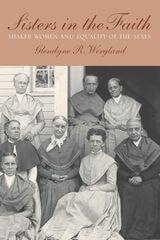
Sisters in the Faith
Shaker Women and Equality of the SexesGlendyne R. Wergland
University of Massachusetts Press, 2011
In 1788, following the death of charismatic founder Mother Ann Lee, the celibate religious group known as the Shakers set out to institutionalize equality of the sexes in their theology, government, and daily practice. In this book, Glendyne Wergland evaluates how well they succeeded in that mission by examining the experiences of women within Shaker communities over more than a century.
Drawing on an extensive archive of primary documents, Wergland discusses topics ranging from girlhood, health, and dress to why women joined the Shakers and how they were viewed by those outside their community. She analyzes the division of labor between men and women, showing that there was considerable cooperation and reciprocity in carrying out most tasks—from food production to laundering to gathering firewood—even as gendered conflicts remained.
In her conclusion, Wergland draws together all of these threads to show that Shaker communities achieved a remarkable degree of gender equality at a time when women elsewhere still suffered under the legal and social strictures of the traditional patriarchal order. In so doing, she argues, the experience of Shaker women served as a model for promoting women's rights in American political culture.