Results by title
10 books match the query 'Shakers'

DANCE UNTO THE LORD
GEORGE DELL
The Ohio State University Press, 2001
George Dell’s Dance unto the Lord is a compelling fusion of history and fiction. Set in 1848 to 1852, when Ohio was considered to be the West, Dance unto the Lord transports the readers to Union Village, a Shaker community in southwestern Ohio. The novel traces the coming of age of Richard and Ruth, young people who wish to marry but are forbidden to do so by Richard’s parents. In desperation, Richard runs away to Cincinnati. Ruth, too, leaves her family. She settles in Union Village and eventually becomes a teacher at the Shaker school. Torn between her desire for freedom and the security of life with the Shakers, Ruth becomes increasingly more immersed in the Shaker society while dreaming of Richard and a life outside the community. Meanwhile, through his experiences with an ill-fated blacksmith’s shop and its owners, Richard learns that life in the city can be complicated and painful.
As he traces Richard’s and Ruth’s experiences, Dell vividly re-creates the texture of rural and city life in mid-nineteenth-century Ohio, providing a fascinating, well-researched account of a long-gone era. Dance unto the Lord provides wonderfully detailed descriptions of a Shaker community and life style. This book will be compelling reading for anyone interested in the time period, the Shakers, or simply a good story.

Domestic Broils
Shakers, Antebellum Marriage, and the Narratives of Mary and Joseph DyerElizabeth De Wolfe
University of Massachusetts Press, 2010

Millennial Praises
A Shaker HymnalChristian Goodwillie
University of Massachusetts Press, 2009

Mother Ann Lee
Morning Star of the ShakersNardi Reeder Campion
Brandeis University Press, 2026
The definitive biography of the founder of the Shaker movement, whose remarkable life is the subject of a new film, The Testament of Ann Lee.
This acclaimed, accessible, and thoroughly researched biography documents the life of Ann Lee, a controversial, religious leader and early feminist figure. Lee established the Shaker movement in 1770 in Manchester, England. The core principles of the Shakers were radical: in an era when wives were the possession of their husband, Lee proclaimed the equality of men and women. The Shakers were dedicated to beliefs in absolute pacifism, equality of the sexes, absolute celibacy, and the cleansing of sin through dancing and chanting to shake away the past.
The Shakers sought inner peace and harmony, but their unusual beliefs, including total abstinence from sex and their exhibitions of mystical ecstasy were considered suspect and led to the imprisonment of Lee and her followers. While jailed, Lee experienced a blinding, soul-splitting vision which reaffirmed her belief in celibacy and named her the second coming of Christ. Seeking religious freedom, she led her followers, known as the United Society of Believers in Christ’s Second Appearing, from England to settle in upstate New York, near Albany.
Mother Ann Lee died in 1784, but her movement continued to grow into the nineteenth century with at least eighteen utopian Shaker communities in Kentucky, Maine, Massachusetts, New Hampshire, New York, and Ohio. Today many of those Shaker settlements are museums. The last remaining Shaker community is at Sabbathday Lake Shaker Village near Poland, Maine. The Testament of Ann Lee, starring Amanda Seyfried, drew on this book among other sources to tell Lee’s story.
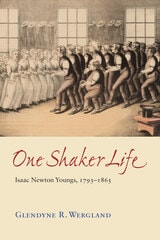
One Shaker Life
Isaac Newton Youngs, 1793-1865Glendyne R. Wergland
University of Massachusetts Press, 2006
A member of the United Society of Believers, better known as the Shakers, Isaac Newton Youngs spent most of his life in New Lebanon, New York, home of the society's central Ministry. As both a private diarist and the official village scribe, he kept meticulous records throughout those years of both his own experience and that of the community. All told, more than four thousand pages of Brother Isaac's journals have survived, documenting the history of the Shakers during the period of their greatest success and providing a revealing view of the daily life of a rank-and-file Believer.
In this deeply researched biography, Glendyne R. Wergland draws on Youngs's writings to tell his story and to explore “the tension between desire and discipline” at the center of his life. She follows Youngs from childhood and adolescence to maturity, through years of demanding responsibility into his fatal decline. In each of these stages, he remained a talented and committed yet independent Shaker, one who chose to stay with the community but often struggled to abide by its stringent rules, including the vow of celibacy. Perhaps above all, he was a man who spent most of his waking hours working diligently at a succession of tasks, making clocks, sewing clothes, fixing roofs, writing poetry, chronicling his daily acts and thoughts.
In his journals, Brother Isaac writes at length of his efforts to control his lust as a young man, and he complains repeatedly about overwork as he grows older. He defines the rules of his community and identifies transgressors, while enciphering his critical entries (and those chronicling his own sexual desires) to avoid detection and uphold the demand for conformity. At times he admits doubt, but without ever relinquishing the belief that he is on the straight and narrow path to salvation. What emerges in the end is the complex portrait of an ordinary man striving to live up to the imperatives of his faith.
Religion and Sexuality
The Shakers, the Mormons, and the Oneida CommunityLawrence Foster
University of Illinois Press, 2009
Winner of the Best Book Award, Mormon History Association

Shaker Fever
America's Twentieth-Century Fascination with a Communitarian SectWilliam D. Moore
University of Massachusetts Press, 2020
This interdisciplinary study places the activities of individuals—including Doris Humphrey, Charles Sheeler, Laura Bragg, Juliana Force, and Edward Deming Andrews—within the larger cultural and historical contexts of nationalism, modernism, and cultural resource management. Taking up previously unexamined primary sources and cultural productions that include the first scholarly studies of the faith, material culture and visual arts, stage performances, and museum exhibitions, Shaker Fever compels a reconsideration of this religious group and its place within American memory. It is sure to delight enthusiasts, public historians, museum professionals, furniture collectors, and anyone interested in the dynamics of cultural appropriation and stewardship.

Shaker Vision
Seeing Beauty in Early AmericaJoseph Manca
University of Massachusetts Press, 2019
In Shaker Vision, Joseph Manca explores original texts, especially diaries and travel journals, and material culture to demonstrate that Shakers enjoyed a remarkably deep experience of the visual world. Shakers shared tastes with mainstream Americans and often employed a similar aesthetic vocabulary, but all within a belief system that made them distinct. In addition to their well-known ascetic architecture, furniture, and handicraft styles, they expressed themselves through ornate and detailed spiritual art and in vivid, visionary experiences. Based on firsthand accounts of the believers themselves, this richly illustrated volume will dramatically change how we assess the visual world of this uniquely American religious sect.
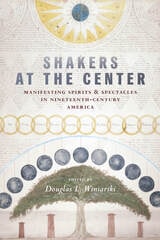
Shakers at the Center
Manifesting Spirits & Spectacles in Nineteenth-Century AmericaEdited by Douglas L. Winiarski
University of Massachusetts Press, 2026
Exploring the theological, social, and cultural dimensions of one of America’s most ambitious prophetic movements
The Shakers’ Era of Manifestations ranks among the most astounding events in American religious history. During the 1840s, members of the United Society of Believers in Christ’s Second Appearing embarked on an audacious project of receiving visions, revelations, and other manifestations from the spirit world and convincing both themselves and the world’s people of their reality. Gifted Shakers known as “instruments” surrendered their bodies to possessing spirits and celestial beings who, in turn, provided the Believers with an unimaginable number of revelatory communications that collapsed time and space, rewrote the Bible, and vastly expanded traditional Protestant beliefs and practices. The fruits of Shaker spiritualism would gain a permanent place in America’s public consciousness.
Hundreds of volumes and thousands of pages of inspired writings, music, and art from the New Era or period of Mother's Work, as the Shakers called it, crowd the shelves of a half dozen major research libraries. The archive is so vast, so extraordinary, so seemingly bizarre that few scholars have dared tackle it in its totality. The authors of this volume, specialists in nineteenth-century American religious studies, have collaborated to produce an extensive analysis of Mother Ann’s Work. They examine a fascinating range of topics: speaking with the dead; the spectacle of Shaker rituals; race, gender, and family life; and the material culture of physical and spiritual things; as well as manuscripts, books, songs, objects, and art produced during the New Era.
Shakers at the Center brings the sprawling elements of the Era of Manifestations together in a single volume. Written for students, scholars, and general readers alike, it will stand for years as the definitive history of the Shakers’ most fascinating and vexing historical period.
Contributors include the volume editor as well as Emily Suzanne Clark, Brett Malcolm Grainger, Sonia Hazard, Dana Logan, Carol Medlicott, Sally M. Promey, Erik R. Seeman, Ryan K. Smith, and David Walker.
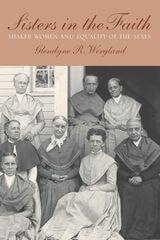
Sisters in the Faith
Shaker Women and Equality of the SexesGlendyne R. Wergland
University of Massachusetts Press, 2011
In 1788, following the death of charismatic founder Mother Ann Lee, the celibate religious group known as the Shakers set out to institutionalize equality of the sexes in their theology, government, and daily practice. In this book, Glendyne Wergland evaluates how well they succeeded in that mission by examining the experiences of women within Shaker communities over more than a century.
Drawing on an extensive archive of primary documents, Wergland discusses topics ranging from girlhood, health, and dress to why women joined the Shakers and how they were viewed by those outside their community. She analyzes the division of labor between men and women, showing that there was considerable cooperation and reciprocity in carrying out most tasks—from food production to laundering to gathering firewood—even as gendered conflicts remained.
In her conclusion, Wergland draws together all of these threads to show that Shaker communities achieved a remarkable degree of gender equality at a time when women elsewhere still suffered under the legal and social strictures of the traditional patriarchal order. In so doing, she argues, the experience of Shaker women served as a model for promoting women's rights in American political culture.