Results by title
7 books match the query 'Sheehan, William'
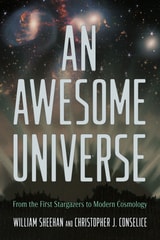
An Awesome Universe
From the First Stargazers to Modern CosmologyWilliam Sheehan and Christopher J. Conselice
University of Arizona Press, 2027
This groundbreaking exploration of humanity’s quest to understand the cosmos spans the earliest observations of the night sky to the latest revelations from advanced space telescopes. It is about humans as much as stars, galaxies, black holes, dark matter, and dark energy. It is a book about the awe we experience in the presence of the awesome universe.
Written by an award-winning historian of astronomy and a professional astronomer specializing in galaxy formation in the early universe, this book provides a comprehensive narrative of cosmic discovery. It examines the evolution of our understanding of the universe—from the first glimpses of the stars to the recognition of the Milky Way as a spiral galaxy and the realization that our universe is filled with countless other galaxies. The book also explores the revolutionary advancements in astrophysics that have shaped our knowledge, including quantum mechanics, nuclear physics, and the study of the still mysterious dark matter and dark energy.
Richly illustrated with remarkable images that show the scale of the universe—from the ancient sky to the ten trillion galaxies now known to exist—An Awesome Universe also addresses some of the most profound questions in science: the nature of life beyond Earth, the fate of the universe, and whether we will ever fully understand the mysteries of space-time, the Big Bang, and the possibility of a multiverse.
This authoritative and visually captivating work offers readers a glimpse into the “Big Picture” of the cosmos, framed by the contributions of pioneering astronomers and driven by our ongoing quest for knowledge about our place in the universe.
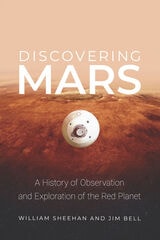
Discovering Mars
A History of Observation and Exploration of the Red PlanetWilliam Sheehan and Jim Bell
University of Arizona Press, 2021
Historian William Sheehan and astronomer and planetary scientist Jim Bell combine their talents to tell a unique story of what we’ve learned by studying Mars through evolving technologies. What the eye sees as a mysterious red dot wandering through the sky becomes a blurry mirage of apparent seas, continents, and canals as viewed through Earth-based telescopes. Beginning with the Mariner and Viking missions of the 1960s and 1970s, space-based instruments and monitoring systems have flooded scientists with data on Mars’s meteorology and geology, and have even sought evidence of possible existence of life-forms on or beneath the surface. This knowledge has transformed our perception of the Red Planet and has provided clues for better understanding our own blue world.
Discovering Mars vividly conveys the way our understanding of this other planet has grown from earliest times to the present. The story is epic in scope—an Iliad or Odyssey for our time, at least so far largely without the folly, greed, lust, and tragedy of those ancient stories. Instead, the narrative of our quest for the Red Planet has showcased some of our species’ most hopeful attributes: curiosity, cooperation, exploration, and the restless drive to understand our place in the larger universe. Sheehan and Bell have written an ambitious first draft of that narrative even as the latest chapters continue to be added both by researchers on Earth and our robotic emissaries on and around Mars, including the latest: the Perseverance rover and its Ingenuity helicopter drone, which set down in Mars’s Jezero Crater in February 2021.
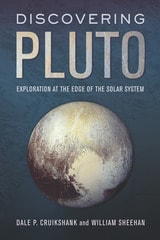
Discovering Pluto
Exploration at the Edge of the Solar SystemDale P. Cruikshank and William Sheehan
University of Arizona Press, 2018
Telling the tale of Pluto’s discovery, the authors recount the grand story of our unfolding knowledge of the outer Solar System, from William Herschel’s serendipitous discovery of Uranus in 1781, to the mathematical prediction of Neptune’s existence, to Percival Lowell’s studies of the wayward motions of those giant planets leading to his prediction of another world farther out. Lowell’s efforts led to Clyde Tombaugh’s heroic search and discovery of Pluto—then a mere speck in the telescope—at Lowell Observatory in 1930.
Pluto was finally recognized as the premier body in the Kuiper Belt, the so-called third zone of our Solar System. The first zone contains the terrestrial planets (Mercury through Mars) and the asteroid belt; the second, the gas-giant planets Jupiter through Neptune. The third zone, holding Pluto and the rest of the Kuiper Belt, is the largest and most populous region of the solar system.
Now well beyond Pluto, New Horizons will continue to wend its lonely way through the galaxy, but it is still transmitting data, even today. Its ultimate legacy may be to inspire future generations to uncover more secrets of Pluto, the Solar System, and the Universe.
Planets and Perception
Telescopic Views and Interpretations, 1609-1909William Sheehan
University of Arizona Press, 1988
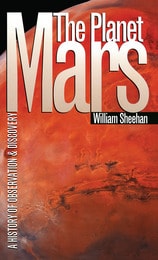
The Planet Mars
A History of Observation and DiscoveryWilliam Sheehan
University of Arizona Press, 1996
In this timely and vividly written account, William Sheehan traces human fascination with Mars back to the naked-eye observers of the planet. He recalls the early telescopic observers who first made out enigmatic markings and polar caps on its surface. Through lively historical anecdotes, he describes in detail the debate over the so-called canals of Mars, which encouraged speculation that the planet might be inhabited. Finally, Sheehan describes more recent theories about the planet, leading up to the present, when unmanned spacecraft have enabled us to make giant strides in exploration.
Well documented and sparked with human interest, this book will be a useful companion and guide in interpreting the barrage of headlines about Mars that is sure to come over the next few years. Amateurs will appreciate the contributions that have been made to Martian studies by people like themselves, and professionals will find much original material that has never before been published. The American Mars Global Surveyor is scheduled for launch in November 1996, and soon after the American Mars Pathfinder will make its way toward the red planet. A Russian mission consisting of an orbiter and two landers will be launched in October 1997. These space travelers will write a whole new chapter in the dramatic story of Mars, a planet whose exploration has only just begun. Astronomy Book Club main selection and selections of Book-of-the-Month Club and Quality Paperback Book Club.
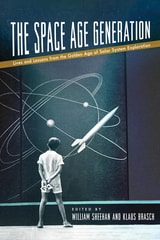
The Space Age Generation
Lives and Lessons from the Golden Age of Solar System ExplorationWilliam Sheehan and Klaus Brasch
University of Arizona Press, 2024
At the heart of this momentous time were the men and women working behind the scenes. Scientists, historians, and astronomers share their memories and contributions from this unparalleled era in essays told in their own words. They are the remarkable generation who witnessed and contributed to some of space science’s most stunning achievements. Here they have recorded their memories—their childhood inspirations, their challenges, failures, and triumphs—for future generations.
A unique and authoritative record of a momentous period in human history, The Space Age Generation highlights the golden age of space exploration and the people who made it happen.
Contributors
Leo Aerts
Alexander Basilevsky
Klaus Brasch
Clark R. Chapman
Dale P. Cruikshank
William K. Hartmann
William Leatherbarrow
Baerbel Koesters Lucchitta
Yvonne Pendleton
Peter H. Schultz
William Sheehan
Paolo Tanga
Charles A. Wood

Worlds in the Sky
Planetary Discovery from Earliest Times Through Voyager and MagellanWilliam Sheehan
University of Arizona Press, 1992
In Worlds in the Sky, William Sheehan gives us a history of this long fascination, weaving together scientific history, anecdotes surrounding planetary discoveries, and the personal reflections of an incurable amateur astronomer. He describes how we arrived at our current understanding of the Moon and the planets and shows how certain individuals in history shaped the world’s knowledge about the Solar System.