Results by title
6 books match the query 'Shelley'
Captain Medwin
Friend of Byron and ShelleyBy Ernest J. Lovell
University of Texas Press, 1962
Here is the first biography of Thomas Medwin—literary adventurer, rascal, scholar, confidence man, successful fortune hunter, and bemused speculator on a grand scale in old Italian oil paintings. Poet, novelist, translator of Aeschylus, cousin and boyhood friend of the poet Shelley, he was a man of fiery temper, fierce hatreds, and enduring loves.
Although an intimate friend of Lord Byron, he was so dangerous (or disreputable) that his Lordship warned Teresa Guiccioli, his last mistress, not to be alone in Medwin's company. Later, Medwin introduced Byron's daughter to her future husband, Lord Lovelace, and so determined the poet's line of descent.
Friend of Washington Irving, gentleman of the old school, neglected Boswell of the nineteenth century, Medwin reported the conversations of Byron, Shelley, Trelawny, Hazlitt, Canova the sculptor, and others. His life and adventures light up little-known aspects of the nineteenth-century literary, military, social, and publishing world—in England, India, Italy, France, Switzerland, and Germany.
Medwin served as midwife to the words of a dead man—Lord Byron—who returned to laugh and sneer at the living from the Captain's pages. The Conversations of Lord Byron thus became the most controversial book of the day, going through a dozen editions, in six countries, and being translated into French, German, and Italian. It aroused the wrath, indignation, or enthusiastic interest of such individuals as Goethe, Lady Byron, Lady Caroline Lamb, the Countess Teresa Guiccioli, John Cam Hobhouse (later Lord Broughton), Sir Walter Scott, John Murray, and Washington Irving. Medwin, whose long and adventurous life extended from the rise and flowering of the Romantic Period to the mid-Victorian Age (which he regarded as a dreary decline from the great heights of his youth), was an influence of the first magnitude in determining the early public image of Byron and the reputation of Shelley.
This often amusing story, as engrossing as a novel, is drawn from all the available accounts, including many important sources never before published. In effect a new contribution to the biographical study of Byron and Shelley, it clarifies Medwin's relations not only with these two poets but also with many other important and interesting figures of the day.
Doctoring the Novel
Medicine and Quackery from Shelley to DoyleSylvia A. Pamboukian
Ohio University Press, 2012
Doctoring the Novel explores the ways in which language constructs and stabilizes these slippery terms by examining medical quackery and orthodoxy in works such as Mary Shelley’s Frankenstein, Charles Dickens’s Bleak House and Little Dorrit, Charlotte Brontë’s Villette, Wilkie Collins’s Armadale, and Arthur Conan Doyle’s Stark Munro Letters. Contextualized in both medical and popular publishing, literary analysis reveals that even supposedly medico-scientific concepts such as orthodoxy and quackery evolve not in elite laboratories and bourgeois medical societies but in the rough-and-tumble of the public sphere, a view that acknowledges the considerable, and often underrated, influence of language on medical practices.

Power and Elusiveness in Shelley
Oscar W. Firkins
University of Minnesota Press, 1937
Power and Elusiveness in Shelley was first published in 1937. Minnesota Archive Editions uses digital technology to make long-unavailable books once again accessible, and are published unaltered from the original University of Minnesota Press editions.
This is a discussion in measured prose of the strange yet frequent union of various abstract elements in Shelley's poetry. The study contains an interesting analysis of the thesis that Shelley's "love of abstraction is only one form—probably the most obvious and the most significant form—of a larger and more general tendency." The object of this essay, in the author's words, "is to collect and combine the manifestations of this larger tendency."
The two great "abstractions" that Firkins selects as the touchstones in his study he generalizes as "power" and "elusiveness," and he shows how these seemingly antithetical qualities are united in both the structure and the style of all Shelley's chief poems.
Shelley and His Readers
Beyond Paranoid PoliticsKim Wheatley
University of Missouri Press, 1999
In Shelley and His Readers, the first full-length critical analysis of the dialogue between Shelley's poetry and its contemporary reviewers, Kim Wheatley argues that Shelley's idealism can be recovered through the study of his poetry's reception. Incorporating extensive research in major early-nineteenth-century British periodicals, Wheatley integrates a reception-based methodology with careful textual analysis to demonstrate that the early reception of Shelley's work registers the immediate impact of the poet's increasingly idealistic passion for reforming the world.
Wheatley examines Shelley's poetry within the context of Romantic-era "paranoid politics," a simultaneously empowering and disabling dynamic in which the reviewers employ a heightened language of defensiveness and persecution that paints their adversaries as Satanic rebels against orthodoxy. This "paranoid style" displays a preoccupation with the efficacy of the printed word and singles out radical writers such as Shelley as sources of social contamination.
Using Shelley's Queen Mab to illustrate his early radicalism, Wheatley demonstrates that the poet, like his contemporary reviewers, is caught up in paranoid rhetoric. Failing to challenge the assumptions underlying the paranoid style-conspiracy and contagion-in this poem Shelley takes merely a defiant, oppositional stance. However, Shelley's later poems, exemplified by Prometheus Unbound and Adonais, circumvent the reviewers' rhetoric through their boldly experimental language, a process registered by the reviewers' own responses. These less explicitly political poems transcend the dynamics of cultural paranoia by shifting to an apolitical conception of the aesthetic. In collaboration with its early readers, Shelley's poetry thus moves momentarily beyond paranoid politics.
The final chapter of this study argues that the posthumous reception of Adonais uniquely replicates the elegiac moves and complex idealism of the poem, concluding with a discussion of how the Shelley circle aestheticized the poet after his death.
Shelley and His Readers offers a new approach to the question of how to recuperate Romantic idealism in the face of challenges from both deconstructive and historicist criticism. Its innovative use of reception-based analysis will make this book invaluable not only to specialists of the Romantic period but also to anyone interested in new developments in literary criticism.
Shelley and Synesthesia
Glenn O'Malley
Northwestern University Press, 1964
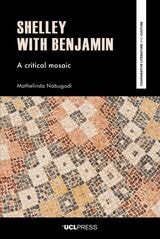
Shelley with Benjamin
A Critical MosaicMathelinda Nabugodi
University College London, 2023
Shelley with Benjamin is an experiment in comparative reading. Born a century apart, Percy Bysshe Shelley and Walter Benjamin are separated by time, language, temperament, and genre. One is a Romantic poet known for his revolutionary politics and delicate lyricism, and the other is a melancholy intellectual who pioneered a dialectical method of thinking in constellations. Yet, taken together, their ideas are mutually illuminating.
In a series of close readings that are by turns playful, erotic, and violent, Mathelinda Nabugodi unveils affinities between two writers whose works are simultaneously interventions in literary history and blueprints for an emancipated future. In addition to offering fresh interpretations of both major and minor writings, she elucidates the personal and ethical stakes of literary criticism. The book will appeal to readers of Shelley and Benjamin as well as those with an interest in comparative literature, literary theory, romantic poetics, and creative critical writing.