Results by title
3 books match the query 'Shepherd, Jeffrey P.'

Gathering Together, We Decide
Archives of Dispossession, Resistance, and Memory in Ndé HomelandsEdited by Margo Tamez, Cynthia Bejarano, and Jeffrey P. Shepherd
University of Arizona Press, 2025
In 2007, the Department of Homeland Security began condemnation proceedings on the property of Dr. Eloisa Tamez, a Lipan Apache (Ndé) professor, veteran, and title holder to land in South Texas deeded to her ancestors under the colonial occupation and rule of King Charles III of Spain in 1761, during a time when Indigenous lands were largely taken and exploited by Spanish colonizers. Crown grants of lands to Indigenous peoples afforded them the opportunity to reclaim Indigenous title and control. The federal government wanted Tamez’s land to build a portion of the “border wall” on the U.S.-Mexico border. She refused. In 2008, the Department of Homeland Security sued her, but she countersued based on Aboriginal land rights, Indigenous inherent rights, the land grant from Spain, and human rights. This standoff continued for years, until the U.S. government forced Tamez to forfeit land for the wall.
In response, Dr. Eloisa Tamez and her daughter, Dr. Margo Tamez, organized a gathering of Lipan tribal members, activists, lawyers, and allies to meet in El Calaboz, South Texas. This gathering was a response to the appropriation of the Tamez family land, but it also provided an international platform to dispute the militarization of Indigenous territory throughout the U.S.-Mexico bordered lands. The gathering and years of ensuing resistance and activism produced an archive of scholarly analyses, testimonios, artwork, legal briefs, poetry, and other cultural productions.
This unique collection spotlights powerful voices and perspectives from Ndé leaders, Indigenous elders, settler-allies, Native youth, and others associated with the Tamez family, the Ndé defiance, and the larger Indigenous rights movement to document their resistance; expose, confront, and end racism and militarization; and to foreground Indigenous women–led struggles for justice.
[more]
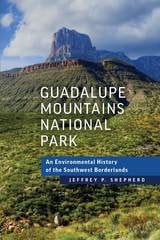
Guadalupe Mountains National Park
An Environmental History of the Southwest BorderlandsJeffrey P. Shepherd
University of Massachusetts Press, 2019
The Guadalupe Mountains stand nearly 9,000 feet tall, spanning the far western fringe of Texas, the border of New Mexico, and the meeting point of the Southern Plains and Chihuahuan Desert. Long an iconic landmark of the Trans-Pecos region, the Guadalupe Mountains have played a critical role for the people in this beautiful corner of the Southwest borderlands. In the late 1960s, the area was finally designated a national park.
Drawing upon published sources, oral histories, and previously unused archival documents, Jeffrey P. Shepherd situates the Guadalupe Mountains and the national park in the context of epic tales of Spanish exploration, westward expansion, Native survival, immigrant settlement, the conservation movement, early tourism, and regional economic development. As Americans cope with climate change, polarized political rhetoric, and suburban sprawl, public spaces such as Guadalupe Mountains National Park remind us about our ties to nature and our historical relationships with the environment.
Drawing upon published sources, oral histories, and previously unused archival documents, Jeffrey P. Shepherd situates the Guadalupe Mountains and the national park in the context of epic tales of Spanish exploration, westward expansion, Native survival, immigrant settlement, the conservation movement, early tourism, and regional economic development. As Americans cope with climate change, polarized political rhetoric, and suburban sprawl, public spaces such as Guadalupe Mountains National Park remind us about our ties to nature and our historical relationships with the environment.
[more]

We are an Indian Nation
A History of the Hualapai PeopleJeffrey P. Shepherd
University of Arizona Press, 2010
Though not as well known as the U.S. military campaigns against the Apache, the ethnic warfare conducted against indigenous people of the Colorado River basin was equally devastating. In less than twenty-five years after first encountering Anglos, the Hualapais had lost more than half their population and nearly all their land and found themselves consigned to a reservation.
This book focuses on the historical construction of the Hualapai Nation in the face of modern American colonialism. Drawing on archival research, interviews, and participant observation, Jeffrey Shepherd describes how thirteen bands of extended families known as The Pai confronted American colonialism and in the process recast themselves as a modern Indigenous nation.
Shepherd shows that Hualapai nation-building was a complex process shaped by band identities, competing visions of the past, creative reactions to modernity, and resistance to state power. He analyzes how the Hualapais transformed an externally imposed tribal identity through nationalist discourses of protecting aboriginal territory; and he examines how that discourse strengthened the Hualapais’ claim to land and water while simultaneously reifying a politicized version of their own history. Along the way, he sheds new light on familiar topics—Indian–white conflict, the creation of tribal government, wage labor, federal policy, and Native activism—by applying theories of race, space, historical memory, and decolonization.
Drawing on recent work in American Indian history and Native American studies, Shepherd shows how the Hualapai have strived to reclaim a distinct identity and culture in the face of ongoing colonialism. We Are an Indian Nation is grounded in Hualapai voices and agendas while simultaneously situating their history in the larger tapestry of Native peoples’ confrontations with colonialism and modernity.
[more]