Results by title
14 books match the query 'Sheridan, Thomas E.'

Arizona
A History, Revised EditionThomas E. Sheridan
University of Arizona Press, 2012
Hailed as a model state history thanks to Thomas E. Sheridan's thoughtful analysis and lively interpretation of the people and events shaping the Grand Canyon State, Arizona has become a standard in the field. Now, just in time for Arizona's centennial, Sheridan has revised and expanded this already top-tier state history to incorporate events and changes that have taken place in recent years. Addressing contemporary issues like land use, water rights, dramatic population increases, suburban sprawl, and the US-Mexico border, the new material makes the book more essential than ever. It successfully places the forty-eighth state's history within the context of national and global events. No other book on Arizona history is as integrative or comprehensive.
From stone spear points more than 10,000 years old to the boom and bust of the housing market in the first decade of this century, Arizona: A History explores the ways in which Native Americans, Hispanics, African Americans, Asians, and Anglos have inhabited and exploited Arizona. Sheridan, a life-long resident of the state, puts forth new ideas about what a history should be, embracing a holistic view of the region and shattering the artificial line between prehistory and history. Other works on Arizona's history focus on government, business, or natural resources, but this is the only book to meld the ethnic and cultural complexities of the state's history into the main flow of the story.
A must read for anyone interested in Arizona's past or present, this extensive revision of the classic work will appeal to students, scholars, and general readers alike.
Contested Ground
Comparative Frontiers on the Northern and Southern Edges of the Spanish EmpireEdited by Donna J. Guy and Thomas E. Sheridan
University of Arizona Press, 1998
Empire of Sand
The Seri Indians and the Struggle for Spanish Sonora, 1645–1803Compiled and edited by Thomas E. Sheridan
University of Arizona Press, 1999
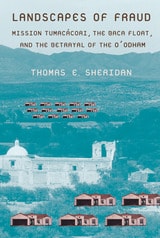
Landscapes of Fraud
Mission Tumacácori, the Baca Float, and the Betrayal of the O’odhamThomas E. Sheridan
University of Arizona Press, 2006
Landscapes of Fraud explores how the penetration of the evolving capitalist world-system created and destroyed communities in the Upper Santa Cruz Valley of Arizona from the late 1600s to the 1970s. Thomas Sheridan has melded history, anthropology, and critical geography to create a penetrating view of greed and power and their lasting effect on those left powerless.
Sheridan first examines how O’odham culture was fragmented by the arrival of the Spanish, telling how autonomous communities moving across landscapes in seasonal rounds were reduced to a mission world of subordination. Sheridan then considers the fate of the Tumacácori grant and Baca Float No. 3, another land grant. He tells the unbroken story of land fraud from Manuel María Gándara’s purchase of the “abandoned” Tumacácori grant at public auction in 1844 through the bankruptcy of the shady real estate developers who had fraudulently promoted housing projects at Rio Rico during the 1960s and ’70s.
As the Upper Santa Cruz Valley underwent a wrenching transition from a landscape of community to a landscape of fraud, the betrayal of the O’odham became complete when land, that most elemental form of human space, was transformed from a communal resource into a commodity bought and sold for its future value. Today, Mission Tumacácori stands as a romantic icon of the past while the landscapes that supported it lay buried under speculative schemes that continue to haunt our history.

Last Water on the Devil's Highway
A Cultural and Natural History of Tinajas AltasBill Broyles, Gayle Harrison Hartmann, Thomas E. Sheridan, Gary Paul Nabhan, and Mary Charlotte Thurtle
University of Arizona Press, 2013
Now an expert cast of authors describes, narrates, and explains the human and natural history of this special place in a thorough and readable account. Addressing the latest archaeological and historical findings, they reveal why Tinajas Altas was so important and how it related to other waterholes in the arid borderlands. Readers can feel like pioneers, following in the footsteps of early Native Americans, Spanish priests and soldiers, gold seekers and borderland explorers, tourists, and scholars.
Combining authoritative writing with a rich array of more than 180 illustrations and maps as well as detailed appendixes providing up-to-date information on the wildlife and plants that live in the area, Last Water on the Devil’s Highway allows readers to uncover the secrets of this fascinating place, revealing why it still attracts intrepid tourists and campers today.
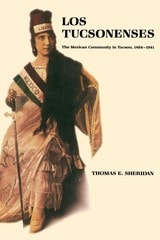
Los Tucsonenses
The Mexican Community in Tucson, 1854–1941Thomas E. Sheridan
University of Arizona Press, 1986
Moquis and Kastiilam
Hopis, Spaniards, and the Trauma of History, Volume I, 1540–1679Edited by Thomas E. Sheridan, Stewart B. Koyiyumptewa, Anton Daughters, Dale S. Brenneman, T. J. Ferguson, Leigh Kuwanwisiwma, and Lee Wayne Lomayestewa
University of Arizona Press, 2015
The editors argue that the Spanish record is incomplete, and only the Hopi perspective can balance the story. The Spanish documentary record (and by extension the documentary record of any European or Euro-American colonial power) is biased and distorted, according to the editors, who assert there are enormous silences about Hopi responses to Spanish missionization and colonization. The only hope of correcting those weaknesses is to record and analyze Hopi oral traditions, which have been passed down from generation to generation, and give voice to Hopi values and Hopi social memories of what was a traumatic period in their past.
Spanish abuses during missionization—which the editors address specifically and directly as the sexual exploitation of Hopi women, suppression of Hopi ceremonies, and forced labor of Hopis—drove Hopis to the breaking point, inspiring a Hopi revitalization that led them to participate in the Pueblo Revolt. Those abuses, the revolt, and the resistance that followed remain as open wounds in Hopi society today.

Moquis and Kastiilam
Hopis, Spaniards, and the Trauma of History, Volume II, 1680–1781Edited by Thomas E. Sheridan, Stewart B. Koyiyumptewa, Anton Daughters, Dale S. Brenneman, T. J. Ferguson, Leigh Kuwanwisiwma, and Lee Wayne Lomayestewa
University of Arizona Press, 2020
The second in a two-volume series, Moquis and Kastiilam, Volume II, 1680–1781 continues the story of the encounter between the Hopis, who the Spaniards called Moquis, and the Spaniards, who the Hopis called Kastiilam, from the Pueblo Revolt in 1680 through the Spanish expeditions in search of a land route to Alta California until about 1781. By comparing and contrasting Spanish documents with Hopi oral traditions, the editors present a balanced presentation of a shared past. Translations of sixteenth-, seventeenth-, and eighteenth-century documents written by Spanish explorers, colonial officials, and Franciscan missionaries tell the perspectives of the European visitors, and oral traditions recounted by Hopi elders reveal the Indigenous experience.
The editors argue that only the Hopi perspective can balance the story recounted in the Spanish documentary record, which is biased, distorted, and incomplete (as is the documentary record of any European or Euro-American colonial power). The only hope of correcting those weaknesses and the enormous silences about the Hopi responses to Spanish missionization and colonization is to record and analyze Hopi oral traditions, which have been passed down from generation to generation since 1540, and to give voice to Hopi values and social memories of what was a traumatic period in their past.
Volume I documented Spanish abuses during missionization, which the editors address specifically and directly as the sexual exploitation of Hopi women, suppression of Hopi ceremonies, and forced labor of Hopi men and women. These abuses drove Hopis to the breaking point, inspiring a Hopi revitalization that led them to participate in the Pueblo Revolt and to rebuff all subsequent efforts to reestablish Franciscan missions and Spanish control. Volume II portrays the Hopi struggle to remain independent at its most effective—a mixture of diplomacy, negotiation, evasion, and armed resistance. Nonetheless, the abuses of Franciscan missionaries, the bloodshed of the Pueblo Revolt, and the subsequent destruction of the Hopi community of Awat’ovi on Antelope Mesa remain historical traumas that still wound Hopi society today.

Paths of Life
American Indians of the Southwest and Northern MexicoEdited by Thomas E. Sheridan and Nancy J. Parezo
University of Arizona Press, 1996

Stitching the West Back Together
Conservation of Working LandscapesEdited by Susan Charnley, Thomas E. Sheridan, and Gary P. Nabhan
University of Chicago Press, 2014
Featuring contributions from an impressive array of scientists, conservationists, scholars, ranchers, and foresters, Stitching the West Back Together explores that expanded, inclusive vision of environmentalism as it delves into the history and evolution of Western land use policy and of the working landscapes themselves. Chapters include detailed case studies of efforts to promote both environmental and economic sustainability, with lessons learned; descriptions of emerging institutional frameworks for conserving Western working landscapes; and implications for best practices and policies crucial to the future of the West’s working forests and rangelands. As economic and demographic forces threaten these lands with fragmentation and destruction, this book encourages a hopeful balance between production and conservation on the large, interconnected landscapes required for maintaining cultural and biological diversity over the longterm.

The Border and Its Bodies
The Embodiment of Risk Along the U.S.-México LineEdited by Thomas E. Sheridan and Randall H. McGuire
University of Arizona Press, 2019
The increasingly militarized U.S.-México border is an intensely physical place, affecting the bodies of all who encounter it. The essays in this volume explore how crossing becomes embodied in individuals, how that embodiment transcends the crossing of the line, and how it varies depending on subject positions and identity categories, especially race, class, and citizenship.
Timely and wide-ranging, this book brings into focus the traumatic and real impact the border can have on those who attempt to cross it, and it offers new perspectives on the effects for rural communities and ranchers. An intimate and profoundly human look at migration, The Border and Its Bodies reminds us of the elemental fact that the border touches us all.
Contributors
Bruce E. Anderson
Jared Beatrice
Rebecca Crocker
Jason De León
Linda Green
Randall H. McGuire
Shaylih Muehlmann
Robin Reineke
Olivia T. Ruiz Marrujo
David Seibert
Thomas E. Sheridan
Angela Soler
Ruth M. Van Dyke
The Presidio and Militia on the Northern Frontier of New Spain
A Documentary History, Volume Two, Part One: The Californias and Sinaloa-Sonora, 1700-1765Edited by Charles W. Polzer and Thomas E. Sheridan
University of Arizona Press, 1997
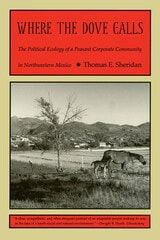
Where the Dove Calls
The Political Ecology of a Peasant Corporate Community in Northwestern MexicoThomas E. Sheridan
University of Arizona Press, 1988
Sheridan has written an ethnography of resource control, one that weds the approaches of political economy and cultural ecology in order to focus upon both the external linkages and internal adaptations that shape three peasant corporate communities. He examines the ecological and economic constraints which scarce and necessary resources place upon households in Cucurpe, and then investigates why many such households have formed corporate communities to insure their access to resources beyond their control. Finally, he identifies the class differences that exist within the corporate communities as well as between members of those organizations and the private ranchers who surround them.
Where the Dove Calls (the meaning of "Cucurpe" in the language of the Opata Indians), an important contribution to peasant studies, reveals the household as the basic unit of Cucurpe society. By viewing Cucurpe's corporate communities as organizations of fiercely independent domestic units rather than as expressions of communal solidarity, Sheridan shows that peasants are among the exploiters as well as the exploited. Cucurpe¤os struggle to maintain the autonomy of their households even as they join together to protect corporate grazing lands and irrigation water. Any attempt to weaken or destroy that independence is met with opposition that ranges from passive resistance to violence.

Zion’s Last Frontier
LDS Ranchers, Federal Regulators, and the Clash of the New West in Capitol Reef Country, UtahThomas E. Sheridan
University of Arizona Press, 2026
Zion’s Last Frontier is a historical ethnography that documents the uniquely Latter-Day Saints (Mormon) ranching community around Capitol Reef National Park in south-central Utah over the last 150 years.
From the arrival of the first LDS pioneers in the 1870s to fifth- and sixth-generation descendants of those pioneers today, anthropologist Thomas E. Sheridan documents their ongoing struggles with the federal and state agencies that control 96 percent of the land they ranch. Changing policies and management philosophies profoundly impact the ranchers’ livelihoods and ways of life. Sheridan argues that the ranchers should qualify as Traditionally Associated People. Only one allotment on the Park remains, but the Park still allows ranchers to drive their cattle on horseback along the few canyons that cut through the Waterpocket Fold as they move their herds from their traditional summer grazing lands to their winter grazing lands.
Pushing beyond binary arguments, Sheridan offers an empathetic look at the lived experiences of rural communities often mischaracterized in debates over public lands and environmentalism. Tensions have been aggravated by a massive increase in the number of tourists that swarm the area in the warmer months and a steady increase in the number of seasonal residents who build second homes there.
Zion’s Last Frontier provides an in-depth look at the clash of cultures between the agrarian Old West and the New West of tourism and second-homers that is playing itself out across so many parts of the rural West today.