Results by title
7 books match the query 'Shipwreck survival'
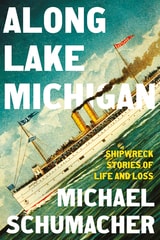
Along Lake Michigan
Shipwreck Stories of Life and LossMichael Schumacher
University of Minnesota Press, 2025
Notable shipwrecks of Lake Michigan throughout a century of enterprise, industry, heroism, and disaster on the Great Lakes
The Great Lakes are graveyards of a vast number of shipwrecks (30,000 by some estimates), and Lake Michigan has more than the other four lakes combined. The stories of those wrecks tell the history of that mighty lake in its endless, mercurial challenge to human endeavor.
Surveying the wreckage throughout the decades, from the fiery end of the twin propeller–driven Phoenix in 1847 to the failure of the Anna Minch to outrun the infamous 1940 Armistice Day storm, Michael Schumacher charts the course of shipping disasters great and small on Lake Michigan. He illuminates the details of maritime weather and shipcraft, the lives devoted to and lost on the water, and the mistakes and monumental failures that led to these ships’ watery ends.
Schumacher’s deft storytelling, drawing from deep research and comprehensive knowledge, brings forth the vivid details of the last minutes of these doomed ships, along with the circumstances surrounding their voyages. Here are tragic tales like that of the Eastland, the deadliest shipwreck in Great Lakes history, lost while docked in the Chicago River; the Rouse Simmons, a wooden schooner loaded with Christmas trees; the train ferry Milwaukee and the Wisconsin, a package freighter, gone within one week of each other in October 1929; and the passenger vessel the Lady Elgin, a devastating loss met with incredible heroism.
Liberally illustrated with historical photographs, the stories of these shipwrecks, spanning a full century of commercial traffic on Lake Michigan, document the myriad forms of bravery and misfortune that mark our encounters with the Great Lakes.
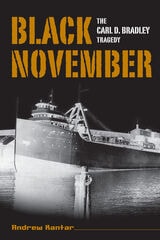
Black November
The Carl D. Bradley TragedyAndrew Kantar
Michigan State University Press, 2006
Michigan’s "storms of November" are famous in song, lore, and legend and have taken a tragic toll, breaking the hulls of many ships and sending them to cold, dark, and silent graves on the bottoms of the Great Lakes. On November 18, 1958, when the limestone carrier Carl D. Bradley broke up during a raging storm on Lake Michigan, it became the largest ship in Great Lakes' history to vanish beneath storm-tossed waves. Along with the Bradley, thirty-three crew members perished. Most of the casualties hailed from the little harbor town of Rogers City, Michigan, a community that was stung with grief when, in an instant, twenty-three women became widows and fifty- three children were left fatherless. Nevertheless, this is also a story of survival, as it recounts the tale of two of the ship’s crew, whose fifteen-hour ordeal on a life raft, in gale-force winds and 25 foot waves, is a remarkable story of endurance and tenacity.
Written in a style that is equally appealing to young adults and adult readers, Black November is a tale of adventure, courage, heroism, and tragedy. Kantar, the author of 29 Missing, a book about the loss of the great lakes freighter the Edmund Fitzgerald, has once again crafted a dramatic narrative that is both informative and compelling. Although the Carl D. Bradley has been called "the ship that time forgot," Black November recalls that tragic day nearly fifty years ago and is a moving tribute to the ship and its crew.
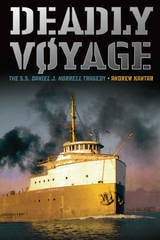
Deadly Voyage
The S.S. Daniel J. Morrell TragedyAndrew Kantar
Michigan State University Press, 2009
This is the harrowing story of one of the worst shipwrecks in Great Lakes history. In the early morning hours of November 29, 1966, the S.S. Daniel J. Morrell was caught in a deadly storm on Lake Huron. Waves higher than the ship crested over it, and winds exceeding sixty miles per hour whipped at its hull, splitting the 603-foot freighter into two giant pieces. Amazingly, after the bow went down, the stern blindly powered itself through the stormy seas for another five miles! Twenty-eight men drowned in the icy waters of Lake Huron, but one sailor—26-year-old Dennis Hale—miraculously survived the treacherous storm. Wearing only boxer shorts, a lifejacket, and a pea coat, Hale clung to a life raft in near-freezing temperatures for 38 hours until he was rescued late in the afternoon of the following day. Three of his fellow crewmates died in his raft.
In Deadly Voyage, Andrew Kantar recounts this tale of tragedy and triumph on Lake Huron. Informed by meticulous research and the eyewitness details provided by Hale, and illustrated with photographs from the Coast Guard search and rescue operation, Kantar depicts one of the most tragic shipwrecks in Great Lakes history.
Surviving the Essex
The Afterlife of America's Most Storied ShipwreckDavid O. Dowling
University Press of New England, 2016

The Life and Strange Surprizing Adventures of Robinson Crusoe
The Stoke Newington EditionDaniel Defoe
Bucknell University Press, 2019
Published by Bucknell University Press. Distributed worldwide by Rutgers University Press.

Too Much Sea for Their Decks
Shipwrecks of Minnesota's North Shore and Isle RoyaleMichael Schumacher
University of Minnesota Press, 2023
Shipwreck stories from along Minnesota’s north shore of Lake Superior and Isle Royale
Against the backdrop of the extraordinary history of Great Lakes shipping, Too Much Sea for Their Decks chronicles shipwrecked schooners, wooden freighters, early steel-hulled steamers, whalebacks, and bulk carriers—some well-known, some unknown or forgotten—all lost in the frigid waters of Lake Superior.
Included are compelling accounts of vessels destined for infamy, such as that of the Stranger, a slender wooden schooner swallowed by the lake in 1875, the sailors’ bodies never recovered nor the wreckage ever found; an account of the whaleback Wilson, rammed by a large commercial freighter in broad daylight and in calm seas, sinking before many on board could escape; and the mysterious loss of the Kamloops, a package freighter that went down in a storm and whose sailors were found on the Isle Royale the following spring, having escaped the wreck only to die of exposure on the island. Then there is the ill-fated Steinbrenner, plagued by bad luck from the time of her construction, when she was nearly destroyed by fire, to her eventual (and tragic) sinking in 1953. These tales and more represent loss of life and property—and are haunting stories of brave and heroic crews.
Arranged chronologically and presented in three sections covering Minnesota's North Shore, Isle Royale, and the three biggest storms in Minnesota’s Great Lakes history (the 1905 Mataafa storm, the 1913 hurricane on the lakes, and the 1940 Armistice Day storm), each shipwreck documented within these pages provides a piece to the history of shipping on Lake Superior.
Torn in Two
The Sinking of the Daniel J. Morrell and One Man's Survival on the Open SeaMichael Schumacher
University of Minnesota Press, 2018
Dennis Hale reached the dock just in time to see the Daniel J. Morrell heading out to open waters, a 600-foot freighter that had plied the waters for sixty years, carrying ore from Minnesota’s Iron Range to steel firms around the Great Lakes. The twenty-six-year-old watchman had, quite literally, missed the boat—which meant scrambling to rejoin the Morrell at its next stop or forfeiting a good chunk of his pay package. Seventy-two hours later, Hale would find himself clinging to a life raft alongside the frozen bodies of his crewmates in the violent waves of Lake Huron. The boat would not be reported missing for another twenty-seven hours and by the time the life raft was found, Dennis Hale would remain as the sole survivor of the wreck of the Daniel J. Morrell.
This is life-and-death drama on the inland sea as only Michael Schumacher can tell it. In Torn in Two the great Lakes historian recreates the circumstances surrounding the terrible storm of November 29, 1966, that broke the mighty freighter in half, sending twenty-five of the Morrell’s twenty-nine-man crew to their deaths and consigning the surviving four to the freezing raft where all but Hale would perish. At the heart of Torn in Two are the terrible hours spent by Hale on the life raft with his crewmen, clinging to life for thirty-eight hours in freezing temperatures and wearing only a peacoat, life jacket, and boxer shorts. The fight to save Hale and find the others, the Coast Guard hearings into what happened, the discovery of the wreckage—Schumacher’s vivid narrative captures every harrowing detail and curious fact of the Morrell’s demise, finally doing justice to this epic shipwreck fifty years past.