Results by title
2 books match the query 'Shkuda, Aaron'
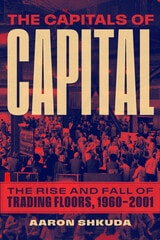
The Capitals of Capital
The Rise and Fall of Trading Floors, 1960–2001Aaron Shkuda
University of Chicago Press, 0
How the transition from physical trading floors to automated ones changed central business districts and urban policy.
Wall Street is defined by the New York Stock Exchange’s headquarters, while the Chicago Board of Trade’s iconic building anchors LaSalle Street in the city’s Loop. These buildings have not moved in a century, but their trading floors have experienced dramatic changes over the past sixty years. While thousands of commuters still work in and around Wall Street, most stocks are traded via computer. Not even the NYSE’s servers are onsite.
The Capitals of Capital charts the rise and dematerialization of stock-exchange trading floors in New York and Chicago, demonstrating how the finance industry has long been entwined with urban planning and development. Aaron Shkuda shows in detail how the industry came to dominate cities both economically and spatially, tracing the demands of firms like Chase Manhattan Bank and the Chicago Mercantile Exchange for larger central facilities, better tax breaks, and other accommodations—until technological developments shifted their priorities from spaces for people to capacity for machines. Shkuda’s history of trading floors reveals financial institutions as change agents in urbanism; through their evolving construction proposals, they forced elected officials, urban planners, architects, and voters to consider the value of trading floors, their significance to a city and its people, and what kind of resources they deserved. Today, as Wall Street towers are converted to apartments and server farms, The Capitals of Capital sheds light on the ever-shifting relationship between the finance industry and urban spaces.
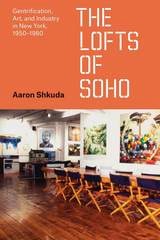
The Lofts of SoHo
Gentrification, Art, and Industry in New York, 1950–1980Aaron Shkuda
University of Chicago Press, 2016
American cities entered a new phase when, beginning in the 1950s, artists and developers looked upon a decaying industrial zone in Lower Manhattan and saw, not blight, but opportunity: cheap rents, lax regulation, and wide open spaces. Thus, SoHo was born. From 1960 to 1980, residents transformed the industrial neighborhood into an artist district, creating the conditions under which it evolved into an upper-income, gentrified area. Introducing the idea—still potent in city planning today—that art could be harnessed to drive municipal prosperity, SoHo was the forerunner of gentrified districts in cities nationwide, spawning the notion of the creative class.
In The Lofts of SoHo, Aaron Shkuda studies the transition of the district from industrial space to artists’ enclave to affluent residential area, focusing on the legacy of urban renewal in and around SoHo and the growth of artist-led redevelopment. Shkuda explores conflicts between residents and property owners and analyzes the city’s embrace of the once-illegal loft conversion as an urban development strategy. As Shkuda explains, artists eventually lost control of SoHo’s development, but over several decades they nonetheless forced scholars, policymakers, and the general public to take them seriously as critical actors in the twentieth-century American city.