Results by title
3 books match the query 'Shock Therapy'
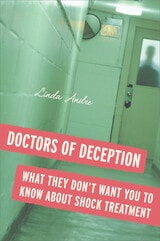
Doctors of Deception
What They Don't Want You to Know about Shock TreatmentAndre, Linda
Rutgers University Press, 2009
Mechanisms and standards exist to safeguard the health and welfare of the patient, but for electroconvulsive therapy (ECT)—used to treat depression and other mental illnesses—such approval methods have failed. Prescribed to thousands over the years, public relations as opposed to medical trials have paved the way for this popular yet dangerous and controversial treatment option.
Doctors of Deception is a revealing history of ECT (or shock therapy) in the United States, told here for the first time. Through the examination of court records, medical data, FDA reports, industry claims, her own experience as a patient of shock therapy, and the stories of others, Andre exposes tactics used by the industry to promote ECT as a responsible treatment when all the scientific evidence suggested otherwise.
As early as the 1940s, scientific literature began reporting incidences of human and animal brain damage resulting from ECT. Despite practitioner modifications, deleterious effects on memory and cognition persisted. Rather than discontinue use of ECT, the $5-billion-per-year shock industry crafted a public relations campaign to improve ECT’s image. During the 1970s and 1980s, psychiatry’s PR efforts misled the government, the public, and the media into believing that ECT had made a comeback and was safe.
Andre carefully intertwines stories of ECT survivors and activists with legal, ethical, and scientific arguments to address issues of patient rights and psychiatric treatment. Echoing current debates about the use of psychopharmaceutical interventions shown to have debilitating side-effects, she candidly presents ECT as a problematic therapy demanding greater scrutiny, tighter control, and full disclosure about its long-term cognitive effects.
[more]
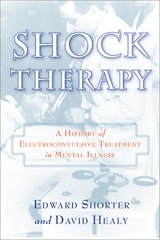
Shock Therapy
A History of Electroconvulsive Treatment in Mental IllnessShorter, Edward
Rutgers University Press, 2007
Shock therapy is making a comeback today in the treatment of serious mental illness. Despite its reemergence as a safe and effective psychiatric tool, however, it continues to be shrouded by a longstanding negative public image, not least due to films such as the classic One Flew over the Cuckoo's Nest, where the inmate of a psychiatric clinic (played by Jack Nicholson) is subjected to electro-shock to curb his rebellious behavior. Beyond its vilification in popular culture, the stereotype of convulsive therapy as a dangerous and inhumane practice is fuelled by professional posturing and public misinformation. Electroconvulsive therapy, or ECT, has in the last thirty years been considered a method of last resort in the treatment of debilitating depression, suicidal ideation, and other forms of mental illness. Yet, ironically, its effectiveness in treating these patients would suggest it as a frontline therapy, bringing relief from acute symptoms and saving lives.
In this book, Edward Shorter and David Healy trace the controversial history of ECT and other "shock" therapies. Drawing on case studies, public debates, extensive interviews, and archival research, the authors expose the myths about ECT that have proliferated over the years. By showing ECT's often life-saving results, Shorter and Healy endorse a point of view that is hotly contested in professional circles and in public debates, but for the nearly half of all clinically depressed patients who do not respond to drugs, this book brings much needed hope.
In this book, Edward Shorter and David Healy trace the controversial history of ECT and other "shock" therapies. Drawing on case studies, public debates, extensive interviews, and archival research, the authors expose the myths about ECT that have proliferated over the years. By showing ECT's often life-saving results, Shorter and Healy endorse a point of view that is hotly contested in professional circles and in public debates, but for the nearly half of all clinically depressed patients who do not respond to drugs, this book brings much needed hope.
[more]
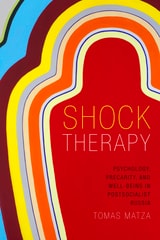
Shock Therapy
Psychology, Precarity, and Well-Being in Postsocialist RussiaTomas Matza
Duke University Press, 2018
After the collapse of the Soviet Union, Russia witnessed a dramatic increase in psychotherapeutic options, which promoted social connection while advancing new forms of capitalist subjectivity amid often-wrenching social and economic transformations. In Shock Therapy Tomas Matza provides an ethnography of post-Soviet Saint Petersburg, following psychotherapists, psychologists, and their clients as they navigate the challenges of post-Soviet life. Juxtaposing personal growth and success seminars for elites with crisis counseling and remedial interventions for those on public assistance, Matza shows how profound inequalities are emerging in contemporary Russia in increasingly intimate ways as matters of selfhood. Extending anthropologies of neoliberalism and care in new directions, Matza offers a profound meditation on the interplay between ethics, therapy, and biopolitics, as well as a sensitive portrait of everyday caring practices in the face of the confounding promise of postsocialist democracy.
[more]