Results by title
8 books match the query 'Short story'
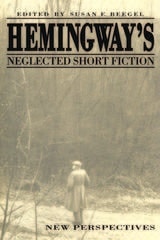
Hemingway's Neglected Short Fiction
New PerspectivesSusan F. Beegel
University of Alabama Press, 1991
“This critical anthology is the result of a brilliant idea….A volume which not only will lead most readers to place more value on a number of stories previously passed over but that will likely extend the reader’s sense of Hemingway’s artistry.” —Studies in American Fiction
Hemingway’s Neglected Short Fiction is a groundbreaking exploration of Ernest Hemingway’s least‑examined stories, works long overshadowed by the towering fame of his novels. The collection reveals how many of Hemingway’s short stories have been cursorily summarized, misread, or simply ignored. Through twenty‑five original essays, leading scholars illuminate the breadth, experimentation, irony, and emotional range found in over thirty stories—tales that challenge the conventional “code hero” paradigm and expose a richer, more complex Hemingway. What emerges is a vivid portrait of an artist whose most overlooked pieces frequently contain his sharpest innovations and deepest moral provocations.
Structured with historical awareness and critical freshness, the volume ranges from Hemingway’s earliest apprentice fiction (“The Mercenaries,” “Up in Michigan,” “My Old Man”) to his experimental, metafictional, or posthumously published works (“A Natural History of the Dead,” “Get a Seeing‑Eyed Dog,” “A Man of the World”). Contributors draw from an impressive range of approaches—rhetorical theory, linguistics, psychoanalysis, semiotics, religious studies, Bakhtinian dialogism, and close textual analysis. Along the way, they revisit stories distorted by biography (“Out of Season,” “Mr. and Mrs. Elliot”), reconsider stories dismissed as trivial (“A Pursuit Race,” “A Day’s Wait”), and restore neglected gems such as “Wine of Wyoming,” “The Sea Change,” and “Homage to Switzerland.”
This book will captivate scholars of modernism, Hemingway specialists, teachers seeking fresh classroom material, and general readers who want to discover the Hemingway hidden between the lines. It is essential reading for anyone interested in the evolution of a major American writer and the vibrant life of the short story form.
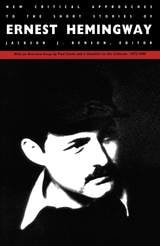
New Critical Approaches to the Short Stories of Ernest Hemingway
Jackson J. Benson, ed.
Duke University Press, 1990
New Critical Approaches to the Short Stories of Ernest Hemingway is an all-new sequel to Benson’s highly acclaimed 1975 book, which provided the first comprehensive anthology of criticism of Ernest Hemingway’s masterful short stories. Since that time the availability of Hemingway’s papers, coupled with new critical and theoretical approaches, has enlivened and enlarged the field of American literary studies. This companion volume reflects current scholarship and draws together essays that were either published during the past decade or written for this collection.
The contributors interpret a variety of individual stories from a number of different critical points of view—from a Lacanian reading of Hemingway’s “After the Storm” to a semiotic analysis of “A Very Short Story” to an historical-biographical analysis of “Old Man at the Bridge.” In identifying the short story as one of Hemingway’s principal thematic and technical tools, this volume reaffirms a focus on the short story as Hemingway’s best work. An overview essay covers Hemingway criticism published since the last volume, and the bibliographical checklist to Hemingway short fiction criticism, which covers 1975 to mid-1989, has doubled in size.
Contributors. Debra A. Moddelmog, Ben Stotzfus, Robert Scholes, Hubert Zapf, Susan F. Beegel, Nina Baym, William Braasch Watson, Kenneth Lynn, Gerry Brenner, Steven K. Hoffman, E. R. Hagemann, Robert W. Lewis, Wayne Kvam, George Monteiro, Scott Donaldson, Bernard Oldsey, Warren Bennett, Kenneth G. Johnston, Richard McCann, Robert P. Weeks, Amberys R. Whittle, Pamela Smiley, Jeffrey Meyers, Robert E. Fleming, David R. Johnson, Howard L. Hannum, Larry Edgerton, William Adair, Alice Hall Petry, Lawrence H. Martin Jr., Paul Smith

Passion and Craft
CONVERSATIONS WITH NOTABLE WRITERSEdited by Bonnie Lyons and Bill Oliver
University of Illinois Press, 1998
Craft go beyond the merely autobiographical, revealing that, despite
their differences, they share passionate devotion and discipline for their
craft.
Included are Richard Ford, winner in 1995 of both the Pulitzer Prize
and the PEN/Faulkner Award; Gina Berriault, 1997 winner of the National
Book Critics Circle Award; Bobbie Ann Mason; T. Coraghessan Boyle; Rick
Bass; Leonard Michaels; Christopher Tilghman; Thom Jones; Julia Alvarez;
Andre Dubus; Jayne Anne Phillips; and Tobias Wolff.
Their comments will interest readers devoted to their novels and stories,
other writers, and aspiring writers.
Short Story Theories
Charles E. May
Ohio University Press, 1977
The essays range from discussions by Poe to comments by John Cheever. Frank O’Connor describes the short story as depicting “an intense awareness of human loneliness,” and Nadine Gordimer suggests that the story is more suitable than the novel in rendering the fragmentary modern experience. Eudora Welty sees the story as something “wrapped in an atmosphere” of its own; Randall Jarrell speaks of the mythic basis of the genre. Elizabeth Bowen and Alberto Moravia discuss thematic and structural distinctions between the novel and the story.
The collection also includes discussions of various types of stories, as satiric and lyric, critical surveys of the development of the modern short story, and the status of the form at the present time. An excellent annotated bibliography is also included, which describes 135 books and articles on the short story, evaluating their contribution to a unified theory of the form.

Stories Of Raymond Carver
A Critical StudyKirk Nesset
Ohio University Press, 1994
In this comprehensive study of Carver, Nesset discusses the relationship of minimalism and postmodern trends and the rise of new realism. By locating Carver in the gallery of American letters, Nesset shows him to be at once more simple and more complex than we might have believed, skillfully laying the groundwork for Carver studies to come.
The New Short Story Theories
Charles E. May
Ohio University Press, 1994
The first edition of May’s Short Story Theories (1976) opened with an essay entitled “The Short Story: An Underrated Art.” Almost two decades later, the short story suffers no such slight. Publishers and critics have become increasingly interested in the form, which has enjoyed a renaissance led by such writers as Raymond Carver, Tobias Wolff, Ann Beattie, Bobbie Ann Mason, and Mary Robison. An important part of this revival of interest, Short Story Theories has continued to attract a strong and loyal audience among students and teachers.
The New Short Story Theories includes a few basic pieces from the earlier volume—Poe’s Hawthorne review, Brander Matthew’s extension and formalization of Poe’s theories, and essays by Randall Jarrell, Elizabeth Bowen, and Nadine Gordimer—but most of the essays are new to the collection.
Addressing problems of definition, historical considerations, issues of technique, and cognitive approaches, essays include:
“The Tale as Genre in Short Story Fiction,” by W. S. Penn
“O. Henry and the Theory of the Short Story,” by Suzanne C. Ferguson
“On Writing,” by Raymond Carver
“From Tale to Short Story,” by Robert F. Marler
“A Cognitive Approach to Storyness,” by Susan Lohafer
May’s new collection will continue to highlight the short story, to provoke debate, and to enrich our experience of a demanding and rewarding literary form.

The Short Fiction Of D.H. Lawrence
Harris, Janice H
Rutgers University Press, 1984
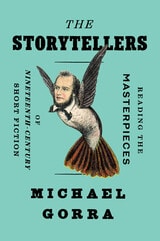
The Storytellers
Reading the Masterpieces of Nineteenth-Century Short FictionMichael Gorra
University of Chicago Press, 2026
Tracing the origins of the modern short story, Michael Gorra provides the first fully realized picture of a century’s worth of great tales.
The Storytellers offers a far-reaching account of the rich tradition of short narratives that flourished in nineteenth-century Europe and America, one that both prepared for and eventually gave way to the modern short story. Tracing unexpected resemblances across languages and decades, Michael Gorra restores a wide-angle view of the form in which works usually treated as stand-alone classics reveal themselves as parts of a single, lively conversation.
What unites these tales, Gorra argues, is their blend of novelty and unity. The book’s heart lies in a series of accessible readings of great tales by Herman Melville, Nikolai Gogol, Ivan Turgenev, E. T. A. Hoffmann, Guy de Maupassant, Nathaniel Hawthorne, Arthur Conan Doyle, Sarah Orne Jewett, Charles Chesnutt, and many more. Beyond its consideration of individual works, The Storytellers examines the formal and thematic concerns that bind the century together: the use of frame tales, accounts of social marginality, and an abundance of ghosts and uncanny coincidences. Over time, Gorra shows, these qualities yielded to a cooler realism, with Anton Chekhov as the key transitional figure. His compressed studies of ordinary lives inspired the modern short story and consigned the gothic flourishes of earlier tales to genre fiction.
What do we want from a story? What makes a tale worth telling? The nineteenth-century tale sought not the grand “meaning of life” promised by the novel, Gorra shows, but sudden revelations from singular events. The Storytellers gives readers an incomparable guide to a vast body of tales that still has the power to thrill and entertain.