Results by title
4 books match the query 'Shot'
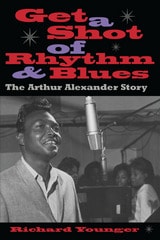
Get a Shot of Rhythm and Blues
The Arthur Alexander StoryRichard Younger
University of Alabama Press, 2000
The first book-length biography of an influential country/soul legend whose songs have been recorded by the Beatles, the Rolling Stones, and Bob Dylan.
Get a Shot of Rhythm and Blues chronicles the rise, fall, and rebirth of Arthur Alexander, an African American singer-songwriter whose music influenced many of the rock and soul musicians of the 1960s. Although his name is not well known today, Alexander's musical legacy is vast. His 1962 song "You Better Move On" was the first hit to emerge from the fledgling Muscle Shoals FAME studio in Alabama, and his fusion of country and soul and his heartfelt vocals on such songs as "Anna (Go to Him)" and "Every Day I Have to Cry" were revered by musicians including the Beatles, the Rolling Stones, and Bob Dylan, all of whom recorded his songs.
Alexander's story is a tragic one, with a brief, redemptive finale. His meteoric rise after the release of "You Better Move On" gave way to lean years caused both by his drug and alcohol abuse and by the mishandling of his career by producers and managers. In 1977, he quit the music business, but his music lived on. In 1992, Alexander returned to
the studio and recorded the critically praised album Lonely Just Like Me. Just three months after the album's release in March 1993, he suffered a heart attack in the offices of his music publisher in Nashville and died three days later.
In telling Alexander's story, Richard Younger captures the burgeoning music scenes in Muscle Shoals and Nashville during the 1960s and 1970s and recovers the life of a fascinating musician whose influence was international. Younger's account is enriched by his interviews with more than 200 artists, family members, and friends--such as Rick Hall, Billy Sherrill, Charlie McCoy, Chuck Jackson, Gerry Marsden, and Kris Kristofferson--and includes an abundance of never-before-seen photographs.
Shot In America
Television, the State, and the Rise of Chicano CinemaChon A. Noriega
University of Minnesota Press, 2000
Redefines media history through Chicano film and television.
One of the most influential figures in ethnic media studies takes direct aim at how Chicano filmmaking has been represented in the history of media in the United States. Shot in America tackles seemingly intractable dilemmas involving the political and market functions of film and TV to provide a definitive response to the debates over cultural and racial identity that have embroiled media and cultural studies over the past two decades.
Noriega offers a compelling and detailed description of an enormous body of work by Chicano media makers against the backdrop of Chicano social movements, politics, and activism over a forty-year period—an extraordinary exposition of the civil rights movement, media reform activities, and public affairs programming that constitutes the prehistory of independent and minority cinemas.Noriega reveals the ways in which Chicano and other minority protests both emerged within and were regulated by the very institutions that excluded them. Shot in America is a study with broad implications for our understanding of cultural politics and the entertainment industries.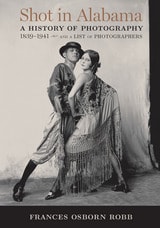
Shot in Alabama
A History of Photography, 1839–1941, and a List of PhotographersFrances Osborn Robb
University of Alabama Press, 2016
A landmark study of vernacular and professional photography, from 1839 to 1941, that frames Alabama’s history through its images.
Shot in Alabama by Frances Osborn Robb is a visual and textual narrative of Alabama’s photographic history from 1839 to 1941. It describes the phenomenon of photography as practiced in Alabama as a major cultural force, paying close attention to the particular contexts from which each image emerges and the fragments of microhistory that each image documents.
Presented chronologically—from the very first photograph ever taken in the state to the appearance of cameras as commonplace possessions in mid-twentieth-century households—Robb draws into sharp relief the eras of daguerreotypes, Civil War photography, photographic portraiture at the end of the nineteenth century, urban and rural photography in the early twentieth century, WPA photography during the Great Depression, postcards and tourist photography, and pre–World War II illustrated books and art photographs. Robb also examines a wide spectrum of vernacular photography: Alabama-made photographs of everyday people and places, the photographs that fill dresser drawers and shoeboxes, a vast array of unusual images against which Alabama’s more typical iconography can be measured.
She also chronicles the work of hundreds of photographers—black and white, amateur and professional, women and men—some little-known outside their communities, some of them the medium’s most important practitioners. “Who Shot Alabama?” is an accompanying appendix that includes 1,400 photographers by name, working dates, and location—a resource that will help countless individuals, families, and archives identify the specific Alabama photographers whose names appear on family photographs or those in institutional collections.
Shot in Alabama is an insightful document of photography as both a communicator and creator of social, cultural, economic, and visual history. It highlights the very personal worlds rendered by individual photographs as well as the larger panorama of Alabama history as seen through the photographs collectively. A landmark work of research, curation, and scholarship, it fills the void of published history on Alabama photography and is an invaluable resource for historians, archivists, librarians, collectors, hobbyists, and readers with an interest in Alabama history or historic photography. Shot in Alabama is a book that all Alabamians will want on their coffee tables.
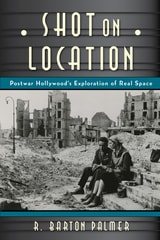
Shot on Location
Postwar American Cinema and the Exploration of Real PlacePalmer, R. Barton
Rutgers University Press, 2016
Renowned film scholar R. Barton Palmer answers this question in Shot on Location by exploring the historical, ideological, economic, and technological developments that led Hollywood to head back outside in order to capture footage of real places. His groundbreaking research reveals that wartime newsreels had a massive influence on postwar Hollywood film, although there are key distinctions to be made between these movies and their closest contemporaries, Italian neorealist films. Considering how these practices were used in everything from war movies like Twelve O’Clock High to westerns like The Searchers, Palmer explores how the blurring of the formal boundaries between cinematic journalism and fiction lent a “reality effect” to otherwise implausible stories.
Shot on Location describes how the period’s greatest directors, from Alfred Hitchcock to Billy Wilder, increasingly moved beyond the confines of the studio. At the same time, the book acknowledges the collaborative nature of moviemaking, identifying key roles that screenwriters, art designers, location scouts, and editors played in incorporating actual geographical locales and social milieus within a fictional framework. Palmer thus offers a fascinating behind-the-scenes look at how Hollywood transformed the way we view real spaces.