Results by title
2 books match the query 'Shotwell, Alexis'

Against Purity
Living Ethically in Compromised TimesAlexis Shotwell
University of Minnesota Press, 2016
The world is in a terrible mess. It is toxic, irradiated, and full of injustice. Aiming to stand aside from the mess can produce a seemingly satisfying self-righteousness in the scant moments we achieve it, but since it is ultimately impossible, individual purity will always disappoint. Might it be better to understand complexity and, indeed, our own complicity in much of what we think of as bad, as fundamental to our lives? Against Purity argues that the only answer—if we are to have any hope of tackling the past, present, and future of colonialism, disease, pollution, and climate change—is a resounding yes. Proposing a powerful new conception of social movements as custodians for the past and incubators for liberated futures, Against Purity undertakes an analysis that draws on theories of race, disability, gender, and animal ethics as a foundation for an innovative approach to the politics and ethics of responding to systemic problems.
Being against purity means that there is no primordial state we can recover, no Eden we have desecrated, no pretoxic body we might uncover through enough chia seeds and kombucha. There is no preracial state we could access, no erasing histories of slavery, forced labor, colonialism, genocide, and their concomitant responsibilities and requirements. There is no food we can eat, clothes we can buy, or energy we can use without deepening our ties to complex webbings of suffering. So, what happens if we start from there?
Alexis Shotwell shows the importance of critical memory practices to addressing the full implications of living on colonized land; how activism led to the official reclassification of AIDS; why we might worry about studying amphibians when we try to fight industrial contamination; and that we are all affected by nuclear reactor meltdowns. The slate has never been clean, she reminds us, and we can’t wipe off the surface to start fresh—there’s no fresh to start. But, Shotwell argues, hope found in a kind of distributed ethics, in collective activist work, and in speculative fiction writing for gender and disability liberation that opens new futures.
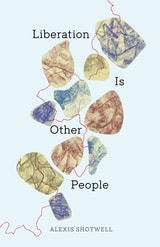
Liberation Is Other People
Alexis Shotwell
University of Minnesota Press, 2026
A compelling call to transform isolation into solidarity and turn shared action into lasting change
Liberation Is Other People offers a bold and timely exploration of how we confront the immense, interconnected challenges of our time. It begins with the truth that many of the crises we face—climate collapse, war, systemic inequality—are human-made and therefore humanly transformable. Yet such “wicked problems” cannot be solved by individuals alone. Every attempt to repair exposes how deeply our lives are entangled across histories of power, privilege, and vulnerability.
Rejecting the idea that personal virtue or guilt can solve the world’s problems, Alexis Shotwell offers a philosophy and practice of collective freedom through collective struggle. Drawing on thinkers such as Angela Davis and Ursula K. Le Guin, she argues that freedom is not the power to act alone but the capacity to shape the world with others. Through sustained engagement with climate politics, white settler responsibility, and the reimagining of sexuality and gender, Liberation Is Other People shows how embracing complicity and acknowledging that none of us stand outside the systems we wish to change can open new possibilities for solidarity and transformation.
Rather than a call to purity or perfection, Liberation Is Other People is a vision of politics as a shared, necessarily imperfect process of creation. Shotwell builds a compelling case that solidarity can be a source of joy, inspiration, and political power. In this age of division and isolation, Shotwell insists that our greatest possibility lies not in fixing the world by our individual selves but in remaking it—together.
Retail e-book files for this title are screen-reader friendly.