Results by title
5 books match the query 'Shrines'
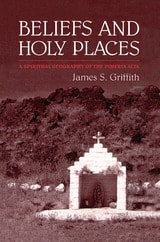
Beliefs and Holy Places
A Spiritual Geography of the Pimería AltaJames S. Griffith
University of Arizona Press, 1992
Folklorist Jim Griffith has lived in the Pimería Alta for more than thirty years, visiting its holy places and attending its fiestas, and has uncovered a background of belief, tradition, and history lying beneath the surface of these cultural expressions. In Beliefs and Holy Places, he reveals some of the supernaturally sanctioned relationships that tie people to places within that region, describing the cultural and religious meanings of locations and showing how bonds between people and places have in turn created relationships between places, a spiritual geography undetectable on physical maps.
Throughout the book, Griffith shows how culture moves from legend to art to belief to practice, all the while serving as a dynamic link between past and future. Now as the desert gives way to newcomers, Griffith's book offers visitors and residents alike a rare opportunity to share in these rich traditions.
Markers and Shrines
Margot Schilpp
Carnegie Mellon University Press, 2025
In Markers and Shrines, Margot Schilpp traces the moments that define us—the losses that strip away our former selves and the resilience that emerges in their wake. These poems illuminate the way the past etches itself onto the future, displaying how experience, no matter how painful, strengthens and redefines us.
With lyrical precision and a musician’s ear for language, Schilpp crafts a world where memory lingers and meaning deepens. Her unembellished eloquence and eye for striking detail turn the everyday into something enlightening, reminding us that even in loss, there is beauty. Markers and Shrines is a reflection on survival and the unseen forces that shape who we become.
Queer Companions
Religion, Public Intimacy, and Saintly Affects in PakistanOmar Kasmani
Duke University Press, 2022
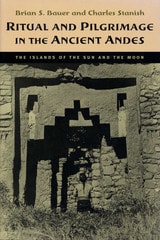
Ritual and Pilgrimage in the Ancient Andes
The Islands of the Sun and the MoonBy Brian S. Bauer and Charles Stanish
University of Texas Press, 2001
The Islands of the Sun and the Moon in Bolivia's Lake Titicaca were two of the most sacred locations in the Inca empire. A pan-Andean belief held that they marked the origin place of the Sun and the Moon, and pilgrims from across the Inca realm made ritual journeys to the sacred shrines there. In this book, Brian Bauer and Charles Stanish explore the extent to which this use of the islands as a pilgrimage center during Inca times was founded on and developed from earlier religious traditions of the Lake Titicaca region.
Drawing on a systematic archaeological survey and test excavations in the islands, as well as data from historical texts and ethnography, the authors document a succession of complex polities in the islands from 2000 BC to the time of European contact in the 1530s AD. They uncover significant evidence of pre-Inca ritual use of the islands, which raises the compelling possibility that the religious significance of the islands is of great antiquity. The authors also use these data to address broader anthropological questions on the role of pilgrimage centers in the development of pre-modern states.
To Take Place
Toward Theory in RitualJonathan Z. Smith
University of Chicago Press, 1987
Smith stresses the importance of place—in particular, constructed ritual environments—to a proper understanding of the ways in which "empty" actions become rituals. He structures his argument around the territories of the Tjilpa aborigines in Australia and two sites in Jerusalem—the temple envisioned by Ezekiel and the Church of the Holy Sepulchre. The first of these locales—the focus of one of the more important contemporary theories of religious ritual—allows Smith to raise questions concerning the enterprise of comparison. His close examination of Eliade's influential interpretation of the Tjilpa tradition leads to a powerful critique of the approach to religion, myth, and ritual that begins with cosmology and the category of "The Sacred."
In substance and in method, To Take Place represents a significant advance toward a theory of ritual. It is of great value not only to historians of religion and students of ritual, but to all, whether social scientists or humanists, who are concerned with the nature of place.
"This book is extraordinarily stimulating in prompting one to think about the ways in which space, or place, is perceived, marked, and utilized religiously. . . . A provocative example of the application of humanistic geography to our understanding of what takes place in religion."—Dale Goldsmith, Interpretation