Results by title
4 books match the query 'Shugaar, Antony'

Life in Peacetime
Francesco Pecoraro
Seagull Books, 0
When Life in Peactime opens, on May 29, 2015, engineer Ivo Brandani is sixty-nine years old. He’s disillusioned and angry—but morbidly attached to life. As he makes a day-long trip home from his job in Sharm el Sheik reconstructing the coral reefs of the Red Sea using synthetics, he reflects on both the brief time he sees remaining ahead and on everything that has happened already in his life to which he can never quite resign himself. We see his slow bureaucratic trudge as a civil servant, long summer vacations on a Greek island, his twisted relationship with his first boss, the turmoil and panic attacks he faced during the student uprisings in 1968 that pushed him away from philosophy and into engineering, and his fearful childhood as a postwar evacuee.
A close-up portrait of an ordinary existence, Life in Peacetime offers a new look at the postwar era in Italy and the fundamental contradictions of a secure, middle-class life.
A close-up portrait of an ordinary existence, Life in Peacetime offers a new look at the postwar era in Italy and the fundamental contradictions of a secure, middle-class life.
[more]
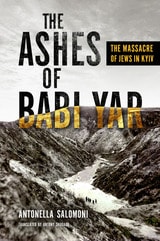
The Ashes of Babi Yar
The Massacre of Jews in KyivAntonella Salomoni, Translated by Antony Shugaar
University of Wisconsin Press, 2025
On September 29 and 30, 1941, in one of the largest mass murders of the Holocaust, German troops massacred 33,771 Jews at the vast gorge located near Kyiv known as Babi Yar (Babij Jar). During and after the war, the territory was modified, redesigned, and converted in order to remove the physical signs of genocide, including the exhumation and incineration of thousands of bodies. In large part this erasure was the result of policies implemented by the Soviet regime, which refused to accept that there had been a “special war” against Jews.
Beginning with an explication of the mass murders and their aftermath, Antonella Salomoni examines the afterlife of a massacre whose physical remains were intentionally hidden. She focuses especially on how the arts—prose, poetry, music, architecture, and painting—shaped a collective narrative that, despite repression, played a crucial role in preserving the history and memory of the genocide.
Beginning with an explication of the mass murders and their aftermath, Antonella Salomoni examines the afterlife of a massacre whose physical remains were intentionally hidden. She focuses especially on how the arts—prose, poetry, music, architecture, and painting—shaped a collective narrative that, despite repression, played a crucial role in preserving the history and memory of the genocide.
[more]
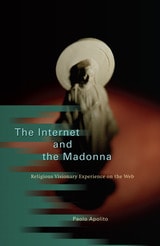
The Internet and the Madonna
Religious Visionary Experience on the WebPaolo Apolito
University of Chicago Press, 2005
In 1994, a devout Catholic woman from Vermont began having religious visions and hearing the voice of the Virgin Mary. To spread word about her mystical experiences, she turned to the Internet. As Paolo Apolito records here, she is only one of many people who use the Web as a tool of religious devotion. Every day, thousands of Catholics—from Italy and Latin America to the United States and Bosnia—use the Internet to describe and celebrate apparitions of Mary, to exchange relics and advice in chat rooms, to make pilgrimages to religious Web sites, and to practice the rites of their faith online.
But how has this potent new mix of technology and religiosity changed the way Catholics view their faith? And what challenges do the autonomous qualities of the Internet pose to the broader authority of Catholicism? Does the democratic nature of access to digital technologies constitute a return to a more archaic and mystical form of Catholicism that predates the modernizing reforms of the Second Vatican Council?
In working through these questions, Apolito considers visions of Mary on the Web over the past two decades, revealing a great deal about religion as it is now experienced through new information technologies. The Internet, he explains, has made possible a decentralized community of the devoted, even as it has absorbed God into the shifts and complexities of electronic circuitry. And this profound development in religious life will only accelerate as use of the Internet spreads around the world.
An indispensable guide to the future of Catholicism, The Internet and the Madonna offers a compelling glimpse into the spiritual life of the connected soul.
[more]
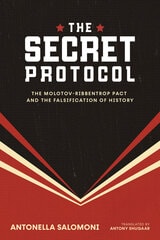
The Secret Protocol
The Molotov-Ribbentrop Pact and the Falsification of HistoryAntonella Salomoni, Translated by Antony Shugaar
University of Wisconsin Press, 2025
In 1939, the Soviet Union and Germany agreed to a nonaggression treaty named for its signatories, foreign ministers Vyacheslav Molotov and Joachim von Ribbentrop. Kept hidden from the public was an addendum to the Molotov-Ribbentrop Pact, a “secret protocol” whose existence was denied by the Soviet Union until 1992. It defined new borders for German and Soviet spheres of influence, effectively preparing for the partition of Poland, the Baltic states, and Bessarabia. Shortly after signing on August 23, 1939, both the USSR and Nazi Germany invaded Poland. In this volume, Antonella Salomoni scrutinizes this consequential document and its afterlives, focusing predominantly on the discourse that surrounded it.
From the moment of the secret protocol’s inception—and the near-instantaneous rumors of its existence—it generated friction and competing narratives. The document became public during the Nuremberg trials, but the USSR declared it a fabrication evidencing the West’s willingness to falsify history. It continues to be relevant to the reconfiguration of history currently advanced by Vladimir Putin. By centering the rumors, accusations, and propaganda the pact precipitated, Salomoni illuminates how political actors can use and abuse history, how they create and disseminate truths and falsehoods, and how they can blur the boundary between facts and fictions even in the glaring face of black-and-white documentation.
From the moment of the secret protocol’s inception—and the near-instantaneous rumors of its existence—it generated friction and competing narratives. The document became public during the Nuremberg trials, but the USSR declared it a fabrication evidencing the West’s willingness to falsify history. It continues to be relevant to the reconfiguration of history currently advanced by Vladimir Putin. By centering the rumors, accusations, and propaganda the pact precipitated, Salomoni illuminates how political actors can use and abuse history, how they create and disseminate truths and falsehoods, and how they can blur the boundary between facts and fictions even in the glaring face of black-and-white documentation.
[more]