Results by title
3 books match the query 'Siano, Pierluigi'
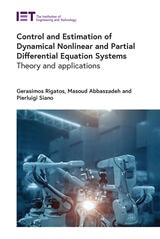
Control and Estimation of Dynamical Nonlinear and Partial Differential Equation Systems
Theory and applicationsGerasimos Rigatos
The Institution of Engineering and Technology, 2022
Robotic and mechatronic systems, autonomous vehicles, electric power systems and smart grids, as well as manufacturing and industrial production systems can exhibit complex nonlinear dynamics or spatio-temporal dynamics which need to be controlled to ensure good functioning and performance.
[more]
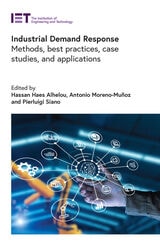
Industrial Demand Response
Methods, best practices, case studies, and applicationsHassan Haes Alhelou
The Institution of Engineering and Technology, 2022
Demand response (DR) describes controlled changes in the power consumption of an electric load to better match the power demand with the supply. This helps with increasing the share of intermittent renewables like solar and wind, thus ensuring use of the generated clean power and reducing the need for storage capacity.
[more]
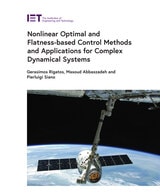
Nonlinear Optimal and Flatness-based Control Methods and Applications for Complex Dynamical Systems
Gerasimos Rigatos
The Institution of Engineering and Technology, 2025
Robotics, mechatronics and autonomous systems can exhibit complex nonlinear dynamics which can lead to unsatisfactory transients and deviation from setpoints or even to instability. A standard approach in the control of these systems had been the concept of diffeomorphisms to bring a system into a linear form. However, these methods are not straightforward and result in complicated state-space model transformations. In this monograph, new methods have been investigated which are not constrained by the shortcomings of global linearization-based control schemes. They can be implemented in a computationally simple manner, are followed by global stability proofs, and perform better than previous optimal control approaches for a wider class of nonlinear dynamical systems and applications.
[more]