Results by title
3 books match the query 'Sicherman, Barbara'
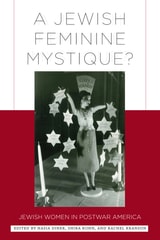
A Jewish Feminine Mystique?
Jewish Women in Postwar AmericaEdited by Hasia R. Diner, Shira Kohn, and Rachel Kranson
Rutgers University Press, 2010
In The Feminine Mystique, Jewish-raised Betty Friedan struck out against a postwar American culture that pressured women to play the role of subservient housewives. However, Friedan never acknowledged that many American women refused to retreat from public life during these years. Now, A Jewish Feminine Mystique? examines how Jewish women sought opportunities and created images that defied the stereotypes and prescriptive ideology of the "feminine mystique."
As workers with or without pay, social justice activists, community builders, entertainers, and businesswomen, most Jewish women championed responsibilities outside their homes. Jewishness played a role in shaping their choices, shattering Friedan's assumptions about how middle-class women lived in the postwar years. Focusing on ordinary Jewish women as well as prominent figures such as Judy Holliday, Jennie Grossinger, and Herman Wouk's fictional Marjorie Morningstar, leading scholars explore the wide canvas upon which American Jewish women made their mark after the Second World War.
As workers with or without pay, social justice activists, community builders, entertainers, and businesswomen, most Jewish women championed responsibilities outside their homes. Jewishness played a role in shaping their choices, shattering Friedan's assumptions about how middle-class women lived in the postwar years. Focusing on ordinary Jewish women as well as prominent figures such as Judy Holliday, Jennie Grossinger, and Herman Wouk's fictional Marjorie Morningstar, leading scholars explore the wide canvas upon which American Jewish women made their mark after the Second World War.
[more]
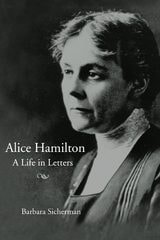
Alice Hamilton
A LIFE IN LETTERSBarbara Sicherman
University of Illinois Press, 2003
Alice Hamilton (1869-1970), a pioneer in the study of diseases of the workplace, a founder of industrial toxicology in the United States, and Harvard's first woman professor, led a long and interesting life. Always a consummate professional, she was also a prominent social reformer whose interest in the environmental causes of disease and in promoting equitable living conditions developed during her years as a resident at Jane Addams's Hull-House.
This legendary figure now comes to life in an integrated work of biography and letters that reveals the personal as well as the professional woman. In documenting Hamilton's evolution from a childhood of privilege to a life of social advocacy, the volume opens a window on women reformers and their role in Progressive Era politics and reform. Because Hamilton was a keen observer and vivid writer, her letters--more than 100 are included here--bring an unmatched freshness and immediacy to a range of subjects, such as medical education; personal relationships and daily life at Hull House; the women's peace movement; struggles for the protection of workers' health; academic life at Harvard; politics and civil liberties during the cold war; and the process of growing old. Her story takes the reader from the Gilded Age to the Vietnam War.
This legendary figure now comes to life in an integrated work of biography and letters that reveals the personal as well as the professional woman. In documenting Hamilton's evolution from a childhood of privilege to a life of social advocacy, the volume opens a window on women reformers and their role in Progressive Era politics and reform. Because Hamilton was a keen observer and vivid writer, her letters--more than 100 are included here--bring an unmatched freshness and immediacy to a range of subjects, such as medical education; personal relationships and daily life at Hull House; the women's peace movement; struggles for the protection of workers' health; academic life at Harvard; politics and civil liberties during the cold war; and the process of growing old. Her story takes the reader from the Gilded Age to the Vietnam War.
[more]
The Girls' History and Culture Reader
The Nineteenth CenturyEdited by Miriam Forman-Brunell and Leslie Paris
University of Illinois Press, 2011
The Girls' History and Culture Reader: The Nineteenth Century provides scholars, instructors, and students with the most influential essays that have defined the field of American girls' history and culture. A relatively new and energetic field of inquiry, girl-centered research is critical for a fuller understanding of women and gender, a deeper consideration of childhood and adolescence, and a greater acknowledgment of the significance of generation as a historical force in American culture and society.
Bringing together work from top scholars of women and youth, The Girls' History and Culture Reader: The Nineteenth Century addresses topics ranging from diary writing and toys to prostitution and slavery. Covering girlhood and the relationships between girls and women, this pioneering volume tackles pivotal themes such as education, work, play, sexuality, consumption, and the body. The reader also illuminates broader nineteenth-century developments—including urbanization, industrialization, and immigration--through the often-overlooked vantage point of girls. As these essays collectively suggest, nineteenth-century girls wielded relatively little political or social power but carved out other spaces of self-expression.
Contributors are Carol Devens, Miriam Forman-Brunell, Jane H. Hunter, Anya Jabour, Anne Scott MacLeod, Susan McCully, Mary Niall Mitchell, Leslie Paris, Barbara Sicherman, Carroll Smith-Rosenberg, Christine Stansell, Nancy M. Theriot, and Deborah Gray White.
[more]