Results by title
2 books match the query 'Sieder, Rachel'
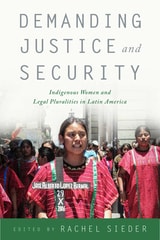
Demanding Justice and Security
Indigenous Women and Legal Pluralities in Latin AmericaSieder, Rachel
Rutgers University Press, 2017
Across Latin America, indigenous women are organizing to challenge racial, gender, and class discrimination through the courts. Collectively, by engaging with various forms of law, they are forging new definitions of what justice and security mean within their own contexts and struggles. They have challenged racism and the exclusion of indigenous people in national reforms, but also have challenged ‘bad customs’ and gender ideologies that exclude women within their own communities.
Featuring chapters on Bolivia, Colombia, Ecuador, Guatemala, and Mexico, the contributors to Demanding Justice and Security include both leading researchers and community activists. From Kichwa women in Ecuador lobbying for the inclusion of specific clauses in the national constitution that guarantee their rights to equality and protection within indigenous community law, to Me’phaa women from Guerrero, Mexico, battling to secure justice within the Inter-American Court of Human Rights for violations committed in the context of militarizing their home state, this book is a must-have for anyone who wants to understand the struggle of indigenous women in Latin America.
Featuring chapters on Bolivia, Colombia, Ecuador, Guatemala, and Mexico, the contributors to Demanding Justice and Security include both leading researchers and community activists. From Kichwa women in Ecuador lobbying for the inclusion of specific clauses in the national constitution that guarantee their rights to equality and protection within indigenous community law, to Me’phaa women from Guerrero, Mexico, battling to secure justice within the Inter-American Court of Human Rights for violations committed in the context of militarizing their home state, this book is a must-have for anyone who wants to understand the struggle of indigenous women in Latin America.
[more]

The Rule of Law in Latin America
The International Promotion of Judicial ReformEdited by Pilar Domingo and Rachel Sieder
University of London Press, 2001
This volume analyzes the judicial reform processes funded by international donor organizations in Latin America. As billions of dollars are spent on judicial reform, it is pertinent to ask about the fate of these projects. The authors examine the way in which international organizations rationalize and prioritize their reform proposals and agenda in Latin America; how reform agendas are implemented and followed up (or not); how international donor organizations relate to national governments and civil society, and to each other; and what factors account for the successes and failures of their reform initiatives. The book also addresses the question of the connection between rule of law reform and broader processes of regime consolidation and state building, from both a political and a social perspective.
[more]