Results by title
19 books match the query 'Sierra Leone'

African Entrepreneurship
Muslim Fula Merchants in Sierra LeoneAlusine Jalloh
Ohio University Press, 1999
Departing from the prevailing scholarship, Jalloh characterizes the Fula businesses as independent, rather than appendages of Western expatriate commerce. In addition to establishing successful businesses, Fula merchants established Islamic educational institutions for propogating the Muslim faith and promoting Islamic scholarship.
This study also examines the evolution of Fula chieftaincy from the colonial era to the postcolonial period and documents the importance of mercantile wealth and networks in the election of Fula chiefs in Freetown. African Entrepreneurship makes an important contribution to the understudied role of African business in Sierra Leone.
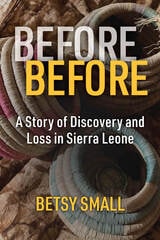
Before Before
A Story of Discovery and Loss in Sierra LeoneBetsy Small
University of Michigan Press, 2025
2025 Foreword INDIES Finalist for Political and Social Sciences
- 2026 Nautilus Silver Book Award in World Cultures' Transformational Growth & Development
Sierra Leone is often sensationalized as a place of extreme violence and suffering—of blood diamonds, child soldiers, war amputations, and Ebola and now the highly addictive drug Kush. Before Before captures daily life in a different country, one Betsy Small first encountered as a Peace Corps worker between 1984–1987, and then rediscovered when she returned decades later with her daughter. Living in Tokpombu, a remote community of forty rice-farming families, the author faced struggles that changed her forever and witnessed the growing tensions in this rainforest village—between the young and old, between the traditions of oral history and honoring the ancestors valued by the elders and the siren call of the illicit diamond mines faced by the youth.
Before Before offers a rare portrait of everyday people, with particular focus on the lives of women and girls, before the brutal war of 1991 tore the country apart. Through Small’s account of immersion in another world as she witnessed injustice and was welcomed as a friend, readers are invited to explore the shared ground of our humanity.

Captain Paul Cuffe, Yeoman
A BiographyJeffrey A. Fortin
University of Massachusetts Press, 2024
Paul Cuffe is best understood as a member of the Black founding fathers—a group of pre-eminent African Americans who built institutions and movements during the first decades of the United States. While he is known amongst scholars, his astounding life story deserves a much wider audience. Jeffrey A. Fortin has crafted a beautiful, moving portrait of this important maritime figure that will appeal to anyone interested in early American history and who loves great story telling.
Born on Cuttyhunk Island, Massachusetts in 1759 to a formerly enslaved African father and a Wampanoag Indian mother, Cuffe emerged from anonymity to become the most celebrated African-American sea captain during the Age of Sail. An abolitionist, veteran, and community activist, celebrity followed Cuffe as he built a shipping empire that traded both in American coastal waters and across the wider Atlantic Ocean. Cuffe and his Black crews shook the foundations of systemic racism, challenging norms by sailing into Charleston and other ports where slavery was legal, and thus demonstrating that business and profits were more powerful than social limitations. He founded America’s first racially integrated school in Westport, Massachusetts, and is considered the leader of the nation’s first back-to-Africa movement. Newspapers in England, the United States, and the Caribbean reported his whereabouts and adventures, and abolitionists hailed him for his Quaker beliefs, sobriety, and commitment to advancing opportunities for persons of African descent.
Drawing on pamphlets, letters, and other documents, and painstakingly reconstructing his genealogy, Fortin vividly describes Cuffe’s experiences and places them within the broader history of the Early Republic to help reveal the central role of African Americans in the founding of the United States. Unlike previous biographies, Fortin situates Cuffe within an Atlantic world where race and identity were fluid, and Africans and African Americans sought to build and govern a free Black nation in West Africa.
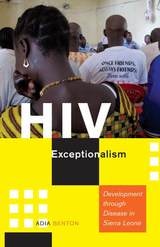
HIV Exceptionalism
Development through Disease in Sierra LeoneAdia Benton
University of Minnesota Press, 2015
WINNER, 2017 RACHEL CARSON PRIZE, SOCIETY FOR THE SOCIAL STUDIES OF SCIENCE
In 2002, Sierra Leone emerged from a decadelong civil war. Seeking international attention and development aid, its government faced a dilemma. Though devastated by conflict, Sierra Leone had a low prevalence of HIV. However, like most African countries, it stood to benefit from a large influx of foreign funds specifically targeted at HIV/AIDS prevention and care.
What Adia Benton chronicles in this ethnographically rich and often moving book is how one war-ravaged nation reoriented itself as a country suffering from HIV at the expense of other, more pressing health concerns. During her fieldwork in the capital, Freetown, a city of one million people, at least thirty NGOs administered internationally funded programs that included HIV/AIDS prevention and care. Benton probes why HIV exceptionalism—the idea that HIV is an exceptional disease requiring an exceptional response—continues to guide approaches to the epidemic worldwide and especially in Africa, even in low-prevalence settings.
In the fourth decade since the emergence of HIV/AIDS, many today are questioning whether the effort and money spent on this health crisis has in fact helped or exacerbated the problem. HIV Exceptionalism does this and more, asking, what are the unanticipated consequences that HIV/AIDS development programs engender?
How Lifeworlds Work
Emotionality, Sociality, and the Ambiguity of BeingMichael Jackson
University of Chicago Press, 2017
In How Lifeworlds Work, Jackson draws on years of ethnographic fieldwork in West Africa to highlight the dynamic quality of human relationships and reinvigorate the study of kinship and ritual. How, he asks, do we manage the perpetual process of accommodation between social norms and personal emotions, impulses, and desires? How are these two dimensions of lived reality joined, and how are the dual imperatives of individual expression and collective viability managed? Drawing on the pragmatist tradition, psychology, and phenomenology, Jackson offers an unforgettable, beautifully written account of how we make, unmake, and remake, our lifeworlds.
In Sierra Leone
Michael Jackson
Duke University Press, 2004
Though the Revolutionary United Front (R.U.F.) ostensibly fought its war (1991–2002) against corrupt government, the people of Sierra Leone were its victims. By the time the war was over, more than fifty thousand were dead, thousands more had been maimed, and over one million were displaced. Jackson relates the stories of political leaders and ordinary people trying to salvage their lives and livelihoods in the aftermath of cataclysmic violence. Combining these with his own knowledge of African folklore, history, and politics and with S. B.’s bittersweet memories—of his family’s rich heritage, his imprisonment as a political detainee, and his position in several of Sierra Leone’s post-independence governments—Jackson has created a work of elegiac, literary, and philosophical power.
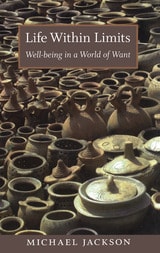
Life Within Limits
Well-being in a World of WantMichael Jackson
Duke University Press, 2011
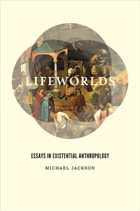
Lifeworlds
Essays in Existential AnthropologyMichael Jackson
University of Chicago Press, 2012
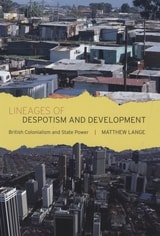
Lineages of Despotism and Development
British Colonialism and State PowerMatthew Lange
University of Chicago Press, 2009
Traditionally, social scientists have assumed that past imperialism hinders the future development prospects of colonized nations. Challenging this widespread belief, Matthew Lange argues in Lineages of Despotism and Development that countries once under direct British imperial control have developed more successfully than those that were ruled indirectly.
Combining statistical analysis with in-depth case studies of former British colonies, this volume argues that direct rule promoted cogent and coherent states with high levels of bureaucratization and inclusiveness, which contributed to implementing development policy during late colonialism and independence. On the other hand, Lange finds that indirect British rule created patrimonial, weak states that preyed on their own populations. Firmly grounded in the tradition of comparative-historical analysis while offering fresh insight into the colonial roots of uneven development, Lineages of Despotism and Development will interest economists, sociologists, and political scientists alike.
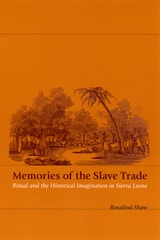
Memories of the Slave Trade
Ritual and the Historical Imagination in Sierra LeoneRosalind Shaw
University of Chicago Press, 2002
Drawing on extensive fieldwork and archival research, Shaw argues that memories of the slave trade have shaped (and been reshaped by) experiences of colonialism, postcolonialism, and the country's ten-year rebel war. Thus money and commodities, for instance, are often linked to an invisible city of witches whose affluence was built on the theft of human lives. These ritual and visionary memories make hitherto invisible realities manifest, forming a prism through which past and present mutually configure each other.
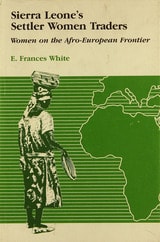
Sierra Leone's Settler Women Traders
Women on the Afro-European FrontierE. Frances White
University of Michigan Press, 1987
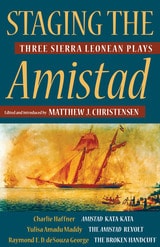
Staging the Amistad
Three Sierra Leonean PlaysCharlie Haffner
Ohio University Press, 2019

Testimony
Found Poems from the Special Court for Sierra LeoneShanee Stepakoff
Bucknell University Press, 2021
Sierra Leone’s devastating civil war barely caught the attention of Western media, but it raged on for over a decade, bringing misery to millions of people in West Africa from 1991 to 2002. The atrocities committed in this war and the accounts of its survivors were duly recorded by international organizations, but they run the risk of being consigned to dusty historical archives.
Derived from public testimonies at a UN-backed war crimes tribunal in Freetown, this remarkable poetry collection aims to breathe new life into the records of Sierra Leone’s civil war, delicately extracting heartbreaking human stories from the morass of legal jargon. By rendering selected trial transcripts in poetic form, Shanee Stepakoff finds a novel way to communicate not only the suffering of Sierra Leone’s people, but also their courage, dignity, and resilience. Her use of innovative literary techniques helps to ensure that the voices of survivors are not forgotten, but rather heard across the world.
This volume also includes an introduction that explores how the genre of “found poetry” can serve as a uniquely powerful means through which writers may bear witness to atrocity. This book’s unforgettable excavation and shaping of survivor testimonies opens new possibilities for speaking about the unspeakable.
The Genealogical Imagination
Two Studies of Life over TimeMichael Jackson
Duke University Press, 2021
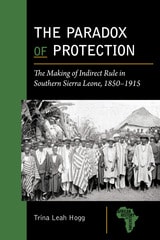
The Paradox of Protection
The Making of Indirect Rule in Southern Sierra Leone, 1850–1915Trina Leah Hogg
Michigan State University Press, 2025
The War Machines
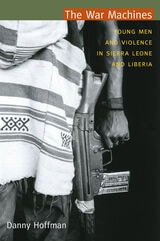
Young Men and Violence in Sierra Leone and LiberiaDanny Hoffman
Duke University Press, 2011
Hoffman argues that in contemporary West Africa, space, sociality, and life itself are organized around making young men available for all manner of dangerous work. Drawing on his ethnographic research over the past nine years, as well as the anthropology of violence, interdisciplinary security studies, and contemporary critical theory, he maintains that the mobilization of West African men exemplifies a global trend in the outsourcing of warfare and security operations. A similar dynamic underlies the political economy of violence in Iraq, Afghanistan, and a growing number of postcolonial spaces. An experienced photojournalist, Hoffman integrates more than fifty of his photographs of young West Africans into The War Machines.
Unraveling of Civil Society
Peacebuilding, Health Crises, and Aid in Twenty-First-Century Guinea and Sierra LeoneMichelle Reddy
Ohio University Press, 2026
In recent years, the capacity of civil society to respond to crises has been increasingly constrained by rising authoritarianism. Yet in West Africa, where civil society has historically played a pivotal role in democratization, this trend reveals deeper structural challenges. Unraveling of Civil Society examines how international aid strategies emphasizing technical capacity and professionalization have inadvertently contributed to the politicization and fragmentation of civil society in Guinea and Sierra Leone.
Drawing on extensive fieldwork—including interviews with representatives of more than a hundred locally led organizations, analysis of 260 strategic plans, and collection of cross-national survey data—this book offers a rare longitudinal and comparative study of civil society in the region. It traces how donor-driven models have led organizations to become sector specific, mimic donor institutions, or align with political interests—ultimately reducing organizational diversity and weakening the social infrastructure necessary for collective action and crisis resilience.
The book situates these findings within broader debates on democratic backsliding, noting that three of the nine countries that transitioned to autocracy between 2021 and 2023—Guinea, Chad, and Mali—are in West Africa. Despite significant international investment, “coup culture” and unconstitutional power shifts have resurged, raising urgent questions about the effectiveness of aid and the role of civil society in sustaining democratic norms.
Combining comparative historical analysis with a mixed-methods approach, Unraveling of Civil Society challenges prevailing assumptions about capacity building and offers practical recommendations for democratizing local organizations from within. It advocates for participatory governance and funding mechanisms and engages with ongoing conversations around the localization and decolonization of aid in a shifting geopolitical landscape.
This book is essential reading for scholars of African studies, political science, development studies, and global civil society as well as for practitioners in crisis management and political reform.
Urban Transformations in Sierra Leone
Knowledge Co-Production and Partnerships for a Just CityEdited by Joseph M. Macarthy, Braima Koroma, Andrea Rigon, Alexandre Apsan Frediani, and Andrea Klingel
University College London, 2024
With a population of over one million, Freetown, Sierra Leone faces serious challenges with service provisions, housing, infrastructure, employment, and climate change. In 2015, the Sierra Leone Urban Research Centre (SLURC) was established to address these challenges through research, capacity building, and advocacy. Urban Transformations in Sierra Leone shares SLURC’s progress, articulating its key findings and reflections on the partnerships it helped enable.

When the State Fails
Studies on Intervention in the Sierra Leone Civil WarTunde Zack-Williams
Pluto Press, 2012
Compared with Iraq, Afghanistan and Kosovo, the recent western intervention in Sierra Leone has been largely forgotten. When the State Fails rectifies this, providing a comprehensive and critical analysis of the intervention.
The civil war in Sierra Leone began in 1991 and was declared officially over in 2002 after UK, UN and regional African military intervention. Some claimed it as a case of successful humanitarian intervention. The authors in this collection provide an informed analysis of the impact of the intervention on democracy, development and society in Sierra Leone. The authors take a particularly critical view of the imposition of neoliberalism after the conflict.
As NATO intervention in Libya shows the continued use of external force in internal conflicts, When the State Fails is a timely book for all students and scholars interested in Africa and the question of ‘humanitarian intervention’.