Results by title
5 books match the query 'Silences'
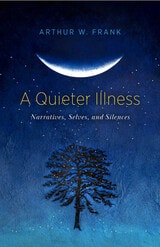
A Quieter Illness
Narratives, Selves, and SilencesArthur W. Frank
University of Chicago Press, 0
In this sequel to The Wounded Storyteller, Arthur W. Frank reminds us of the power of narrative in the lives of ill people and those who care for them.
The Wounded Storyteller became a classic by witnessing the voices of ill people, recognizing how they express themselves in three prevalent narratives: restitution stories, evocations of chaos, and quest stories. Thirty years later, Frank expands this framework. He proposes a fourth narrative: one that seeks no restitution, claims no quest, yet feels no chaos—the stillness narrative. This story allows us to see more clearly our interdependence as well as the wisdom of uncertainty; it also teaches the value of letting go and waiting.
In the stillness narrative, Frank finds new opportunities for dialogue with clinical professionals. They too need healing, and healing moments occur when everyone recognizes their mutual, if asymmetrical, dependence. As Frank tells the stories that won’t leave him, he guides readers toward understanding how the stories they tell and hear affect their capacity to heal both themselves and others.

Omertà
A Book of SilencesAndrea Tompa
Seagull Books, 2024
A rural area not far from the city of Cluj-Napoca, a former Hungarian province that has been part of Romania since 1920. World War II has ended and the region is under the firm clasp of Stalinist collectivization. In the atmospheric village of Kolozsvár, Omertà unfolds a riveting tale through four poignant perspectives, each peeling back the layers of its central characters’ lives against the backdrop of a tumultuous Eastern Europe in the mid-twentieth century.
Kali, a peasant woman, escapes an abusive marriage to embark on a transformative journey to Kolozsvár, seeking refuge and purpose. She is employed as a maid by Vilmos, a reluctant Communist Party member with an unwavering dedication to his garden. As Vilmos’s botanical brilliance attracts the state’s attention, a clash between personal desires and political obligations ensues. Annush, the third narrator, a lovestruck teenager, becomes entangled in a complex web of emotions, grappling with love, loss, and the evolving landscape of her homeland. The tale deepens with Eleonora, who, seeking solace in a monastery, becomes a casualty of political purges and the suppression of religious faith under Romania’s oppressive regime.
In this epic novel, Romanian-born Hungarian author Andrea Tompa skillfully intertwines these tales, shedding light on the injustices and corruption of a regime that sought to extinguish cultural identities. The lives of Kali, Vilmos, Annush, and Eleonora weave a tapestry of love, resilience, the virtue of roses, and the quiet strength required to endure in the face of political turmoil.
Silences
Martha Ronk
Omnidawn, 2019
These poems endeavor to give a much-deserved voice to silence, addressing the power of what is not seen. While silence remains perpetually out of reach, Ronk invites us to follow the language that creeps up to its edges. The poems in this collection form an inquiry that moves through the presence of silence and reveals insights into the character of the visual art in which it lives.

The Silences of Hammerstein
Hans Magnus Enzensberger
Seagull Books, 2009
The Silences of Hammerstein, the latest work from one of Germany’s most significant contemporary authors, engages readers with a blend of a documentary, collage, narration, and fictional interviews. The gripping plot revolves around the experiences of real-life German General Kurt von Hammerstein and his wife and children. A member of an old military family, a brilliant staff officer, and the last commander of the German army before Hitler seized power, Hammerstein, who died in 1943 before Hitler’s defeat, was nevertheless an idiosyncratic character. Too old to be a resister, he retained an independence of mind that was shared by his children: three of his daughters joined the Communist Party, and two of his sons risked their lives in the July 1944 Plot against Hitler and were subsequently on the run till the end of the war. Hammerstein never criticized his children for their activities, and he maintained contacts with the Communists himself and foresaw the disastrous end of Hitler’s dictatorship.
In The Silences of Hammerstein, Hans Magnus Enzensberger offers a brilliant and unorthodox account of the military milieu whose acquiescence to Nazism consolidated Hitler’s power and of the heroic few who refused to share in the spoils.
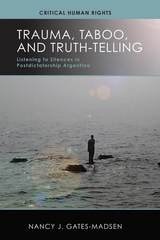
Trauma, Taboo, and Truth-Telling
Listening to Silences in Postdictatorship ArgentinaNancy J. Gates-Madsen
University of Wisconsin Press, 2018
Nancy J. Gates-Madsen reads between the lines of Argentine cultural texts (fiction, drama, testimonial narrative, telenovela, documentary film) to explore the fundamental role of silence—the unsaid—in the expression of trauma. Her careful examination of the interplay between textual and contextual silences illuminates public debate about the meaning of memory in Argentina—which stories are being told and, more important, which are being silenced. The imposition of silence is not limited to the military domain or its apologists, she shows; the human rights community also perpetuates and creates taboos.