Results by title

8 books match the query 'Silver'

cover of Controlling the Silver

Controlling the Silver

Lorna Goodison

University of Illinois Press, 2004
Renowned poet Lorna Goodison has written a new collection of elegies and praise songs which explore the close link between history and genealogy in the Caribbean experience. Her subjects range from the economic genius of market women to the complex beauty of the natural world.
 
[more]
cover of From Silver to Cocaine: Latin American Commodity Chains and the Building of the World Economy, 1500-2000

From Silver to Cocaine

Latin American Commodity Chains and the Building of the World Economy, 1500-2000

Steven Topik, Carlos Marichal, and Zephyr Frank, eds.

Duke University Press, 2006

Demonstrating that globalization is a centuries-old phenomenon, From Silver to Cocaine examines the commodity chains that have connected producers in Latin America with consumers around the world for five hundred years. In clear, accessible essays, historians from Latin America, England, and the United States trace the paths of many of Latin America’s most important exports: coffee, bananas, rubber, sugar, tobacco, silver, henequen (fiber), fertilizers, cacao, cocaine, indigo, and cochineal (insects used to make dye). Each contributor follows a specific commodity from its inception, through its development and transport, to its final destination in the hands of consumers. The essays are arranged in chronological order, according to when the production of a particular commodity became significant to Latin America’s economy. Some—such as silver, sugar, and tobacco—were actively produced and traded in the sixteenth century; others—such as bananas and rubber—only at the end of the nineteenth century; and cocaine only in the twentieth.

By focusing on changing patterns of production and consumption over time, the contributors reconstruct complex webs of relationships and economic processes, highlighting Latin America’s central and interactive place in the world economy. They show how changes in coffee consumption habits, clothing fashions, drug usage, or tire technologies in Europe, Asia, and the Americas reverberate through Latin American commodity chains in profound ways. The social and economic outcomes of the continent’s export experience have been mixed. By analyzing the dynamics of a wide range of commodities over a five-hundred-year period, From Silver to Cocaine highlights this diversity at the same time that it provides a basis for comparison and points to new ways of doing global history.

Contributors. Marcelo Bucheli, Horacio Crespo, Zephyr Frank, Paul Gootenberg, Robert Greenhill, Mary Ann Mahony, Carlos Marichal, David McCreery, Rory Miller, Aldo Musacchio, Laura Nater, Ian Read, Mario Samper, Steven Topik, Allen Wells
[more]
cover of Silver and Politics in Nevada

Silver and Politics in Nevada

Al Glass

University of Nevada Press, 1969

Monetary policy and politics have been inextricably intertwined in the United States since the earliest days of the Republic. Indeed, some of the most outstanding events in United States political history have involved maneuvering, dealing, and ultimately legislating on financial questions. By the 1890s, with the government over a hundred years old, the issues far from being settled became perhaps as important as they had ever been in the century-old debates. As the nineteenth century entered its last decade, however, the problems turned not solely on broad economic subjects, but on the metal coinage of the nation and its effect on the financial order. The so-called Populist Revolt of the 1880s and 1890s added fervor and color to the disputes that erupted, and turned the eyes of the country to the western region, where metals and mining had be-come, in some areas, the basis of the economy.

Nevada contained an outstanding example of the fermentthat erupted over the coinage question. There, the decline of the great Comstock lode, in combination with the most difficult features of recurring national and local economic depressions, caused a political outbreak of unusual pro-portions. After failing to bring about a desired inflation of the national currency through remonetization of silver, Nevadans turned to an extravagant-and ultimately unsuc-cessful-action: the politicians put together a new organization and called it the Silver Party of Nevada. This book represents an attempt to reconstruct the political history of the Silver party's decade in power.
[more]
cover of Soldiers and Silver: Mobilizing Resources in the Age of Roman Conquest

Soldiers and Silver

Mobilizing Resources in the Age of Roman Conquest

By Michael J. Taylor

University of Texas Press, 2020

By the middle of the second century BCE, after nearly one hundred years of warfare, Rome had exerted its control over the entire Mediterranean world, forcing the other great powers of the region—Carthage, Macedonia, Egypt, and the Seleucid empire—to submit militarily and financially. But how, despite its relative poverty and its frequent numerical disadvantage in decisive battles, did Rome prevail? Michael J. Taylor explains this surprising outcome by examining the role that manpower and finances played, providing a comparative study that quantifies the military mobilizations and tax revenues for all five powers. Though Rome was the poorest state, it enjoyed the largest military mobilization, drawing from a pool of citizens, colonists, and allies, while its wealthiest adversaries failed to translate revenues into large or successful armies. Taylor concludes that state-level extraction strategies were decisive in the warfare of the period, as states with high conscription and low taxation raised larger, more successful armies than those that primarily sought to maximize taxation. Comprehensive and detailed, Soldiers and Silver offers a new and sophisticated perspective on the political dynamics and economies of these ancient Mediterranean empires.
[more]
cover of The Bewitchment of Silver: The Social Economy of Mining in Nineteenth-Century Peru

The Bewitchment of Silver

The Social Economy of Mining in Nineteenth-Century Peru

Jose R. Deustua

Ohio University Press, 1999

Mining was crucial for the development of nineteenth-century Peru. Silver mining in particular was a key to both the export sector and the creation of an internal market and national development. The Bewitchment of Silver is an inquiry into the impact of that mineral on a national economy in a country at the periphery of nineteenth-century capitalism.

José Deustua argues that developing countries must be understood in terms of achieving domestic development as well as in their role in generating foreign exchange and in linking themselves to the world economy. Focusing on various sectors of Peru’s mining production, the mines, owners and mine workers, the transportation networks and the use of muleteers, this study is also concerned with market-building and domestic development in nineteenth-century Latin America.
[more]
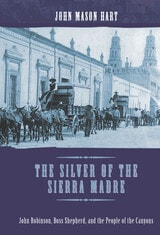
cover of The Silver of the Sierra Madre: John Robinson, Boss Shepherd, and the People of the Canyons

The Silver of the Sierra Madre

John Robinson, Boss Shepherd, and the People of the Canyons

John Mason Hart

University of Arizona Press, 2008
In the great barranca known today as Copper Canyon, the small mining town of Batopilas once experienced a silver bonanza among the largest ever known. American investors, believing that Mexico offered an unexploited cornucopia, began purchasing mines in the Sierra Madre, seeking to expand their hold on natural resources outside U.S. borders. From 1861 until the Revolution of 1910, the men of the Batopilas Mining Company ruled the region using their wealth, armed might, and extensive connections. The technology, industrialism, and politics their interests brought to this remote community tied the Tarahumara, Yaqui, Mayo, and other peoples of the barrancas directly to the economies of the United States and China. Local society was revolutionized, and a dramatic tapestry of human interactions was created. Based on many volumes of mining company records, The Silver of the Sierra Madre exposes the mentality and methods of mine owners John Robinson and Alexander “Boss” Shepherd, vividly detailing their exploitation of the people and the natural resources of Chihuahua. Hart aptly demonstrates the human and financial losses resulting from President Porfirio Díaz’s development programs, which relied on foreign investors, foreign managers, and foreign technology. This unprecedented work also provides a highly interesting ethnographic and social description of one of the least-known areas of Mexico. It is a tale of power and desperation, respect and arrogance, adventure and tragedy, and, ultimately, triumph and survival.
[more]
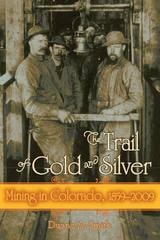
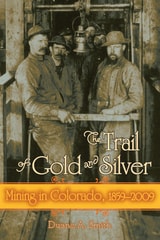
cover of The Trail of Gold and Silver: Mining in Colorado, 1859-2009

The Trail of Gold and Silver

Mining in Colorado, 1859-2009

Duane A. Smith

University Press of Colorado, 2009

In The Trail of Gold and Silver, historian Duane A. Smith details Colorado's mining saga - a story that stretches from the beginning of the gold and silver mining rush in the mid-nineteenth century into the twenty-first century. Gold and silver mining laid the foundation for Colorado's economy, and 1859 marked the beginning of a fever for these precious metals. Mining changed the state and its people forever, affecting settlement, territorial status, statehood, publicity, development, investment, economy, jobs both in and outside the industry, transportation, tourism, advances in mining and smelting technology, and urbanization. Moreover, the first generation of Colorado mining brought a fascinating collection of people and a new era to the region.

Written in a lively manner by one of Colorado's preeminent historians, this book honors the 2009 sesquicentennial of Colorado's gold rush. Smith's narrative will appeal to anybody with an interest in the state's fascinating mining history over the past 150 years.
[more]
cover of Trail Of Gold & Silver

Trail Of Gold & Silver

D Smith

University Press of Colorado, 2009

[more]