Results by title

3 books match the query 'Silver Age'
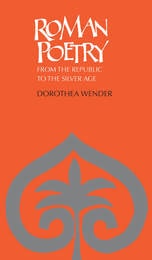
cover of Roman Poetry: From the Republic to the Silver Age

Roman Poetry

From the Republic to the Silver Age

Translated and with Introduction by Dorothea Wender

Southern Illinois University Press, 1991

Meshing her own wit, verve, and gusto with that of the Roman poets she translates, Dorothea Wender strips both the cloak of awe and the dusty mantle of boredom from the classics.

Available for the first time in paper, these English verse translations of the major classical Roman poets feature hefty selections from the savage urban satire of Juvenal, the moving philosophy of Lucretius, the elegance of Horace, the grace and humor of Catullus, the grave music of Virgil, the passion of Propertius, the sexy sophistication of Ovid, and the obscenity of Martial.

Noting Wender’s “candor,” the Classical Outlook reported that in “20th-century terms, she makes the poems lively and pertinent.”

The Boston Globe said, “The conciseness is astonishing, the informa­tion [in the introductions to each poet] provocative. The freshness of the selections should do much to augment the audience for these poets and may even inspire examination of the originals.”

The best advice came from Wender herself: “Read these good poems.”
[more]
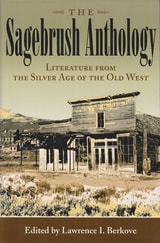
cover of The Sagebrush Anthology: Literature from the Silver Age of the Old West

The Sagebrush Anthology

Literature from the Silver Age of the Old West

Edited by Lawrence I. Berkove

University of Missouri Press, 2006

Sagebrush School is a term applied to a group of writers who spent their creative years in Nevada from the 1860s to the early twentieth century—its most illustrious representative being Mark Twain. Yet most of their work was never republished from the periodicals in which it first appeared and today remains largely unknown to many scholars and aficionados of Western literature.
Lawrence I. Berkove, acknowledged as the leading authority on this body of literature, has assembled an exceptional collection that rescues the lively works of the Sagebrush School from the dusty archives in which they have languished. The Sagebrush Anthology enlarges Mark Twain’s circle to encompass the Sagebrush Bohemians through a compelling blend of humorous and serious fiction, memoir, nonfiction, letters, and poetry. These selections convey the experiences shaped by Nevada’s rough-and-tumble culture, abounding in wit and humor—with a fondness for literary hoaxes—that were the last major formative influence on Twain.
The anthology contains sixty-eight selections—seven by Twain—representing outstanding work by accomplished Sagebrushers Dan De Quille, Sam Davis, Joe Goodman, and Rollin Daggett, plus pieces by lesser-known writers such as Arthur McEwen, Alf Doten, and Fred Hart. Berkove’s introduction recounts the history of the school and identifies and analyzes its main thematic and stylistic characteristics. He shows that Sagebrush literature records and reflects the collision of the last generation of frontiersmen with the new culture of technology, industry, and big business—men of talent, imagination, and integrity driven to work out distinctive ways of coping with an unresponsive system of justice, an economy tilted toward the rich, and a society that impinged on individual liberties.
Although many critics have noted the influence that this period had on Twain when he lived in Virginia City, few have delineated the influence of specific writers on his style. The Sagebrush Anthology not only shows that some of the ideas and literary techniques credited to Twain can be seen as characteristics of the school that he assimilated and refined, but it also fosters an appreciation of these other writers in their own right, showing that their work encompassed topics and genres that Twain barely addressed. By casting new light on the movement, it invites students and general readers to appreciate a silver flowering of Western literature that remains entertaining and instructive for our own time.
[more]
cover of The Silver Age in Our Home: A Memoir of Russian Literary Life in the 20th Century

The Silver Age in Our Home

A Memoir of Russian Literary Life in the 20th Century

Sophia Bogatyreva

Central European University Press, 2027

Before emigrating to the United States, Sophia Bogatyreva was a prominent literary editor and a part of Moscow and Leningrad literary circles that included Joseph Brodsky, Konstantin Bogatyrev, Korney Chukovsky, Nadezhda Mandelshtam, Lilya Brik and many other celebrities. Her memoirs, written in a brilliantly lucid and humorous style, represent several generations of Soviet literary intelligentsia. Her focus is on those segments of Soviet intelligentsia that preserved their living connections with traditions of modernism and avant-garde despite ideological control and political repressions, while at the same not retreating into the “underground” but rather being well-published and well-read. Bogatyreva’s memoirs convey the complex and multi-layered atmosphere uniting those writers who had to discover ingenious and frequently brilliant ways to use their remarkable talents in the narrow space of the permissible. Angela Brintlinger and Catherine O’Neil’s translation excellently conveys the original style, lucidity and humor of Bogatyreva’s book.

These memoirs read as a significant contribution to scholarship, full of important facts and characterizations. At the same time, they become an original intellectual novel with real-life protagonists seen from the point of view of a child, teenager and young woman. The position of the narrator creates a “defamiliarizing” effect similar to the one about which the Formalists and first and foremost Viktor Shklovsky wrote. However, this powerful effect is “hidden in plain view” – the style of Bogatyreva’s memoirs is strikingly transparent and non-pretentious, which makes her book available even for an unprepared reader.

Mark Lipovetsky, Columbia University
[more]