Results by title
5 books match the query 'Simic, Charles'
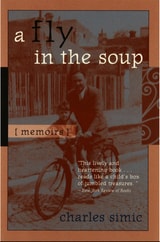
A Fly in the Soup
MemoirsCharles Simic
University of Michigan Press, 2003
In this evocative memoir by one of America's most revered contemporary poets, Charles Simic recounts his journey from a childhood in war-torn Yugoslavia to his coming-of-age experiences as a young bohemian in New York City, then as a reluctant draftee in the United States Army. Simic’s early years in Belgrade, a city bombed first by the Nazis in 1941 and then by the Allies in 1944, recall memories of bombs, broken glass, and visits from the Gestapo. His family is jailed for trying to flee the newly Communist Yugoslavia and finally manages to emigrate in 1953. Their first stop is Paris, where the teenaged Simic, craving the forbidden, slips out for his first taste of French nightlife and nudie shows. In New York and Chicago, Simic attends high school and his intense interests in art, poetry, jazz, film — and women — ripen into fully formed passions. The memoir continues with recollections of Simic’s induction into the Army, the publication of his first poem, and family dinners with his highly opinionated but much beloved Uncle Boris. A Fly in the Soup is both the story of a young man whose travel agents were Hitler and Stalin, and an autobiography of the childhood and coming of age of one of the most respected contemporary American poets.
[more]
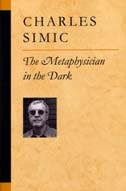
The Metaphysician in the Dark
Charles Simic
University of Michigan Press, 2003
Charles Simic's quicksilver imagination, his masterly way with words, and his unalloyed love of life and language alike inform every page of this wonderfully wide-ranging collection. Again and again, Simic takes up a subject and turns it this way and that, showing us what we haven't noticed before, inviting us to share an infectious delight that turns everything, in the end, into poetry. It's a gift that has won him a coveted MacArthur Fellowship, among many honors, but he wears his magic lightly.
Often, he addresses poetry itself. Among the pieces here are appreciations of Mark Strand, James Merrill, John Ashbery, and James Tate, each evaluated with a keen eye tempered by a generous spirit. Other essays discuss Joseph Brodsky, Czeslaw Milosz, and Vasko Popa; to these writers he brings the understanding available only to those who can read them in the original. In considering Brodsky's translations, for instance, he offers insights regarding not only the poet himself but the very nature of language. Elsewhere, he peers into poetry's past and its future: as a vessel of memory, a witness to history, and a mirror of human experience.
But perhaps the greatest pleasures afforded by The Metaphysician in the Dark, as he styles himself with a beguiling mix of modesty and irony, appear when Simic goes further afield. His look at the deadpan comedy of Buster Keaton is as revealing of the author as of the actor and his craft; his perusal of a Heironymous Bosch altarpiece captures both the painter's sense of apocalypse and a riotous joy in the piling of detail upon detail; his review of a book on Joseph Cornell examines how obsession becomes art. He is fluently familiar with subjects as diverse as Saul Bellow's novels and Aberlardo Morell's extraordinary camera obscura photographs. Yet when he takes the gloves off, as in two essays on the Serbia of Slobodan Milosevic, his outrage is as forceful as his pride is strong in his own Serbian heritage.
Each of the two dozen essays here reflects a sophistication irresistible in its simplicity; taken together, they display a questing intelligence and a panorama of life and art.
Charles Simic is an acclaimed poet, novelist, essayist and teacher. Winner of a MacArthur Fellowship and a Pulitzer Prize, he is the author of more than twenty volumes of poetry and six books of prose, as well as numerous translations. He is Distinguished University Professor of English at the University of New Hampshire, where he has taught since 1973.
[more]
Uncertainty and Plenitude
Five Contemporary PoetsPeter Stitt
University of Iowa Press, 1997
From the extraordinary diversity of contemporary poetry, Peter Stitt, the distinguished critic and editor of the Gettysburg Review, has chosen in this book to write about five poets only, all premier practitioners—John Ashbery, Stephen Dobyns, Charles Simic, Gerald Stern, and Charles Wright, with a special look at Stanley Kunitz in relation to Wright. Stitt's confident and inventive assessments of these fine poets' work help us gain some focus on the “uncertainty and plenitude” of the current poetry scene, demonstrating that concentrated and knowledgeable criticism can show us ways to begin measuring the accomplishments of our poetic age.
Stitt's interest in these five poets is intellectual and aesthetic. As he states, “I chose these particular writers because their work continues to interest me deeply, both intellectually and formally, even after years of familiarity.” He uses his understanding of the philosophical implications inherent in modern physics, as they apply to both content and form, as the basis for his close analysis.
Stitt attends to the poets' writerly strategies so that we may discover in their poetry where “surface form” intersects and complements meaning and thus becomes, in John Berryman's terms, “deep form.” He explains what these poets say and how they say it and what relationships lie between. He also shows how humor plays a part in some of their work.
[more]
Wonderful Words, Silent Truth
Essays on Poetry and a MemoirCharles Simic
University of Michigan Press, 1990
Included in this collection of essays is an autobiographical sketch of the poet's early years in Yugoslavia during World War II
[more]
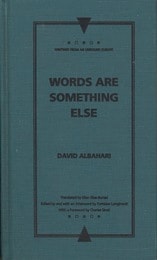
Words Are Something Else
David Albahari
Northwestern University Press, 1996
David Albahari is one of the most prominent prose writers to come out of the former Yugoslavia in the last twenty years. His short stories, which developed largely outside the canon of Serbian literature, have influenced a generation of Balkan writers. This collection gathers Albahari's best and most important stories, moving from an early preoccupation with the family and Central European culture to metafictional searches for the roots of his identity.
[more]