Results by title
3 books match the query 'Simon, Erika'
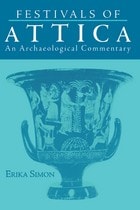
Festivals of Attica
An Archaeological CommentaryErika Simon
University of Wisconsin Press, 2002
The festivals of the Athenian sacred calendar constitute a vital key to classical Greek culture and religion. Erika Simon sets out here to explicate those complex and often obscure festivals. By careful marshaling of a variety of proofs from literary, historical, and archaeological sources, she is able to justify some startling conclusions and achieve a comprehensive and truly original synthesis that clarifies, as never before, the probable origins and meanings of the Attic cults.
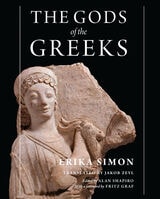
The Gods of the Greeks
Erika Simon, Translated by Jakob Zeyl, Edited by Alan Shapiro
University of Wisconsin Press, 2021
This careful and fluid translation finally makes Simon’s landmark edition accessible to English-language readers. With an abundance of beautiful illustrations, the book examines portrayals of the thirteen major gods in art over the course of two millennia. Scholars who study the lives and practices of those living in ancient Greece will value this newest contribution.
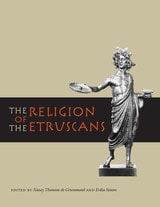
The Religion of the Etruscans
Edited by Nancy Thomson de Grummond and Erika Simon
University of Texas Press, 2006
Devotion to religion was the distinguishing characteristic of the Etruscan people, the most powerful civilization of Italy in the Archaic period. From a very early date, Etruscan religion spread its influence into Roman society, especially with the practice of divination. The Etruscan priest Spurinna, to give a well-known example, warned Caesar to beware the Ides of March. Yet despite the importance of religion in Etruscan life, there are relatively few modern comprehensive studies of Etruscan religion, and none in English. This volume seeks to fill that deficiency by bringing together essays by leading scholars that collectively provide a state-of-the-art overview of religion in ancient Etruria.
The eight essays in this book cover all of the most important topics in Etruscan religion, including the Etruscan pantheon and the roles of the gods, the roles of priests and divinatory practices, votive rituals, liturgical literature, sacred spaces and temples, and burial and the afterlife. In addition to the essays, the book contains valuable supporting materials, including the first English translation of an Etruscan Brontoscopic Calendar (which guided priests in making divinations), Greek and Latin sources about Etruscan religion (in the original language and English translation), and a glossary. Nearly 150 black and white photographs and drawings illustrate surviving Etruscan artifacts and inscriptions, as well as temple floor plans and reconstructions.