Results by title
3 books match the query 'Simplicity'

One God, One People
Oneness and Unity in Early ChristianityStephen C. Barton
SBL Press, 2023
From ancient times to the present day, utopian social ideas have made the unity of humankind a central concern. In the face of the threats to civic peace and harmony caused by misrule, factions, inequality, and moral weakness, philosophical and religious traditions in antiquity gave considered attention to the attainment of oneness both as an ideal and as an embodied practice. In this volume, scholars of ancient history, early Judaism, and biblical studies come together to show that ideas of unity and practices of oneness were grounded in larger conceptions of worldview, cosmic order, and power, with theological ideas such as the oneness of God laying an important foundation. In particular, contributors focus on how early Christians, with their inherited Jewish, Greek, and Roman traditions, reinterpreted oneness in light of their new identity as “members of Christ” and how they put it into practice. Contributors are Stephen C. Barton, Anna Sieges-Beal, Max Botner, Andrew J. Byers, Carsten Claußen, Kylie Crabbe, Robbie Griggs, James R. Harrison, Walter J. Houston, T. J. Lang, Jutta Leonhardt-Balzer, John-Paul Lotz, Lynette Mitchell, Nicholas J. Moore, Elizabeth E. Shively, Julien C. H. Smith, and Alan Thompson.
[more]
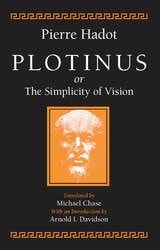
Plotinus or the Simplicity of Vision
Pierre Hadot
University of Chicago Press, 1993
The most penetrating and thorough account available of the work of ancient philosopher Plotinus, from the world's leading expert on his thought
Pierre Hadot's lively philosophical portrait of Plotinus is the preeminent introduction to the man and his thought. Michael Chase's lucid translation—complete with a useful chronology and analytical bibliography—at last makes this book available to the English-speaking world.
Hadot carefully examines Plotinus's views on the self, existence, love, virtue, gentleness, and solitude. He shows that Plotinus, like other philosophers of his day, believed that Plato and Aristotle had already articulated the essential truths; for him, the purpose of practicing philosophy was not to profess new truths but to engage in spiritual exercises so as to live philosophically. Seen in this light, Plotinus's counsel against fixation on the body and all earthly matters stemmed not from disgust or fear, but rather from his awareness of the negative effect that bodily preoccupation and material concern could have on spiritual exercises.
[more]
Simplicity and Complexity
Pondering Literature, Science, and PaintingFloyd Merrell
University of Michigan Press, 1998
Behind every apparently placid surface there lies an unruly ocean of complexity. Fractals, chaos theory, and dissipative structures bear witness to these hidden complexities of the universe. Complementing these ideas in the sciences, fiction from the likes of Jorge Luis Borges, Italo Calvino, Thomas Pynchon, and Samuel Beckett reveals our deep-seated desire for simplicity while we are obliged to learn to cope with complexity. And painting, especially since Paul Cézanne, exposes the complexity pervading what we often wish to take simply as what there is. Simplicity and Complexity is about simplicity and complexity, order and disorder, as seen through the lenses of fiction, the sciences, and works of art. Floyd Merrell offers a nonmathematical account of chaos theory, fractal geometry, and the physics of complexity insofar as they are relevant to crucial facets of literature and painting created over the past century. Though his account is informal, he addresses technical concepts and philosophical questions, and sheds new light on the authors and painters he discusses. His radically interdisciplinary approach is within the mainstream of postmodern practices, yet it criticizes the tendency toward facile conclusions and sweeping generalizations regarding relations between the arts, the humanities, and the sciences. It brings a collection of disciplines under an umbrella that is protective of particular theories, concepts, methods, and practices, while revealing connecting threads in the tenuously linked web of all human endeavors to know the product of the mind and of the world. "Merrell gives inter-disciplinarity a new horizon and continues the dialogue between the sciences and literature in a way I have not seen since Hegel tried to pull it all together in his Encyclopedia." --Eugen Baer, Professor of Philosophy, Hobart and William Smith Colleges
[more]