Results by title
7 books match the query 'Simulation methods'
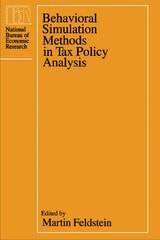
Behavioral Simulation Methods in Tax Policy Analysis
Edited by Martin Feldstein
University of Chicago Press, 1983
The principal focus of the project has been on the microsimulation of individual behavior. Thus, this volume includes studies of individual responses to an over reduction in tax rates and to changes in the highest tax rates; a study of alternative tax treatments of the family; and studies of such specific aspects of household behavior as tax treatment of home ownership, charitable contributions, and individual saving behavior. Microsimulation techniques are also used to estimate the effects of alternative policies on the long-run financial status of the social security program and to examine the effects of alternative tax rules on corporate investment and of foreign-source income on overseas investment.
The papers devoted to the development of general equilibrium simulation models to include an examination of the implications of international trade and capital flows, a study of the effects of capital taxation that uses a closed economy equilibrium model, and an examination of the effect of switching to an inflation-indexed tax system. In the volume's final paper, a life-cycle model in which individuals maximize lifetime utility subject to a lifetime budget constraint is used to simulate the effects of tax rules on personal savings.
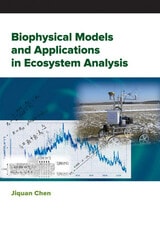
Biophysical Models and Applications in Ecosystem Analysis
Chen, Jiquan
Michigan State University Press, 2021
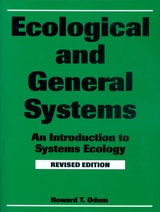
Ecological and General Systems
An Introduction to Systems Ecology, Revised EditionHoward T. Odum
University Press of Colorado, 1994
First published as Systems Ecology in 1983, Ecological and General Systems proposes principles of self-organization and the designs that prevail by maximizing power and efficiency. Comparisons to fifty other systems languages are provided. Innovative presentations are given on earth homeostasis (Gaia); the inadequacy of presenting equations without network relationships and energy constraints; the alternative interpretation of high entropy complexity as adaptive structure; basic equations of ecological economics; and the energy basis of scientific hierarchy.
Part I introduces energetics, hierarchy, and systems modeling. Part II features design elements: intersections, autocatalytic modules, loops, series, parallel elements, and webs. Part III includes embodied energy, spectra of energy quality, temperature, complexity, spatial distribution, and diversity. Part IV discusses production, consumption, ecosystems, succession, economic systems, anthropological models, urban and regional models, global biogeochemistry, and the universe.
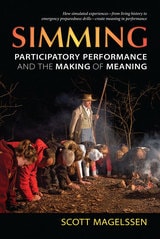
Simming
Participatory Performance and the Making of MeaningScott Magelssen
University of Michigan Press, 2014
At an ecopark in Mexico, tourists pretend to be illegal migrants, braving inhospitable terrain and the U.S. Border Patrol as they attempt to cross the border. At a living history museum in Indiana, daytime visitors return after dark to play fugitive slaves on the Underground Railroad. In the Mojave Desert, the U.S. Army simulates entire provinces of Iraq and Afghanistan, complete with bustling villages, insurgents, and Arabic-speaking townspeople, to train soldiers for deployment to the Middle East. At a nursing home, trainees put on fogged glasses and earplugs, thick bands around their finger joints, and sandbag harnesses to simulate the effects of aging and to gain empathy for their patients.
These immersive environments in which spectator-participants engage in simulations of various kinds—or “simming”—are the subject of Scott Magelssen’s book. His book lays out the ways in which simming can provide efficacy and promote social change through affective, embodied testimony. Using methodology from theater history and performance studies (particularly as these fields intersect with cultural studies, communication, history, popular culture, and American studies), Magelssen explores the ways these representational practices produce, reify, or contest cultural and societal perceptions of identity.
Tactical Media
Rita Raley
University of Minnesota Press, 2009
In Tactical Media, Rita Raley provides a critical exploration of the new media art activism that has emerged out of, and in direct response to, postindustrialism and neoliberal globalization. Through close readings of projects by the DoEAT group, the Critical Art Ensemble, Electronic Civil Disobedience, and other tactical media groups, she articulates their divergent methods and goals and locates a virtuosity that is also boldly political. Contemporary models of resistance and dissent, she finds, mimic the decentralized and virtual operations of global capital and the post-9/11 security state to exploit and undermine the system from within.
Emphasizing the profound shift from strategy to tactics that informs new media art-activism, Raley assesses the efficacy of its symbolic performances, gamings, visualizations, and hacks. With its cogent analyses of new media art and their social impact, Tactical Media makes a timely and much needed contribution to wider debates about political activism, contemporary art, and digital technology.
Unruly Complexity
Ecology, Interpretation, EngagementPeter J. Taylor
University of Chicago Press, 2005
For each realm Taylor shows that unruly complexity-situations that lack definite boundaries, where what goes on "outside" continually restructures what is "inside," and where diverse processes come together to produce change-should not be suppressed by partitioning complexity into well-bounded systems that can be studied or managed from an outside vantage point. Using case studies from Australia, North America, and Africa, he encourages readers to be troubled by conventional boundaries-especially between science and the interpretation of science-and to reflect more self-consciously on the conceptual and practical choices researchers make.
World Politics Simulations in a Global Information Age
Hemda Ben-Yehuda, Luba Levin-Banchik, and Chanan Naveh
University of Michigan Press, 2015