Results by title
5 books match the query 'Sinclair, Upton'
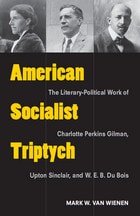
American Socialist Triptych
The Literary-Political Work of Charlotte Perkins Gilman, Upton Sinclair, and W. E. B. Du BoisMark W. Van Wienen
University of Michigan Press, 2014
"A meticulously researched, highly informed, carefully argued, and very accessible account of American socialism, socialists, and socialistic thinking, from the late nineteenth century through the 1960s . . . challenges the intellectual and political legacy of Werner Sombart's Why Is There No Socialism in the United States?, whose spirit still hovers over animated discussions about the 'failures' of socialism in the United States."
---James A. Miller, George Washington University
"A valuable rethinking and reframing of the traditions of leftist literary scholarship in the U.S."
---Sylvia Cook, University of Missouri, St. Louis
American Socialist Triptych: The Literary-Political Work of Charlotte Perkins Gilman, Upton Sinclair, and W. E. B. Du Bois explores the contributions of three writers to the development of American socialism over a fifty--year period and asserts the vitality of socialism in modern American literature and culture.
Drawing upon a wide range of texts including archival sources, Mark W. Van Wienen demonstrates the influence of reform-oriented, democratic socialism both in the careers of these writers and in U.S. politics between 1890 and 1940. While offering unprecedented in-depth analysis of modern American socialist literature, this book charts the path by which the supposedly impossible, dangerous ideals of a cooperative commonwealth were realized, in part, by the New Deal.
American Socialist Triptych provides in-depth, innovative readings of the featured writers and their engagement with socialist thought and action. Upton Sinclair represents the movement's most visible manifestation, the Socialist Party of America, founded in 1901; Charlotte Perkins Gilman reflects the socialist elements in both feminism and 1890s reform movements, and W. E. B. Du Bois illuminates social democratic aspirations within the NAACP. Van Wienen's book seeks to re-energize studies of Sinclair by treating him as a serious cultural figure whose career peaked not in the early success of The Jungle but in his nearly successful 1934 run for the California governorship. It also demonstrates as never before the centrality of socialism throughout Gilman's and Du Bois's literary and political careers.
More broadly, American Socialist Triptych challenges previous scholarship on American radical literature, which has focused almost exclusively on the 1930s and Communist writers. Van Wienen argues that radical democracy was not the phenomenon of a decade or of a single group but a sustained tradition dispersed within the culture, providing a useful genealogical explanation for how socialist ideas were actually implemented through the New Deal.
American Socialist Triptych also revises modern American literary history, arguing for the endurance of realist and utopian literary modes at the height of modernist literary experimentation and showing the importance of socialism not only to the three featured writers but also to their peers, including Edward Bellamy, Hamlin Garland, Jack London, Edna St. Vincent Millay, and Claude McKay. Further, by demonstrating the importance of social democratic thought to feminist and African American campaigns for equality, the book dialogues with recent theories of radical egalitarianism. Readers interested in American literature, U.S. history, political theory, and race, gender, and class studies will all find in American Socialist Triptych a valuable and provocative resource.

Manassas
A Novel of the WarUpton Sinclair
University of Alabama Press, 2000
Centers on the moral dimension of the conflict as it traces a young Mississippi boy’s conversion from pro-slavery Southerner to abolitionist Union soldier
Allan Montague, born on a Mississippi plantation about twenty years before the Civil War, has grown up with slavery and considers it natural. When his father moves to Boston for business and takes the boy with him, young Allan carries a knife given to him by his cousin to use in killing abolitionists.
The first abolitionist young Allan meets in Boston is Levi Coffin, the reputed founder of the Underground Railroad. In this first of many meetings with historical figures, Allan forms a friendship with Coffin, who eventually takes him to hear a speech by former slave Frederick Douglass. Douglass's powerful words cement Allan's transformation into an abolitionist—a transformation that will lead him back to his Deep South home with the hope of freeing slaves and eventually back to the North and the fateful Battle of Manassas.
Kent Gramm, author of the introduction for this new edition of Manassas, calls the novel “a modern version of the morality play,” with the United States as the central character. “The real story, he writes, is the moral phenomenon of the Civil War.” It is a powerful book that deserves to be revived, read, and studied.
The Brass Check
A STUDY OF AMERICAN JOURNALISMUpton Sinclair
University of Illinois Press, 2002
Fueled by mounting disdain for newspapers run by business tycoons and conservative editors, Sinclair self-published The Brass Check in the years after The Jungle had made him a household name. Despite Sinclair’s claim that this was his most important book, it was dismissed by critics and shunned by reviewers. Yet it sold over 150,000 copies and enjoyed numerous printings.
A substantial introduction to this paperback edition by Robert W. McChesney and Ben Scott asserts the book’s importance as a cornerstone critique of commercial journalism and a priceless resource for understanding the political turbulence of the Progressive Era.
The Jungle
Upton Sinclair
University of Illinois Press, 1988

The Muckrakers
Edited by Arthur Weinberg and Lila Weinberg
University of Illinois Press, 1964
From 1902, when it latched onto such mass circulation magazines as Collier's and McClure's, until it merged into the Progressive movement in 1912, muckraking relentlessly pricked the nation's social conscience by exposing the abuses of industry and politics. Ranging in tone from the scholarly to the sensational, muckraking articles attacked food adulteration, unscrupulous insurance practices, fraudulent claims for patent medicines, and links between government and vice. When muckrakers raised their voices against child labor, graft, monopoly, unsafe mill conditions, and the white slave trade of poor immigrant girls, they found a receptive audience. "I aimed at the public's heart," wrote Upton Sinclair about The Jungle, "and by accident I hit it in the stomach."
Gathering the most significant pieces published during the heyday of the muckraking movement, The Muckrakers brings vividly to life this unique era of exposure and self-examination. For each article, Arthur and Lila Weinberg provide concise commentary on the background of its subject and the specific and long-range repercussions of its publication. The volume features the work of both journalists and fiction writers, including Ida Tarbell, Lincoln Steffens, Upton Sinclair, Ray Stannard Baker, Samuel Hopkins Adams, Thomas W. Lawson, Charles Edward Russell, and Mark Sullivan.
Eloquent and uncompromising, the muckrakers shocked America from a state of lethargy into Progressive reform. This generous volume vividly captures the urgency of their quest.