Results by title
18 books match the query 'Single mothers'
A Roof Over My Head
Homeless Women and the Shelter IndustryJean Calterone Williams
University Press of Colorado, 2003
The author draws upon interviews with homeless women, interviews with housed people, and, finally, evaluations of shelter services, philosophies, and policies to get at the causes and social construction of homelessness. A Roof Over My Head is a ground-breaking study that unveils the centrality of abuse and poverty in homeless women's lives and outlines ways in which societal responses can and should be more effective.
Crossing the Blue Willow Bridge
A Journey to My Daughter's Birthplace in ChinaNancy McCabe
University of Missouri Press, 2011
Imitation of Life
Fannie Hurst
Duke University Press, 2004
The author of numerous bestselling novels, a masterful short story writer, and an outspoken social activist, Fannie Hurst was a major celebrity in the first half of the twentieth century. Daniel Itzkovitz’s introduction situates Imitation of Life in its literary, biographical, and cultural contexts, addressing such topics as the debates over the novel and films, the role of Hurst’s one-time secretary and great friend Zora Neale Hurston in the novel’s development, and the response to the novel by Hurst’s friend Langston Hughes, whose one-act satire, “Limitations of Life” (which reverses the races of Bea and Delilah), played to a raucous Harlem crowd in the late 1930s. This edition brings a classic of popular American literature back into print.

Juniper Blue
(A Novel)Susan Lang
University of Nevada Press, 2006
This engrossing new novel by acclaimed author Susan Lang continues the saga of Ruth Farley, the fiercely independent young woman who was the protagonist of Small Rocks Rising, published by the University of Nevada Press in 2002. Ruth is still on her homestead at the end of a rugged canyon in California’s Mojave Desert, still struggling to survive on her own and to recover from a brutal rape and the murder of her lover. Now she must also face the responsibility of motherhood. The ensuing story expands Ruth’s world to encompass the panorama of Depression-era Southern California—miners and ranchers hanging on until times are better; Indians trying to preserve their ancient culture and identity; Okies, vagrants, and breadlines; the wealth and glitter of the movie industry; and narrow-minded small-town gossips. Ruth’s life also expands as she adjusts to motherhood, trying to maintain her autonomy and isolation and trying to preserve the tenuous web that links her to the seductive ruthlessness of the desert and to its ancient people and their wisdom. Ruth is one of the most engaging characters in recent fiction, complex and contradictory, stubborn and vulnerable, passionately in love with her austere desert home. Lang tells her story, the saga of a fully modern woman seeking her own identity and destiny against the turbulent, colorful setting of the rapidly changing twentieth-century West.
Lives on the Edge
Single Mothers and Their Children in the Other AmericaValerie Polakow
University of Chicago Press, 1994
Making Ends Meet
How Single Mothers Survive Welfare and Low-Wage WorkKathryn Edin
Russell Sage Foundation, 1997
Meeting Sophie
A Memoir of AdoptionNancy McCabe
University of Missouri Press, 2003
The baby is screaming again. My baby. I hoist her off the narrow hotel bed--again--and try to cradle her as I rock my torso back and forth in an uncomfortable straight-backed chair.
This baby does not cradle. She doesn't know how to cuddle, to be soothed in anyone's arms. She howls and arches away, squirms and flops, a sixteen-pound fish out of water. I'm not used to holding babies, and she's not used to be being held, but when I try to put her down, she wails. My arms feel chafed, raw, and my wrists ache from the hours of straining to hang on to her.
Huge tears pool in her eyes. These tears could break my heart. These screams could break my eardrums.
Mildred Pierce
Edited by Albert J. La Valley; Tino T. Balio, Series Editor
University of Wisconsin Press, 1980
Joan Crawford forged a new and successful screen image in this powerful women's noir film; winning her an Academy Award for best actress.
Albert J. LaValley's through and insightful guide to Mildred Pierce at once tells us much about the making of this complex film, the problems and process of transferring the story to the screen, the specific and important roles of the producer, director, and set designer, and how the film relates to broad trends within the industry. It is without a doubt the most thorough treatment of this important American motion picture.

Moon Lily
(a novel)Susan Lang
University of Nevada Press, 2008
Mothering by Degrees
Single Mothers and the Pursuit of Postsecondary EducationDuquaine-Watson, Jillian M.
Rutgers University Press, 2017
In Mothering by Degrees, Jillian Duquaine-Watson shows how single mothers pursuing college degrees must navigate a difficult course as they attempt to reconcile their identities as single moms, college students, and in many cases, employees. They also negotiate a balance between what they think a good mother should be, and what society is telling them, and how that affects their choices to go to college, and whether to stay in college or not.
The first book length study to focus on the lives and experiences of single mothers who are college students, Mothering by Degrees points out how these women are influenced by dominant American ideologies of motherhood, and the institutional parameters of the schools they attend, and argues for increased attention to the specific ways in which the choices, challenges, and opportunities available to mothers are shaped within their specific environments, as well as the ways in which mothers help shape those environments...
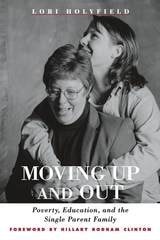
Moving Up And Out
Poverty, Education & Single Parent FamilyLori Holyfield, foreword by Hillary Rodham Clinton
Temple University Press, 2001
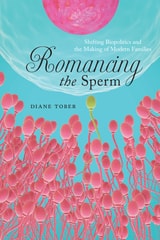
Romancing the Sperm
Shifting Biopolitics and the Making of Modern FamiliesDiane Tober
Rutgers University Press, 2019
In Romancing the Sperm, Diane Tober explores the intersections between sperm donation and the broader social and political environment in which “modern families” are created and regulated. Through tangible and intimate stories, this book provides a captivating read for anyone interested in family and kinship, genetics and eugenics, and how ever-expanding assisted reproductive technologies continue to redefine what it means to be human.
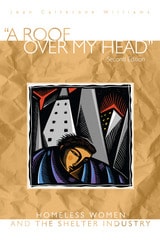
Roof Over My Head, Second Edition
Homeless Women and the Shelter IndustryJean Calterone Williams
University Press of Colorado, 2016
Based upon extensive ethnographic data, “A Roof Over My Head” examines the lives of homeless women who cope with domestic violence, low-income housing shortages, and poverty. The author draws upon interviews with homeless women, interviews with housed people, and, finally, evaluations of shelter services, philosophies, and policies to get at the causes and social constructions of homelessness. “A Roof Over My Head” is a groundbreaking study that unveils the centrality of abuse and poverty in homeless women’s lives and outlines ways in which societal responses can and should be more effective.
The second edition explores recent attempts to integrate homeless and battered women’s shelters and recent research on domestic violence as a cause of homelessness. It contains a new introduction that analyzes the most recent homeless policy developments and paints a picture of the homeless population today. With updated statistics and policy information throughout, the second edition of “A Roof Over My Head” illustrates why ending homelessness in the United States continues to present a thorny and complex challenge.
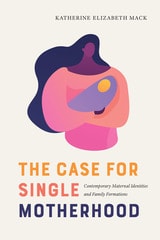
The Case for Single Motherhood
Contemporary Maternal Identities and Family FormationsKatherine E. Mack
University of Alabama Press, 2024
Scholars of rhetoric have largely overlooked the inherent rhetoricity of family. In The Case for Single Motherhood, Katherine Mack posits family as a central concern of rhetorical studies by reflecting on how language is used by single mothers who seek to reenvision the personal, social, and political meanings of family.
Drawing on intersectional and rhetorical theories, Mack demonstrates how the category of elective single motherhood emerged in response to the historically differential treatment of “unwed mothers” along racial and class lines. Through her readings of a range of self-sponsored ESM texts—guidebooks, memoirs, and interactive digital media written by and primarily for other ESMs—and from her perspective as an elective single mother herself, Mack evaluates the rhetorical power, as well as the exclusions and hierarchies, that the ESM label effects. She analyzes how ESMs envision motherhood, visions that entail their musings about who can and should mother. Ultimately, Mack offers women who are considering nonnormative paths to motherhood a way to affirm their maternal identities and paths without disparaging others’.
Scholars in the fields of rhetoric and feminist rhetorical studies will find in this volume an illuminating perspective on the rhetorical power of self-sponsored texts in particular. Crafting a methodology to identify and evaluate the goals and effects of legitimacy work and selecting sources that bring academic attention to varied genres of self-sponsored writings, Mack paves the way for future rhetorical studies of motherhood and family.
The Lucky
(A Novel)H. Lee Barnes
University of Nevada Press, 2003

The Strange Side of the Tracks
George Avant
Parkhurst Brothers, Inc., 2015
Some kids have to grow up fast. This is the story of Lonnie Tobin, one such young man. Weary of the physical abuse his mother is subjected to from his father, he takes matt ers into his own hands. Convincing her to flee their fearful home life, son and mother sneak away in the night to the small town of Rocky Branch, where they find peace with her family. It is a corner of the world he thought they had left behind forever. But mysteries abound in this little wooded village, and an unexpected adventure begins when word of a nightly monster on the loose stirs fear among the residents. Young Lonnie soon forgets about his father and becomes fascinated by the story, only to find he might be spending a litt le too much time on The Strange Side of the Tracks.
Unruly Domestication
Poverty, Family, and Statecraft in Urban PeruKristin Skrabut
University of Texas Press, 2024
2024 Flora Tristán Book Award, Sección Perú, Latin American Studies Association
How the international war on poverty shapes identities, relationships, politics, and urban space in Peru.
Unruly Domestication investigates how Peru’s ongoing, internationally endorsed "war on poverty" shapes politics, intimate identities, and urban space in Lima. Drawing on a decade of embedded, ethnographic research in Lima’s largest and most recently founded “extreme poverty zone,” Kristin Skrabut demonstrates how Peru’s efforts to fight poverty by formalizing property, identity, and family status perpetuate environmentally unsustainable urban sprawl, deepen discrimination against single mothers, and undermine Peruvians’ faith in public officials and in one another. In the process, Skrabut reveals myriad entanglements of poverty, statecraft, and private life, exploring how families are made and unmade through political practices, how gender inequalities are perpetuated through policy, and how Peruvians’ everyday pursuits of state-sanctioned domestic ideals reproduce informality and landscapes of poverty in the urban periphery.
The only full-length ethnography written about Lima’s iconic and policy-inspiring shantytowns in thirty years, Unruly Domestication provides valuable insight into the dynamics of housing and urban development in the Global South, elucidating the most intimate and profound effects of global efforts to do good.
Watercolor Women Opaque Men
A Novel in VerseAna Castillo, introduction by Carmen Tafolla
Northwestern University Press, 2017
In this updated edition of Ana Castillo’s celebrated novel in verse, featuring a new introduction by Poet Laureate of Texas Carmen Tafolla, we revisit the story’s spirited heroine, known only as “Ella” or “She,” as she takes us through her own epic journey of self-actualization as an artist and a woman. With a remarkable combination of tenderness, lyricism, wicked humor, and biting satire, Castillo dramatizes Ella’s struggle through poverty as a Chicano single mother at the threshold of the twenty-first century, fighting for upward mobility while trying to raise her son to be independent and self-sufficient. Urged on by the gods of the ancients, Ella’s life interweaves with those of others whose existences are often neglected, even denied, by society’s status quo. Castillo’s strong rhythmic voice and exploration of such issues as love, sexual orientation, and cultural identity will resonate with readers today as much as they did upon the book’s original publication more than ten years ago. This expanded edition also includes a short preface by the author, as well as a glossary, a reader’s guide, and a list of additional suggested readings.