Results by title
8 books match the query 'Site'
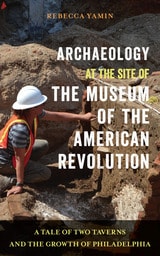
Archaeology at the Site of the Museum of the American Revolution
A Tale of Two Taverns and the Growth of PhiladelphiaRebecca Yamin
Temple University Press, 2019
When the Museum of the American Revolution acquired the land at Third and Chestnut streets in Olde City, Philadelphia, it came with the condition that an archaeological investigation be conducted. The excavation that began in the summer of 2014 yielded treasures in the trash: unearthed privy pits provided remarkable finds from a mid-eighteenth-century tavern to relics from a button factory dating to the early twentieth century. These artifacts are described and analyzed by urban archaeologist Rebecca Yamin in Archaeology at the Site of the Museum of the American Revolution.
Yamin, lead archaeologist on the dig, catalogues items—including earthenware plates and jugs, wig curlers, clay pipes, and liquor bottles—to tell the stories of their owners and their roles in Philadelphia history. As she uncovers the history of the people as well as their houses, taverns, and buildings that were once on the site, she explains that by looking at these remains, we see the story of the growth of Philadelphia from its colonial beginnings to the Second World War.
Archaeology at the Site of the Museum of the American Revolution is a perfect keepsake for armchair archaeologists, introductory students, and history buffs.
Being a Skull
Site, Contact, Thought, SculptureGeorges Didi-Huberman
University of Minnesota Press, 2016
What would a sculpture look like that has as its task to touch thought? For the French philosopher and Art Historian, Georges Didi-Huberman, this is the central question that permeates throughout the work of Italian artist Giuseppe Penone. Through a careful study of Penone’s work regarding a sculptural and haptic process of contact with place, thought, and artistic practice, Didi-Huberman takes the reader on a journey through various modes of thinking by way of being. Taking Penone’s artwork “Being the river” as a thematic starting point, Didi-Huberman sketches a sweeping view of how artists through the centuries have worked with conceptions of the skull, that is, the mind, and ruminates on where thought is indeed located.
From Leonardo da Vinci to Albrecht Dürer, Didi-Huberman guides us to the work of Penone and from there, into the attempts of a sculptor whose works strives to touch thought. What we uncover is a sculptor whose work becomes a series of traces of the site of thought. Attempting to trace, by way of a series of frottages, reports, and developments, this imperceptible zone of contact. The result is a kind of fossil of the brain: the site of thought, namely, the site for getting lost and for disproving space. Sculpting at the same time what inhabits as well as what incorporates us.
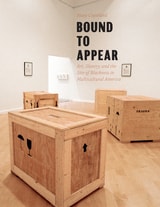
Bound to Appear
Art, Slavery, and the Site of Blackness in Multicultural AmericaHuey Copeland
University of Chicago Press, 2013

Disability Praxis
The Body as a Site of StruggleBob Williams-Findlay
Pluto Press, 2003
‘A masterful intervention that is particularly pertinent for an age of austerity, pandemic, and rising living costs’ Robert Chapman, author of Empire of Normality
‘A brilliant and much-needed contribution to current debates’ Ioana Cerasella Chis, University of Birmingham
‘A comprehensive analysis which also intelligently looks at how disability can fit into the modern world’ Joshua Hepple, activist, writer and disability equality trainer
The rise of the extreme right globally, the crisis of capitalism, and the withdrawal of all but the most punitive arms of the state are disastrously impacting disabled people’s lives.
Bob Williams-Findlay offers an account of the transformative potential of disability praxis and how it relates to disabled politics and activism. He addresses different sites of struggle, showing how disabled people have advanced radical theory into implementing policies.
Examining the growth of the global Disabled People’s Movement during the 1960s, Williams-Findlay shows how a new social discourse shifted away from seeing disability as restrictions on an individual’s body towards understanding the impact of restrictions created by capitalist relations. He shines a light on the contested definitions of disability, asking us to reconsider how different socio-political contexts produce varied understandings of social oppression and how we can play a role in transforming definitions and societies.
Bob Williams-Findlay is the founder of Birmingham Disability Rights Group and the former Chair of the national organization BCODP. He has written in various publications on the topic of disability politics.
Fieldworks
From Place to Site in Postwar PoeticsLytle Shaw
University of Alabama Press, 2013
Fieldworks offers a historical account of the social, rhetorical, and material attempts to ground art and poetry in the physicality of a site.
Arguing that place-oriented inquiries allowed poets and artists to develop new, experimental models of historiography and ethnography, Lytle Shaw draws out the shifting terms of this practice from World War II to the present through a series of illuminating case studies. Beginning with the alternate national genealogies unearthed by William Carlos Williams in Paterson and Charles Olson in Gloucester, Shaw demonstrates how subsequent poets sought to ground such inquiries in concrete social formations—to in effect live the poetics of place: Gary Snyder in his back-to-the-land familial compound, Kitkitdizze; Amiri Baraka in a black nationalist community in Newark; Robert Creeley and the poets of Bolinas, California, in the capacious “now” of their poet-run town. Turning to the work of Robert Smithson—who called one of his essays an “appendix to Paterson,” and who in turn has exerted a major influence on poets since the 1970s—Shaw then traces the emergence of site-specific art in relation both to the poetics of place and to the larger linguistic turn in the humanities, considering poets including Clark Coolidge, Bernadette Mayer, and Lisa Robertson.
By putting the poetics of place into dialog with site-specificity in art, Shaw demonstrates how poets and artists became experimental explicators not just of concrete locations and their histories, but of the discourses used to interpret sites more broadly. It is this dual sense of fieldwork that organizes Shaw’s groundbreaking history of site-specific poetry.

Modern Melbourne
City and Site of Nature and CultureRod Giblett
Intellect Books, 2020
It places Melbourne within an international context by comparing and contrasting it to other cities built on or beside wetlands, including London, New York, Paris, Los Angeles, and Toronto. Further, it is the first book to apply the work of European thinkers and writers on modernity and the modern city—such as Walter Benjamin and Peter Sloterdijk—to an analysis of Melbourne. Giblett considers the intertwining of nature and culture, people and place, and cities and wetlands in this bioregional and ecocultural analysis. Placing the city in its proper bioregional and international contexts, Modern Melbourne provides a rich historical analysis of the cultural capital of Australia.
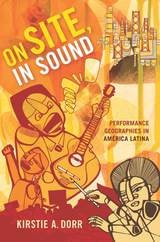
On Site, In Sound
Performance Geographies in América LatinaKirstie A. Dorr
Duke University Press, 2018

The Sun Tunnels Encyclo
Exploring Nancy Holt's Earthwork through Perception and SiteHikmet Sidney Loe
University of Utah Press, 2027
The Sun Tunnels Encyclo: Exploring Nancy Holt’s Earthwork through Perception and Site affords new information on the artist’s iconic work of land art. American artist Nancy Holt (1938-2014) extended her practice into the land, employing light, vision, and perception through photography, film, installations, and poetics. By creating her expansive earthwork Sun Tunnels (1973-76), Holt became a leader within the land art movement. Through her eponymous essay (1977) and film (1978), Holt presents the work through interdisciplinary topics: scientific (astronomical, mathematical, geologic, architectural) and regional (historical, cultural). Land use (Indigenous peoples, migration, military, industrial) joins poetry and philosophy to extend the work’s site-specificity. Through these myriad subjects, The Sun Tunnels Encyclo explores Holt’s pronouncement: “the center of the work becomes the center of the world.”