Results by title

4 books match the query 'Size'

cover of A Land the Size of Binoculars

A Land the Size of Binoculars

Igor Klekh

Northwestern University Press, 2004

Igor Klekh emerges as a writer from the crossroads of Europe—Western Ukraine—influenced by the great Russian literary tradition as well as the languages and dialects of both East-Central Europe and his native country. A Land the Size of Binoculars collects his breakthrough 1993 novella Kallimakh's Wake, five short pieces, and two more recent novellas.

Throughout, Klekh studies landscapes as intimate as the terrain between fathers and sons and as broad as the wild, mysterious Carpathian Mountains. His work has been compared to that of Borges, Eco, and the magical realists, and celebrated for its synthesis of numerous literary traditions, its use of esoteric knowledge, and its breathtaking prose.
 
[more]
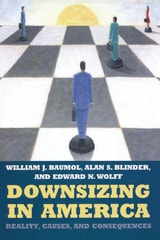
cover of Downsizing in America: Reality, Causes, and Consequences

Downsizing in America

Reality, Causes, and Consequences

William J. Baumol

Russell Sage Foundation, 2003
In the 1980s and early 1990s, a substantial number of U.S. companies announced major restructuring and downsizing. But we don't know exactly what changes in the U.S. and global economy triggered this phenomenon. Little research has been done on the underlying causes of downsizing. Did companies actually reduce the size of their workforces, or did they simply change the composition of their workforces by firing some kinds of workers and hiring others? Downsizing in America, one of the most comprehensive analyses of the subject to date, confronts all these questions, exploring three main issues: the extent to which firms actually downsized, the factors that triggered changes in firm size, and the consequences of downsizing. The authors show that much of the conventional wisdom regarding the spate of downsizing in the 1980s and 1990s is inaccurate. Nearly half of the large firms that announced major layoffs subsequently increased their workforce by more than 10 percent within two or three years. The only arena in which downsizing predominated appears to be the manufacturing sector-less than 20 percent of the U.S. workforce. Downsizing in America offers a range of compelling hypotheses to account for adoption of downsizing as an accepted business practice. In the short run, many companies experiencing difficulties due to decreased sales, cash flow problems, or declining securities prices reduced their workforces temporarily, expanding them again when business conditions improved. The most significant trigger leading to long-term downsizing was the rapid change in technology. Companies rid themselves of their least skilled workers and subsequently hired employees who were better prepared to work with new technology, which in some sectors reduced the size of firm at which production is most efficient. Baumol, Blinder, and Wolff also reveal what they call the dirty little secret of downsizing: it is profitable in part because it holds down wages. Downsizing in America shows that reducing employee rolls increased profits, since downsizing firms spent less money on wages relative to output, but it did not increase productivity. Nor did unions impede downsizing. The authors show that unionized industries were actually more likely to downsize in order to eliminate expensive union labor. In sum, downsizing transferred income from labor to capital-from workers to owners
[more]
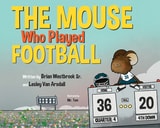
cover of The Mouse Who Played Football

The Mouse Who Played Football

Written by Brian Westbrook Sr. and Lesley Van Arsdall

Temple University Press, 2022

Some folks think Brian the mouse is too small. He may be a tough little fella, but they are not sure Brian has what it takes. The Mouse Who Played Football, by former Philadelphia Eagles running back Brian Westbrook Sr. and sports reporter Lesley Van Arsdall, shows how Brian the mouse proves everyone wrong with unyielding confidence that his small size can be his strength.

This charming children’s book, featuring appealing and dynamic illustrations by Mr. Tom, demonstrates how Brian the mouse overcomes what others see as a “big problem.” His determination—as well as speed and toughness on the gridiron—helps him become a star player in high school, college, and eventually, the MFL, the Mouse Football League.

The Mouse Who Played Football, based on Westbrook’s own experiences,is an inspiring story that encourages young readers to believe in themselves and make their unique differences their strengths.

[more]
cover of The Size of the Universe

The Size of the Universe

Joseph Cardinale

University of Alabama Press, 2010


The landscape of this novel in stories—Joseph Cardinale’s first book-length work of fiction—is as familiar as childhood yet beguilingly surreal. The question of whether or not the child in the first fiction and the man in the last story are the same person—and whether any person is the same from one moment to the next—is perhaps the book’s main question.

In prose as spare as it is meticulous, The Size of the Universe conjures an elegant labyrinth of time, space, and memory, in which a wavering self, a self on the verge of becoming nothing, seeks a safe haven from the throes of near-religious ecstasy. It is a debut work that is inviting, perplexing, and bold.

[more]