Results by title
8 books match the query 'Skills'
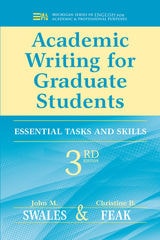
Academic Writing for Graduate Students, 3rd Edition
Essential Tasks and SkillsJohn M. Swales & Christine B. Feak
University of Michigan Press, 2012
Among the many changes in the third edition:
*newer, longer, and more authentic texts and examples
*greater discipline variety in texts (added texts from hard sciences and engineering)
*more in-depth treatment of research articles
*greater emphasis on vocabulary issues
*revised flow-of-ideas section
*additional tasks that require students to do their own research
*more corpus-informed content
*binding that allows the book to lay flat when open.
The Commentary (teacher's notes and key) (978-0-472-03506-9) has been revised expanded.
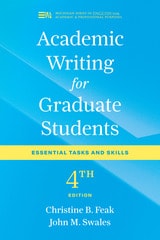
Academic Writing for Graduate Students
Essential Tasks and SkillsChristine B. Feak and John M. Swales
University of Michigan Press, 2027
For decades, Academic Writing for Graduate Students has introduced writers to the skills they need for successful academic writing. Now covering academic writing across an even broader range of disciplines, the new edition focuses on recurring rhetorical patterns found in academic texts and on the ways writers consider their audience, purpose, and disciplinary expectations as they make choices.
The book brings together short readings from published, student, and pedagogically-constructed texts with guided tasks to analyze how texts are organized and how claims are presented and supported. The first four units prepare students for academic writing while the following four units dive into genre-specific activities, such as the writing of summaries, critiques, and different research article sections. Throughout the book, readers will develop their rhetorical consciousness to see how strategic writing choices contribute to author positioning.
In Academic Writing for Graduate Students, 4th Edition, students will:
- Analyze real student writing for information flow, citation patterns, and authorial stance
- Learn to recognize different rhetorical patterns, such as cause and effect
- Engage with different types of writing, such as summaries, critiques, data commentary, book reviews, and research articles
Commentary for Academic Writing for Graduate Students, 2d ed.
Essential Tasks and SkillsJohn M. Swales and Christine B. Feak
University of Michigan Press, 2004
Like its predecessor, this edition of Academic Writing for Graduate Students
"explains understanding the intended audience, the purpose of the paper, and academic genres.
"includes the use of task-based methodology, analytic group discussion, and genre consciousness-raising.
"shows how to write summaries and critiques.
"features "language focus" sections that address linguistic elements as they affect the wider rhetorical objectives.
"helps students position themselves as junior scholars in their academic communities.
Commentary for Academic Writing for Graduate Students, 3rd Ed.
Essential Tasks and SkillsJohn M. Swales & Christine B. Feak
University of Michigan Press, 2012
The Commentary for the third edition of this successful guide to writing has been revised and expanded in many ways to provide more support for instructors; this includes additional tasks for Units Two and Four to supplement the main text. However, the collegial tone established in previous Commentaries between Swales & Feak and instructors has been retained.
This volume contains commentaries on each of the eight units plus the two appendixes. The format for each unit includes
- a summary of the main points of the unit along with a list of topics covered.
- a synopsis of activities, divided into Language Focus sections and description of tasks.
- some general notes designed to capture the character of the unit, to indicate alternative activities, or to anticipate problems that may arise.
- detailed commentary and discussion of individual tasks, including model or sample answers where possible.
Commentary for Academic Writing for Graduate Students
Essential Tasks and SkillsChristine B. Feak and John M. Swales
University of Michigan Press, 2027
Now in its 4th edition, the Commentary for Academic Writing for Graduate Students remains an important companion text. Useful for instructors as well as students and scholars using Academic Writing for Graduate Students for self-study, the Commentary includes a synopsis of what each unit attempts to achieve, further discussion of certain points, and sample responses to the more controlled tasks. Many of the responses or model texts come directly from class discussion or from submitted homework, which students generously offered for inclusion. In response to numerous requests, the authors have expanded the number of teaching suggestions included at the end of each unit for this edition.
Education, Skills, and Technical Change
Implications for Future US GDP GrowthEdited by Charles R. Hulten and Valerie A. Ramey
University of Chicago Press, 2018
Education, Skills, and Technical Change explores various facets of these questions and provides an overview of educational attainment in the United States and the channels through which labor force skills and education affect GDP growth. Contributors to this volume focus on a range of educational and training institutions and bring new data to bear on how we understand the role of college and vocational education and the size and nature of the skills gap. This work links a range of research areas—such as growth accounting, skill development, higher education, and immigration—and also examines how well students are being prepared for the current and future world of work.

Making Shift Happen
Directing ImpactMargareth de Wit
Amsterdam University Press, 2021
Margareth de Wit has inspired hundreds of professionals within the education sector to see themselves as playing the central role in providing better education through intelligent collaboration in self-managing school teams. Her experiences show that systematic attention to leadership and group dynamics creates organizations that are both successful and future-proof. Providing striking examples from her broad practice and experience, historical comparisons, human interactions, analytical schemes, and evidence-based methods, de Wit paints a picture of the road that leads to effective leadership. While this transition is never finished, it is nevertheless one that always leads to both personal and organizational improvement.
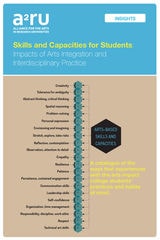
Skills and Capacities for Students
Impacts of Arts Integration and Interdisciplinary PracticeGabriel Harp
A2RU Intervals, 2020