Results by title

14 books match the query 'Skin'

cover of Beneath the Skin of Sorrow: Improvisations on Loss

Beneath the Skin of Sorrow

Improvisations on Loss

Nnenna Freelon

Duke University Press, 2025

Over a period of just six months, eminent jazz vocalist and composer Nnenna Freelon’s life changed irrevocably. Her soulmate and husband of nearly forty years, the renowned architect Phil Freelon, passed away from ALS, her sister Debbie succumbed to cancer, and the family dog, Basie, died as well. In the immediate wake of these compounding losses, Freelon could not find a way to process or understand her grief and lost the ability to read, sing, and improvise. The inner melody that had vibrated inside of her since childhood went silent. She then realized that the only way to move forward was to lean into her grief.

Part love story, part homage to jazz, and part guide to creative practice within bereavement, Beneath the Skin of Sorrow follows Freelon’s difficult and personal journey to healing. Calling on the improvisational skills that she had built over her forty-year career as a jazz singer, Freelon crafted her new reality by improvising—thinking about grieving as a series of small, daily engagements with the world around her. Slowly, Freelon regained the pieces of her musical sensibility, realizing that flowing between words spoken and words sung allowed her to understand what could not be fully realized in either realm.

By improvising a new life, Freelon forged a new companionship between grief, art, and daily life. In the essays, poems, lyrics, and explorations of jazz standards that comprise this lyrical and elegiac memoir, Freelon shows how thinking about grief as an exercise in improvisation can lead to a creative coexistence with grief in all its forms.
[more]
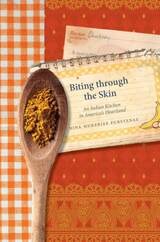
cover of Biting through the Skin: An Indian Kitchen in America's Heartland

Biting through the Skin

An Indian Kitchen in America's Heartland

Nina Mukerjee Furstenau

University of Iowa Press, 2013

At once a traveler’s tale, a memoir, and a mouthwatering cookbook, Biting through the Skin offers a first-generation immigrant’s perspective on growing up in America’s heartland. Author Nina Mukerjee Furstenau’s parents brought her from Bengal in northern India to the small town of Pittsburg, Kansas, in 1964, decades before you could find long-grain rice or plain yogurt in American grocery stores. Embracing American culture, the Mukerjee family ate hamburgers and softserve ice cream, took a visiting guru out on the lake in their motorboat, and joined the Shriners. Her parents transferred the cultural, spiritual, and family values they had brought with them to their children only behind the closed doors of their home, through the rituals of cooking, serving, and eating Bengali food and making a proper cup of tea.

As a girl and a young woman, Nina traveled to her ancestral India as well as to college and to Peace Corps service in Tunisia. Through her journeys and her marriage to an American man whose grandparents hailed from Germany and Sweden, she learned that her family was not alone in being a small pocket of culture sheltered from the larger world. Biting through the Skin shows how we maintain our differences as well as how we come together through what and how we cook and eat. In mourning the partial loss of her heritage, the author finds that, ultimately, heritage always finds other ways of coming to meet us. In effect, it can be reduced to a 4 x 6-inch recipe card, something that can fit into a shirt pocket. It’s on just such tiny details of life that belonging rests.

In this book, the author shares her shirt-pocket recipes and a great deal more, inviting readers to join her on her journey toward herself and toward a vital sense of food as culture and the mortar of community.
[more]
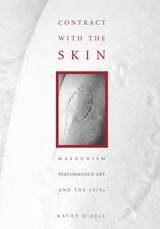
cover of Contract With The Skin: Masochism, Performance Art, and the 1970s

Contract With The Skin

Masochism, Performance Art, and the 1970s

Kathy O'Dell

University of Minnesota Press, 1998

Places masochistic performance within a social and historical context.

Having yourself shot. Putting out fires with your bare hands and feet. Biting your own body and photographing the marks. Sewing your own mouth shut. These seemingly aberrant acts were committed by performance artists during the 1970s. Why would anyone do these things? What do these kinds of masochistic performances tell us about the social and historical context in which they occurred? Fascinating and accessibly written, Contract with the Skin addresses such questions through a reconsideration of these acts in relation to psychoanalytic and legal concepts of masochism.

O’Dell argues that the growth of masochistic performance during the 1970s must be seen in the context of society’s response to the Vietnam War and contemporaneous changes in theories of contract. She contends that the dynamic that exists between audience and performer during these masochistic acts relates to tensions resulting from ruptures in the social contract. Indeed, as the war in Vietnam waned, so did masochistic performance, only to reemerge in the 1980s in relation to the “war on AIDS” and the censorious “culture wars.”Focusing on 1970s performance artists Vito Acconci, Chris Burden, Gina Pane, and collaborators Marina Abramovi´c/Ulay as well as those with similar sensibilities from the late 1980s onward (Bob Flanagan, David Wojnarowicz, Simon Leung, Catherine Opie, Ron Athey, Lutz Bacher, and Robby Garfinkel), O’Dell provides photographic documentation of performances and quotations from interviews with many of the artists. Throughout, O’Dell asks what we can do about the institutionalized forms of masochism for which these performances are metaphors. Contract with the Skin is a provocative guide to this little-studied area, and offers new ways of thinking about performance art and artistic production.
[more]
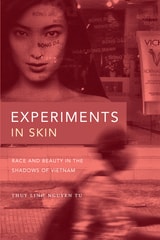
cover of Experiments in Skin: Race and Beauty in the Shadows of Vietnam

Experiments in Skin

Race and Beauty in the Shadows of Vietnam

Thuy Linh Nguyen Tu

Duke University Press, 2021
In Experiments in Skin Thuy Linh Nguyen Tu examines the ongoing influence of the Vietnam War on contemporary ideas about race and beauty. Framing skin as the site around which these ideas have been formed, Tu foregrounds the histories of militarism in the production of US biomedical knowledge and commercial cosmetics. She uncovers the efforts of wartime scientists in the US Military Dermatology Research Program to alleviate the environmental and chemical risks to soldiers' skin. These dermatologists sought relief for white soldiers while denying that African American soldiers and Vietnamese civilians were also vulnerable to harm. Their experiments led to the development of pharmaceutical cosmetics, now used by women in Ho Chi Minh City to tend to their skin, and to grapple with the damage caused by the war's lingering toxicity. In showing how the US military laid the foundations for contemporary Vietnamese consumption of cosmetics and practices of beauty, Tu shows how the intersecting histories of militarism, biomedicine, race, and aesthetics become materially and metaphorically visible on skin.
[more]
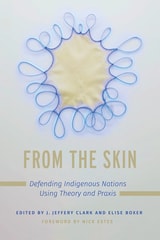
cover of From the Skin: Defending Indigenous Nations Using Theory and Praxis

From the Skin

Defending Indigenous Nations Using Theory and Praxis

Edited by J. Jeffery Clark and Elise Boxer; Foreword by Nick Estes

University of Arizona Press, 2023

In this volume, contributors demonstrate the real-world application of Indigenous theory to the work they do in their own communities and how this work is driven by urgency, responsibility, and justice—work that is from the skin.

In From the Skin, contributors reflect on and describe how they apply the theories and concepts of Indigenous studies to their communities, programs, and organizations, and the ways the discipline has informed and influenced the same. They show the ways these efforts advance disciplinary theories, methodologies, and praxes. Chapters cover topics including librarianship, health programs, community organizing, knowledge recovery, youth programming, and gendered violence. Through their examples, the contributors show how they negotiate their peoples’ knowledge systems with knowledge produced in Indigenous studies programs, demonstrating how they understand the relationship between their people, their nations, and academia.

Editors J. Jeffery Clark and Elise Boxer propose and develop the term practitioner-theorist to describe how the contributors theorize and practice knowledge within and between their nations and academia. Because they live and exist in their community, these practitioner-theorists always consider how their thinking and actions benefit their people and nations. The practitioner-theorists of this volume envision and labor toward decolonial futures where Indigenous peoples and nations exist on their own terms.

Contributors
Randi Lynn Boucher-Giago
Elise Boxer
Shawn Brigman
J. Jeffery Clark
Nick Estes
Eric Hardy
Shalene Joseph
Jennifer Marley
Brittani R. Orona
Alexander Soto
[more]
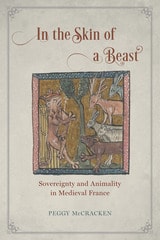
cover of In the Skin of a Beast: Sovereignty and Animality in Medieval France

In the Skin of a Beast

Sovereignty and Animality in Medieval France

Peggy McCracken

University of Chicago Press, 2017

In medieval literature, when humans and animals meet—whether as friends or foes—issues of mastery and submission are often at stake. In the Skin of a Beast shows how the concept of sovereignty comes to the fore in such narratives, reflecting larger concerns about relations of authority and dominion at play in both human-animal and human-human interactions.

Peggy McCracken discusses a range of literary texts and images from medieval France, including romances in which animal skins appear in symbolic displays of power, fictional explorations of the wolf’s desire for human domestication, and tales of women and snakes converging in a representation of territorial claims and noble status. These works reveal that the qualities traditionally used to define sovereignty—lineage and gender among them—are in fact mobile and contingent. In medieval literary texts, as McCracken demonstrates, human dominion over animals is a disputed model for sovereign relations among people: it justifies exploitation even as it mandates protection and care, and it depends on reiterations of human-animal difference that paradoxically expose the tenuous nature of human exceptionalism.
[more]
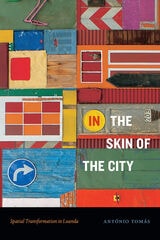
cover of In the Skin of the City: Spatial Transformation in Luanda

In the Skin of the City

Spatial Transformation in Luanda

António Tomás

Duke University Press, 2022
With In the Skin of the City, António Tomás traces the history and transformation of Luanda, Angola, the nation’s capital as well as one of the oldest settlements founded by the European colonial powers in the Southern Hemisphere. Drawing on ethnographic and archival research alongside his own experiences growing up in Luanda, Tomás shows how the city’s physical and social boundaries—its skin—constitute porous and shifting interfaces between center and margins, settler and Native, enslaver and enslaved, formal and informal, and the powerful and the powerless. He focuses on Luanda’s “asphalt frontier”—the (colonial) line between the planned urban center and the ad hoc shantytowns that surround it—and the ways squatters are central to Luanda’s historical urban process. In their relationship with the state and their struggle to gain rights to the city, squatters embody the process of negotiating Luanda’s divisions and the sociopolitical forces that shape them. By illustrating how Luanda emerges out of the continual redefinition of its skin, Tomás offers new ways to understand the logic of urbanization in cities across the global South.
[more]
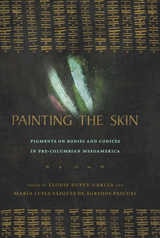
cover of Painting the Skin: Pigments on Bodies and Codices in Pre-Columbian Mesoamerica

Painting the Skin

Pigments on Bodies and Codices in Pre-Columbian Mesoamerica

Edited by Élodie Dupey García and María Luisa Vázquez de Ágredos Pascual

University of Arizona Press, 2018

Mesoamerican communities past and present are characterized by their strong inclination toward color and their expert use of the natural environment to create dyes and paints. In pre-Hispanic times, skin was among the preferred surfaces on which to apply coloring materials. Archaeological research and historical and iconographic evidence show that, in Mesoamerica, the human body—alive or dead—received various treatments and procedures for coloring it.

Painting the Skin brings together exciting research on painted skins in Mesoamerica. Chapters explore the materiality, uses, and cultural meanings of the colors applied to a multitude of skins, including bodies, codices made of hide and vegetal paper, and even building “skins.” Contributors offer physicochemical analysis and compare compositions, manufactures, and attached meanings of pigments and colorants across various social and symbolic contexts and registers. They also compare these Mesoamerican colors with those used in other ancient cultures from both the Old and New Worlds. This cross-cultural perspective reveals crucial similarities and differences in the way cultures have painted on skins of all types.

Examining color in Mesoamerica broadens understandings of Native religious systems and world views. Tracing the path of color use and meaning from pre-Columbian times to the present allows for the study of the preparation, meanings, social uses, and thousand-year origins of the coloring materials used by today’s Indigenous peoples.

Contributors:

María Isabel Álvarez Icaza Longoria
Christine Andraud
Bruno Giovanni Brunetti
David Buti
Davide Domenici
Élodie Dupey García
Tatiana Falcón Álvarez
Anne Genachte-Le Bail
Fabrice Goubard
Aymeric Histace
Patricia Horcajada Campos
Stephen Houston
Olivia Kindl
Bertrand Lavédrine
Linda R. Manzanilla Naim
Anne Michelin
Costanza Miliani
Virgina E. Miller
Sélim Natahi
Fabien Pottier
Patricia Quintana Owen
Franco D. Rossi
Antonio Sgamellotti
Vera Tiesler
Aurélie Tournié
María Luisa Vázquez de Ágredos Pascual
Cristina Vidal Lorenzo

[more]
cover of Skin and Starch: Manioc and Worldmaking in the Caribbean

Skin and Starch

Manioc and Worldmaking in the Caribbean

Isabel Bradley

Duke University Press, 2027

Skin and Starch traces the movements and meanings of manioc, also known as cassava or yuca, across the Atlantic world to show how this tropical plant sustained both colonial exploitation and assertions of Black and Indigenous humanity. Isabel Bradley follows manioc from Caribbean forest gardens to slaving ships, from plantation provision grounds to maroon subsistence networks, to reveal how transplantations of this tuberous root helped to shape human projects of subjugation and self-making. Drawing from an extensive archive of natural histories, plantation records, printed images, material culture, and francophone Caribbean literature and art, Bradley argues that embodied encounters between manioc and its growers informed modes of perception and possibility for subjects navigating colonial modernity. Skin and Starch presents a dynamic study of the diverse knowledges produced in the orbit of manioc cultivation and the generative forms of resistance and worldmaking that emerged within and against colonial monoculture and its violence.
[more]
cover of Skin and Starch: Manioc and Worldmaking in the Caribbean

Skin and Starch

Manioc and Worldmaking in the Caribbean

Isabel Bradley

Duke University Press, 2027

Skin and Starch traces the movements and meanings of manioc, also known as cassava or yuca, across the Atlantic world to show how this tropical plant sustained both colonial exploitation and assertions of Black and Indigenous humanity. Isabel Bradley follows manioc from Caribbean forest gardens to slaving ships, from plantation provision grounds to maroon subsistence networks, to reveal how transplantations of this tuberous root helped to shape human projects of subjugation and self-making. Drawing from an extensive archive of natural histories, plantation records, printed images, material culture, and francophone Caribbean literature and art, Bradley argues that embodied encounters between manioc and its growers informed modes of perception and possibility for subjects navigating colonial modernity. Skin and Starch presents a dynamic study of the diverse knowledges produced in the orbit of manioc cultivation and the generative forms of resistance and worldmaking that emerged within and against colonial monoculture and its violence.
[more]
cover of The Skin of Meaning: Collected Literary Essays and Talks

The Skin of Meaning

Collected Literary Essays and Talks

Aaron Shurin

University of Michigan Press, 2016
A volume in the Poets on Poetry series, which collects critical works by contemporary poets, gathering together the articles, interviews, and book reviews by which they have articulated the poetics of a new generation.

In The Skin of Meaning, Aaron Shurin has collected thirty years’ worth of his provocative essays. Fueled by gender and queer studies and combined with radical traditions in poetry, Shurin’s essays combine a highly personal and lyrical vision with a trenchant social analysis of poetry’s possibilities. Whether he’s examining innovations in poetic form, analyzing the gestures of drag queens, or dissecting the language of AIDS, Shurin’s writing is evocative, his investigations rigorous, and his point of view unabashed.

Shurin’s poetic practice braids together many strands in contemporary, innovative writing, from the San Francisco Renaissance to Language Poetry and New Narrative Writing. His mentorships with Robert Duncan and Denise Levertov; his studies at New College of California, where he was the first graduate of the epochal Poetics Program; and his years of teaching writing provide a rich background for these essays. San Francisco provides the color and context for formulations of “prosody now,” propositions of textual collage, and theories of radical narrativity, while the heart of the book searches through the dire years of the AIDS epidemic to uncover poetic meaning, and “make the heroes heroes.”

[more]
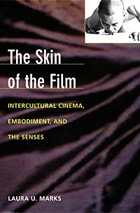
cover of The Skin of the Film: Intercultural Cinema, Embodiment, and the Senses

The Skin of the Film

Intercultural Cinema, Embodiment, and the Senses

Laura U. Marks

Duke University Press, 2000

Memories that evoke the physical awareness of touch, smell, and bodily presence can be vital links to home for people living in diaspora from their culture of origin. How can filmmakers working between cultures use cinema, a visual medium, to transmit that physical sense of place and culture? In The Skin of the Film Laura U. Marks offers an answer, building on the theories of Gilles Deleuze and others to explain how and why intercultural cinema represents embodied experience in a postcolonial, transnational world.

Much of intercultural cinema, Marks argues, has its origin in silence, in the gaps left by recorded history. Filmmakers seeking to represent their native cultures have had to develop new forms of cinematic expression. Marks offers a theory of “haptic visuality”—a visuality that functions like the sense of touch by triggering physical memories of smell, touch, and taste—to explain the newfound ways in which intercultural cinema engages the viewer bodily to convey cultural experience and memory. Using close to two hundred examples of intercultural film and video, she shows how the image allows viewers to experience cinema as a physical and multisensory embodiment of culture, not just as a visual representation of experience. Finally, this book offers a guide to many hard-to-find works of independent film and video made by Third World diasporic filmmakers now living in the United States, Great Britain, and Canada.

The Skin of the Film draws on phenomenology, postcolonial and feminist theory, anthropology, and cognitive science. It will be essential reading for those interested in film theory, experimental cinema, the experience of diaspora, and the role of the sensuous in culture.

[more]
cover of Twenty Square Feet of Skin

Twenty Square Feet of Skin

Megan Baxter

The Ohio State University Press, 2023
Longlisted for the 2024 PEN America Diamonstein-Spielvogel Award for the Art of the Essay “A pensive inquiry, often breathtakingly beautiful and relatable, into how and where and with whom we fit.” —Kirkus The essays in Twenty Square Feet of Skin tell their stories through the body—encased as it is in “that greatest of organs, that membrane that protects the individual from the universe”—as Megan Baxter’s entrée to and home within the larger world that surrounds her. What does a tattoo mean? How can plastic surgery transform? What is the history of pedicures? Where does the mind wander on a long run? Through every example, Baxter writes toward a greater understanding of how self-knowledge is forged through physical experiences. With the input of Prince, Walt Whitman, Don Johnson, Andrew Wyeth, Meriwether Lewis, and others, Baxter reflects on love, identity, and belonging by looking closely at her skin, toenails, and DNA. Playful, wandering, and deeply felt, Twenty Square Feet of Skin weaves a strange, rich tapestry of flesh and bones, art and body, skin and scar. In embracing the beauty and peril of physicality in crystalline detail, Baxter asks us all to ponder what makes us human within these frail, flawed, powerful, and wonderful bodies of ours.
[more]
cover of We See with the Skin: On Zora Neale Hurston's Methodology

We See with the Skin

On Zora Neale Hurston's Methodology

Roshanak Kheshti

Duke University Press, 2026

Roshanak Kheshti opens her book with a line from one of Zora Neale Hurston’s earliest stories: “we see with the skin.” From this brief but potent line, Kheshti examines how Hurston’s understanding of Black skin as both seen and seeing offers radical insight into racialized perception and Black consciousness. Kheshti follows Hurston’s travels across the back woods of Florida, Georgia, Alabama, and Louisiana as a filmmaker and sensory ethnographer of the African diasporic spiritual practice of hoodoo. Through her travels, Hurston encountered a sensibility that could animate the object status of being colored with the power of a return gaze. Kheshti considers both how Hurston poetically exploited the synesthetic logic at the heart of race thinking—being colored—and how her embodied performance ethnography catalogued an outside to that logic. We See with the Skin is an original mapping of Hurston’s synesthetic theory and its broader implications for understanding minoritarian perception and thought.
[more]