Results by title

4 books match the query 'Skocpol, Theda'
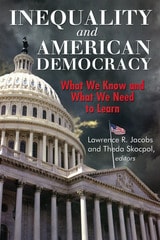
cover of Inequality and American Democracy: What We Know and What We Need to Learn

Inequality and American Democracy

What We Know and What We Need to Learn

Lawrence R. Jacobs

Russell Sage Foundation, 2005
In the twentieth century, the United States ended some of its most flagrant inequalities. The "rights revolution" ended statutory prohibitions against women's suffrage and opened the doors of voting booths to African Americans. Yet a more insidious form of inequality has emerged since the 1970s—economic inequality—which appears to have stalled and, in some arenas, reversed progress toward realizing American ideals of democracy. In Inequality and American Democracy, editors Lawrence Jacobs and Theda Skocpol headline a distinguished group of political scientists in assessing whether rising economic inequality now threatens hard-won victories in the long struggle to achieve political equality in the United States. Inequality and American Democracy addresses disparities at all levels of the political and policy-making process. Kay Lehman Scholzman, Benjamin Page, Sidney Verba, and Morris Fiorina demonstrate that political participation is highly unequal and strongly related to social class. They show that while economic inequality and the decreasing reliance on volunteers in political campaigns serve to diminish their voice, middle class and working Americans lag behind the rich even in protest activity, long considered the political weapon of the disadvantaged. Larry Bartels, Hugh Heclo, Rodney Hero, and Lawrence Jacobs marshal evidence that the U.S. political system may be disproportionately responsive to the opinions of wealthy constituents and business. They argue that the rapid growth of interest groups and the increasingly strict party-line voting in Congress imperils efforts at enacting policies that are responsive to the preferences of broad publics and to their interests in legislation that extends economic and social opportunity. Jacob Hacker, Suzanne Mettler, and Dianne Pinderhughes demonstrate the feedbacks of government policy on political participation and inequality. In short supply today are inclusive public policies like the G.I. Bill, Social Security legislation, the War on Poverty, and the Voting Rights Act of 1965 that changed the American political climate, mobilized interest groups, and altered the prospect for initiatives to stem inequality in the last fifty years. Inequality and American Democracy tackles the complex relationships between economic, social, and political inequality with authoritative insight, showcases a new generation of critical studies of American democracy, and highlights an issue of growing concern for the future of our democratic society.
[more]
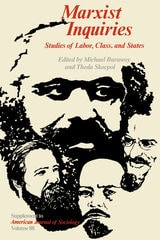
cover of Marxist Inquiries: Studies of Labor, Class, and States

Marxist Inquiries

Studies of Labor, Class, and States

Edited by Michael Burawoy and Theda Skocpol

University of Chicago Press, 1983

This collection exemplifies the resurgence of Marxist ideas in contemporary social research. Its purpose is neither to cover all the areas of Marxist research nor to survey alternative Marxist perspectives or schools. Rather the volume assembles nine examples of the most interesting work being done today by younger sociologists who are seriously pursuing the rich and provocative arguments to be found in the ongoing Marxist tradition. All contributions build upon or react to Marxist theoretical perspectives. They employ such diverse research techniques as participant observation, statistical analysis, interviewing, and the examination of archives of public documents. Among the topics covered:

– the economic bases of state policies and their determination by social and political struggles;
–  the politcal reshaping of international economic order;
– industrial work in relation to other institutions (such as education, patriarchy, and citizenship);
– the transformation of class structures in capitalist and state-socialist societies.

Published as a supplement to American Journal of Sociology, these studies constitute essential reading both for those sociologists who see Marxism as a powerful framework for understanding capitalist societies and for those who may not be committed to working within the Marxist tradition but nevertheless want to see Marxist hypotheses fully researched and debated.
[more]
cover of Policy Challenges in Modern Health Care

Policy Challenges in Modern Health Care

Edited by David Mechanic, Lynn B. Rogut, David Colby, and James R. Knickman

Rutgers University Press, 2005

Health care delivery in the United States is an enormously complex enterprise, and its $1.6 trillion annual expenditures involve a host of competing interests. While arguably the nation offers among the most technologically advanced medical care in the world, the American system consistently under performs relative to its resources. Gaps in financing and service delivery pose major barriers to improving health, reducing disparities, achieving universal insurance coverage, enhancing quality, controlling costs, and meeting the needs of patients and families.

Bringing together twenty-five of the nation’s leading experts in health care policy and public health, this book provides a much-needed perspective on how our health care system evolved, why we face the challenges that we do, and why reform is so difficult to achieve. The essays tackle tough issues including: socioeconomic disadvantage, tobacco, obesity, gun violence, insurance gaps, the rationing of services, the power of special interests, medical errors, and the nursing shortage.

Linking the nation’s health problems to larger political, cultural, and philosophical contexts, Policy Challenges in Modern Health Care offers a compelling look at where we stand and where we need to be headed.
[more]
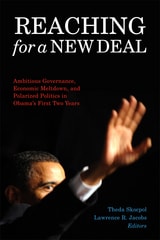
cover of Reaching for a New Deal: Ambitious Governance, Economic Meltdown, and Polarized Politics in Obama's First Two Years

Reaching for a New Deal

Ambitious Governance, Economic Meltdown, and Polarized Politics in Obama's First Two Years

Theda Skocpol

Russell Sage Foundation, 2011

During his winning presidential campaign, Barack Obama promised to counter rising economic inequality and revitalize America's middle-class through a series of wide-ranging reforms. His transformational agenda sought to ensure affordable healthcare; reform the nation's schools and make college more affordable; promote clean and renewable energy; reform labor laws and immigration; and redistribute the tax burden from the middle class to wealthier citizens. The Wall Street crisis and economic downturn that erupted as Obama took office also put U.S. financial regulation on the agenda. By the middle of President Obama's first term in office, he had succeeded in advancing major reforms by legislative and administrative means. But a sluggish economic recovery from the deep recession of 2009, accompanied by polarized politics and governmental deadlock in Washington, DC, have raised questions about how far Obama's promised transformations can go. Reaching for a New Deal analyzes both the ambitious domestic policy of Obama's first two years and the consequent political backlash—up to and including the 2010 midterm elections. Reaching for a New Deal opens by assessing how the Obama administration overcame intense partisan struggles to achieve legislative victories in three areas—health care reform, federal higher education loans and grants, and financial regulation. Lawrence Jacobs and Theda Skocpol examine the landmark health care bill, signed into law in spring 2010, which extended affordable health benefits to millions of uninsured Americans after nearly 100 years of failed legislative attempts to do so. Suzanne Mettler explains how Obama succeeded in reorienting higher education policy by shifting loan administration from lenders to the federal government and extending generous tax tuition credits. Reaching for a New Deal also examines the domains in which Obama has used administrative action to further reforms in schools and labor law. The book concludes with examinations of three areas—energy, immigration, and taxes—where Obama's efforts at legislative compromises made little headway. Reaching for a New Deal combines probing analyses of Obama's domestic policy achievements with a big picture look at his change-oriented presidency. The book uses struggles over policy changes as a window into the larger dynamics of American politics and situates the current political era in relation to earlier pivotal junctures in U.S. government and public policy. It offers invaluable lessons about unfolding political transformations in the United States.
[more]