Results by title
4 books match the query 'Sleep disorders'
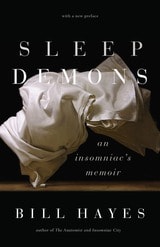
Sleep Demons
An Insomniac’s MemoirBill Hayes
University of Chicago Press, 2018
An acclaimed journalist and memoirist—and partner of the late neurologist Oliver Sacks—Hayes has been plagued by insomnia his entire life. The science and mythology of sleep and sleeplessness form the backbone to Hayes’s narrative of his personal battles with sleep and how they colored his waking life, as he threads stories of fugitive sleep through memories of growing up in the closet, coming out to his Irish Catholic family, watching his friends fall ill during the early years of the AIDS crisis in San Francisco, and finding a lover. An erudite blend of science and personal narrative, Sleep Demons offers a poignant introduction to the topics for which Hayes has since become famous, including art, eros, city life, the history of medical science, and queer identity.
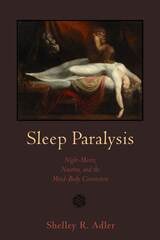
Sleep Paralysis
Night-mares, Nocebos, and the Mind-Body ConnectionAdler, Shelley R
Rutgers University Press, 2011
Shelley R. Adler's fifteen years of field and archival research focus on the ways in which night-mare attacks have been experienced and interpreted throughout history and across cultures and how, in a unique example of the effect of nocebo (placebo's evil twin), the combination of meaning and biology may result in sudden nocturnal death.
The Science of Sleep
What It Is, How It Works, and Why It MattersWallace B. Mendelson
University of Chicago Press, 2017
In The Science of Sleep, sleep expert Wallace B. Mendelson explains the elements of human sleep states and explores the variety of sleep disorders afflicting thousands of people worldwide. Mendelson lays out the various treatments that are available today and provides a helpful guide for one of life’s most important activities. By offering the first scientific yet accessible account of sleep science, Mendelson allows readers to assess their personal relationships with sleep and craft their own individual approaches to a comfortable and effective night’s rest.
Addressing one of the major public health issues of the day with cutting-edge research and empathetic understanding, The Science of Sleep is the definitive illustrated reference guide to sleep science.
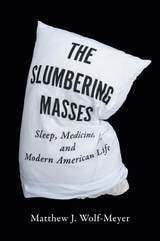
The Slumbering Masses
Sleep, Medicine, and Modern American LifeMatthew J. Wolf-Meyer
University of Minnesota Press, 2016
Americans spend billions of dollars every year on drugs, therapy, and other remedies trying to get a good night’s sleep. Anxieties about not getting enough sleep and the impact of sleeplessness on productivity, health, and happiness pervade medical opinion, the workplace, and popular culture. In The Slumbering Masses, Matthew J. Wolf-Meyer addresses the phenomenon of sleep and sleeplessness in the United States, tracing the influence of medicine and industrial capitalism on the sleeping habits of Americans from the nineteenth century to the present.
Before the introduction of factory shift work, Americans enjoyed a range of sleeping practices, most commonly two nightly periods of rest supplemented by daytime naps. The new sleeping regimen—eight uninterrupted hours of sleep at night—led to the pathologization of other ways of sleeping. Arguing that the current model of sleep is rooted not in biology but in industrial capitalism’s relentless need for productivity, The Slumbering Masses examines so-called Z-drugs that promote sleep, the use of both legal and illicit stimulants to combat sleepiness, and the contemporary politics of time. Wolf-Meyer concludes by exploring the extremes of sleep, from cases of perpetual sleeplessness and the use of the sleepwalking defense in criminal courts to military experiments with ultra-short periods of sleep.
Drawing on untapped archival sources and long-term ethnographic research with people who both experience and treat sleep abnormalities, Wolf-Meyer analyzes and sharply critiques how sleep and its supposed disorders are understood and treated. By recognizing the variety and limits of sleep, he contends, we can establish more flexible expectations about sleep and, ultimately, subvert the damage of sleep pathology and industrial control on our lives.