Results by title
2 books match the query 'Sleeper, R. W.'
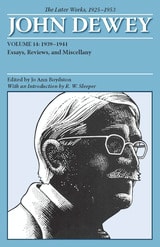
The Later Works of John Dewey, Volume 14, 1925 - 1953
1939 - 1941, Essays, Reviews, and MiscellanyJohn Dewey. Edited by Jo Ann Boydston
Southern Illinois University Press, 2008
This volume republishes forty-four essays, reviews, and miscellaneous pieces from 1939, 1940, and 1941.
In his Introduction, R. W. Sleeper characterizes the contents of this volume as “vintage Dewey. Ranging widely over problems of theory and practice, they reveal him commencing his ninth decade at the peak of his intellectual powers.”
“Nature in Experience,” Dewey’s reply to Morris R. Cohen and William Ernest Hocking, “is a model of clarity and responsiveness,” writes Sleeper, “perhaps his clearest statement of why it is that metaphysics does not play the fundamental role for him that it had regularly played for his predecessors.”

The Necessity of Pragmatism
John Dewey's Conception of PhilosophyR. W. Sleeper
University of Illinois Press, 1986
Identifying Dewey's differences with his pragmatist forerunners, Charles Sanders Peirce and William James, Sleeper elucidates Dewey's reshaping of pragmatism and the radical significance of his philosophy of culture. In this first paperback edition, a new introduction by Tom Burke establishes the ongoing importance of Sleeper's analysis of the integrity of Dewey's work and its implications for mathematics, aesthetics, and the cognitive sciences.