Results by title
19 books match the query 'Small business'
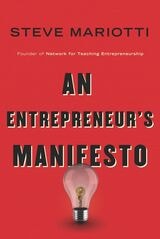
An Entrepreneur’s Manifesto
Steve Mariotti
Templeton Press, 2015
In an increasingly competitive world market, how does the United States rank? Many Americans are worried about the economic state of their nation, especially now that countries like China are becoming ever more economically powerful. What does America need to both stabilize and energize its economy?
Entrepreneurship, Steve Mariotti claims, is vital. An Entrepreneur’s Manifesto is Mariotti’s rallying cry for the world to recognize the potential that business creation holds for the individual and the economy. Mariotti explores how entrepreneurship affects schools and prisons, developed cities and isolated villages, brick-and-mortar stores, and internet-based businesses. He takes a hard look at the research on entrepreneurial education, entrepreneurship, government policy, and the social and cultural attributes most likely to foster successful business creation, incorporating his discussions with some of the best minds on the question of entrepreneurship. Mariotti also examines how the rise of the Internet and Web-based innovations like crowdfunding have both changed—and not changed—the fundamentals of promoting those who take the ultimate gamble of going into business for themselves.
As the author of several leading textbooks on the subject and founder of the Network for Teaching Entrepreneurship (NFTE), a global nonprofit organization that has educated more than 500,000 students and trained more than 5,000 teachers in 50 countries, Mariotti is both an experienced and reliable leader in what he calls the entrepreneurial revolution. Mariotti frequently writes for the Huffington Post and has been recruited by the State Department to discuss his ideas on youth entrepreneurship in Cambodia and other developing countries seeking to escape the shackles of centrally planned economic policies.
Neither a dry recitation of academic theory nor a scattered collection of feel-good stories, An Entrepreneur’s Manifesto builds on Mariotti’s unique perspective to offer a critique that is both inspiring and practical. Riveting stories complement enlightening real-world perspectives, making the work relatable and inspiring.
“There is no more revolutionary act,” Mariotti says, “than starting a business.”
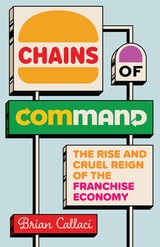
Chains of Command
The Rise and Cruel Reign of the Franchise EconomyBrian Callaci
University of Chicago Press, 2026
A surprising look at the big business of owning small businesses and what America’s franchise economy means for its workers.
Walk into a McDonald’s anywhere in the United States, and it will be identical to every other McDonald’s in the country. Yet, that particular store is almost certainly owned and operated by an “independent” franchisee. While McDonald’s presents an image of centralized uniformity to the consumer, it shows a different face to the small business owners operating its stores under its control and the workers preparing its product to its standards. How then does McDonald’s—and its big business peers—manage to be two things at once?
In this revelatory work, economist Brian Callaci shows how franchisors have altered the legal treatment of corporations in their favor through a decades-long crusade of lobbying and litigation. Their efforts subsequently unleashed a slew of legal and economic sins upon the US economy and labor force, allowing multinational corporations to control continent-spanning empires while outsourcing employment and scapegoating legal responsibilities onto small businesses. The result: the unfettered growth of some of America’s most recognizable businesses, at the aggregate expense of America’s workers.
Remarkable in both its scale and synthesis, Callaci’s story is the first chronicle of this business movement—initially resisted by US courts before experiencing a dramatic reversal of fortune after decades of campaigning by some of America’s most established entrepreneurs. An urgent and erudite history, Chains of Command reveals how the US labor market was tamed one small business at a time.
Dynamic Management of Growing Firms
A Strategic ApproachLorraine Uhlaner Hendrickson and John Psarouthakis
University of Michigan Press, 1998
Financing State and Local Economic Development
Michael Barker, ed.
Duke University Press, 1983
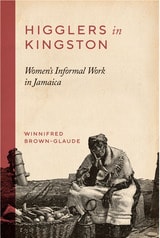
Higglers in Kingston
Women's Informal Work in JamaicaWinnifred Brown-Glaude
Vanderbilt University Press, 2011
In Higglers in Kingston, Winnifred Brown-Glaude puts the reader on the ground in frenetic urban Kingston, the capital and largest city in Jamaica. She explores the lives of informal market laborers, called "higglers," across the city as they navigate a corrupt and inaccessible "official" Jamaican economy. But rather than focus merely on the present-day situation, she contextualizes how Jamaica arrived at this point, delving deep into the island's history as a former colony, a home to slaves and masters alike, and an eventual nation of competing and conflicted racial sectors.
Higglers in Kingston weaves together contemporary ethnography, economic history, and sociology of race to address a broad audience of readers on a crucial economic and cultural center.

International Differences in Entrepreneurship
Edited by Josh Lerner and Antoinette Schoar
University of Chicago Press, 2010
Often considered one of the major forces behind economic growth and development, the entrepreneurial firm can accelerate the speed of innovation and dissemination of new technologies, thus increasing a country's competitive edge in the global market. As a result, cultivating a strong culture of entrepreneurial thinking has become a primary goal throughout the world.
Surprisingly, there has been little systematic research or comparative analysis to show how the growth of entrepreneurship differs among countries in various stages of development. International Differences in Entrepreneurship fills this void by explaining how a country's institutional differences, cultural considerations, and personal characteristics can affect the role that entrepreneurs play in its economy. Developing an understanding of the origins of entrepreneurs as well as the choices they make and the complexity of their activities across countries and industries are of central importance to this volume. In addition, contributors consider how environmental factors of individual economies, such as market regulation, government subsidies for banks, and support for entrepreneurial culture affect the industry and the impact that entrepreneurs have on growth in developing nations.

Jua Kali Kenya
Change and Development in an Informal Economy, 1970–1995Kenneth King
Ohio University Press, 1996
In this remarkable book Kenneth King brings the subject alive through the photographs and life histories of jua kali people. He has also revisited, twenty years later, many of the artisans whom he interviewed exhaustively in the period from 1972 to 1974 and about whom he wrote in The African Artisan, one of the first full-length studies to be published on the informal sector.
For donors, NGOs, and national governments, the book offers many relevant examples, and some cautions, about what has been achieved by ordinary Kenyans, mostly without government support. It will prove equally valuable for students and teachers of development policy, technology policy, and education and training policies not least because of its superb bibliography of over 700 entries related to small enterprise development.
Obliging Need
Rural Petty Industry in Mexican CapitalismBy Scott Cook and Leigh Binford
University of Texas Press, 1990
For centuries throughout large portions of the globe, petty agriculturalists and industrialists have set their physical and mental energies to work producing products for direct consumption by their households and for exchange. This twofold household reproduction strategy, according to both Marxist and neoclassical approaches to development, should have disappeared from the global economy as labor was transformed into a producer as well as a consumer of capitalist commodities. But in fact, during the twentieth century, only the United States and Britain seem to have approximated this predicted scenario. Tens of millions of households in contemporary Asia, Africa, and Latin America and millions more in industrialized capitalist economies support themselves through petty commodity production alone or in combination with petty industry wage labor.
Obliging Need provides a detailed and comprehensive analysis of small-scale peasant and artisan enterprise in the Oaxaca Valley of Mexico. The authors show how commodity production is organized and operates in different craft industries, as well as the ways in which it combines with other activities such as household chores, agriculture, wage labor, and petty commerce. They demonstrate how—contrary to developmentalist dogma—small-scale capitalism develops from within Mexico's rural economy.
These findings will be important for everyone concerned with improving the lives and economic opportunities of countryfolk in the Third World. As the authors make clear, political mobilization in rural Mexico will succeed only as it addresses the direct producers' multiple needs for land, credit, more jobs, health insurance, and, most importantly, more equitable remuneration for their labor and greater rewards for their enterprise.
Oil and Urbanization on the Pacific Coast
Ralph Bramel Lloyd and the Shaping of the Urban WestMichael R. Adamson
West Virginia University Press, 2018
Oil and Urbanization on the Pacific Coast tells the story of oilman Ralph Bramel Lloyd, a small business owner who drove the development of one of America’s largest oil fields. Lloyd invested his petroleum earnings in commercial real estate—much of it centered around automobiles and the fuel they require—in several western cities, notably Portland, Oregon. Putting the history of extractive industry in dialogue with the history of urban development, Michael R. Adamson shows how energy is woven into the fabric of modern life, and how the “energy capital” of Los Angeles exerted far-flung influence in the US West.
A contribution to the relatively understudied history of small businesses in the United States, Oil and Urbanization on the Pacific Coast explores issues of interest to multiple audiences, such as the competition for influence over urban development waged among local growth machines and outside corporate interests; the urban rivalries of a region; the importance of public capital in mobilizing the commercial real estate sector during the Great Depression and World War II; and the relationships among owners, architects, and contractors in the execution of commercial building projects.
On My Own
Korean Businesses and Race Relations in AmericaIn-Jin Yoon
University of Chicago Press, 1997
In On My Own, In-Jin Yoon combines an intimate fieldwork account of Korean-black relations in Chicago and Los Angeles with extensive quantitative analysis at the national level. Yoon argues that a complete understanding of the contemporary Korean-American community requires systematic analyses of patterns of Korean immigration, entrepreneurship, and race relations with other minority groups. He explains how small business has become the major economic activity of Korean immigrants and how Korean businesses in minority neighborhoods have intensified racial tensions between Koreans and minorities like blacks and Latinos.
“A groundbreaking study of Korean-black relations. Yoon’s insights on immigration, entrepreneurship, and race relations significantly enhance our understanding of urban racial tensions.”—William Julius Wilson, Harvard University

Peruvians in Paterson
Building Businesses and CommunityGianncarlo Muschi
Rutgers University Press, 2027
Peruvians were among the first Latinos to arrive in Paterson and other cities in New Jersey during the post-WW II period. Over successive generations, they established a prosperous ethnic enclave that contributed to Paterson’s socioeconomic renewal. Yet their migration experience has remained relatively unexamined by scholars. This book examines the role of entrepreneurship and informality in the emergence and evolution of the Peruvian community of Paterson. It highlights the historical significance of the establishment of small businesses and social organizations as important cultural elements that validated their physical presence in the area. By uncovering the diverse strategies that Peruvians utilized for building a community, Muschi contends that their culture of informality and resourcefulness paved the way for their economic advancement and the consolidation of the Peruvian community. This book also shows that the informal economic practices introduced by Peruvians altered the social and economic landscape of Paterson and contributed to the revitalization of the local economy. Through the examination of oral histories, archival material from local newspapers, and memoirs declassified by the Peruvian consulate, the author challenges the oversimplified portrayal of Latinos as blue- collar workers with few opportunities for socioeconomic advancement. Peruvians in Paterson demonstrates that Latino migrants achieve wealth and ethnic empowerment in the process of adjustment and community building, suggesting new lines for future research.

Small Business and the Public Library
Strategies for a Successful PartnershipLuise Weiss
American Library Association, 2011
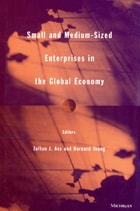
Small and Medium-Sized Enterprises in the Global Economy
Zoltan J. Acs and Bernard Yeung, Editors
University of Michigan Press, 1999
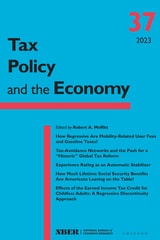
Tax Policy and the Economy, Volume 37
Edited by Robert A. Moffitt
University of Chicago Press Journals, 2023
Tax Policy and the Economy publishes current academic research on taxation and government spending with both immediate bearing on policy debates and longer-term interest.
This volume of Tax Policy and the Economy presents new research on important issues concerning US taxation and transfers. First, Edward L. Glaeser, Caitlin S. Gorback, and James M. Poterba examine the distribution of burdens associated with taxes on transportation. Replacing the gasoline tax with a vehicle-miles-traveled (VMT) tax would increase the burden on higher-income households, who drive more fuel-efficient cars and are more likely to own electric vehicles. User charges for airports, subways, and commuter rail are progressive, while the burden of bus fees is larger for lower-income households than for their higher-income counterparts. Next, Katarzyna Bilicka, Michael Devereux, and Irem Güçeri investigate tax shifting by multinational companies (MNCs) and the implications of a potential Global Minimum Tax (GMT). They find that MNCs shift intellectual property to tax havens, and that a large share of patenting activity takes place in tax havens where little or no R&D occurs. Tax havens are particularly important for MNCs with large subsidiary networks; such firms would likely be subject to a GMT. Mark Duggan, Audrey Guo, and Andrew C. Johnston study the role of experience rating in the Unemployment Insurance (UI) system and find that the current structure stabilizes the labor market because it penalizes firms with high rates of UI-eligible layoffs. In the fourth paper, David Altig, Laurence J. Kotlikoff, and Victor Yifan Ye calculate how retiring at different ages will affect Social Security benefit amounts, taking into account taxation and other benefits. They find that virtually all individuals aged 45 to 62 should wait until age 65 or later to maximize their Social Security benefits. Indeed, 90 percent would benefit from waiting until age 70, but only 10 percent do so. Finally, Jonathan Meer and Joshua Witter examine the potential impact of the Earned Income Tax Credit on the labor force decisions of childless adults who are eligible for a small credit after they reach age 25. Comparing labor force attachment changes just before and after this age suggests that the EITC has little impact on the labor force participation of this group.
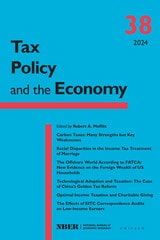
Tax Policy and the Economy, Volume 38
Edited by Robert A. Moffitt
University of Chicago Press Journals, 2024
Tax Policy and the Economy publishes current academic research on taxation and government spending with both immediate bearing on policy debates and longer-term interest.
This volume presents new research on taxation and public expenditure programs, with particular focus on how they affect economic behavior. John Guyton, Kara Leibel, Dayanand Manoli, Ankur Patel, Mark Payne, and Brenda Schafer study the disallowance of Earned Income Tax Credit (EITC) benefits as a result of IRS audits, and find that in post-audit years, audited taxpayers are less likely than similar non-audited taxpayers to claim EITC benefits. Janet Holtzblatt, Swati Joshi, Nora Cahill, and William Gale provide new empirical evidence on racial differences in the income tax penalty, or bonus, associated with a couple being married. Haichao Fan, Yu Liu, Nancy Qian, and Jaya Wen evaluate how computerizing value-added tax transactions in China affected the tax revenue collected from large manufacturing firms. Niels Johannesen, Daniel Reck, Max Risch, Joel Slemrod, John Guyton, and Patrick Langetieg study data on the ownership of foreign bank accounts and other financial accounts as reported on income tax returns. They find that many of these accounts are in tax havens, and they discuss the impact of the Foreign Account Tax Compliance Act on tax compliance and government revenue. Louis Kaplow integrates charitable giving into an optimal income tax framework, and shows that the externalities associated with such giving are key to determining its optimal tax treatment. Finally, Roger Gordon compares caps or quantity targets on emissions with carbon taxes and points out that which one dominates can be situation-specific and depend on a number of features of the economy.
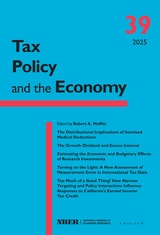
Tax Policy and the Economy, Volume 39
Edited by Robert A. Moffitt
University of Chicago Press Journals, 2025
Tax Policy and the Economy publishes current academic research on taxation and government spending with both immediate bearing on policy debates and longer-term interest. This volume highlights new insights on taxation, transfer programs, and related issues. First, analyzing the itemized medical deduction in the US federal income tax, Gopi Shah Goda, Ithai Lurie, Priyanka Parikh, and Chelsea Swete find that this provision disproportionately benefits higher-income taxpayers, particularly after the passage of the 2017 Tax Cuts and Jobs Act. They also consider alternative structures, such as a tax credit, that could make the distribution of the tax benefits for those with high medical outlays more equal. Next, Danny Yagan analyzes factors influencing the US federal budget deficit and the debt-to-GDP ratio. He describes the "growth dividend," the impact of GDP growth on the debt ratio, and warns about the potential costs of high debt-to-GDP ratios, especially when interest rates rise. In the third paper, Theresa Gullo, Benjamin Page, David Weiner, and Heidi Williams synthesize the economic evidence on the economic and budgetary effects of R&D investment and examine how this evidence could be incorporated into the standard projections generated by various federal agencies. Fourth, Rosanne Altshuler, Lysle Boller, and Juan Carlos Suárez Serrato investigate profit shifting by US multinational corporations and evaluate the importance of aggregation errors in reported foreign earnings and on estimates of profit shifting elasticities based on these data. Finally, David Neumark and Zeyu Li find no employment effect of California’s Earned Income Tax Credit on less-skilled single mothers, in contrast with the effects of federal and other states' programs. They suggest that structural differences and interactions with minimum wage laws explain this result.
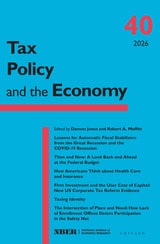
Tax Policy and the Economy, Volume 40
Edited by Damon Jones and Robert A. Moffitt
University of Chicago Press Journals, 2026
Timely and authoritative research on the latest issues in tax policy.
Tax Policy and the Economy publishes current academic research on taxation and government spending with both immediate bearing on policy debates and longer-term interest.
This volume presents new research on taxation, transfer programs, and related issues. Karen Dynan and Douglas Elmendorf examine the potential impact of automatic fiscal stabilizers on fiscal policy and economic activity. They find that a stabilizer providing direct payments could have produced faster unemployment decline after the Great Recession without raising inflation and much lower inflation after COVID-19 at the cost of a slower unemployment reduction. Alan J. Auerbach and William Gale review federal budget history and project the US debt-to-GDP ratio over the next 30 years, arguing that high projected debt could constrain future policy actions. They also explore possible fiscal consolidation policies. Beatrice Ferrario and Stefanie Stantcheva survey Americans’ views of health care and insurance, finding broad agreement regarding costs, access, and efficiency but partisan gaps in policy preferences stemming from fundamentally different views of government scope rather than contrasting efficiency or fairness beliefs. Jonathan S. Hartley, Kevin A. Hassett, and Joshua D. Rauh analyze the corporate investment response to the Tax Cut and Jobs Act of 2017, finding a larger response than a number of earlier studies of investment sensitivity would have suggested. Joel Slemrod reviews historical taxation based on racial, religious, and gender identity and examines how tax policies that are not conditioned on any of these attributes can nevertheless differentially impact families as a result of systemic differences in their economic circumstances. Finally, Marianne Bitler, Jason Cook, Chloe N. East, Sonya R. Porter, and Laura Tiehen analyze geographic proximity effects on Supplemental Nutrition Assistance Program (SNAP) participation, finding that when a SNAP office opens, participation increases by about 20%. When an office closes, they find that participation drops by about 8% in the next two years.
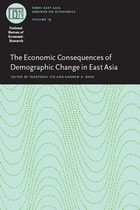
The Economic Consequences of Demographic Change in East Asia
Edited by Takatoshi Ito and Andrew K. Rose
University of Chicago Press, 2010
Recent studies show that almost all industrial countries have experienced dramatic decreases in both fertility and mortality rates. This situation has led to aging societies with economies that suffer from both a decline in the working population and a rise in fiscal deficits linked to increased government spending. East Asia exemplifies these trends, and this volume offers an in-depth look at how long-term demographic transitions have taken shape there and how they have affected the economy in the region.
The Economic Consequences of Demographic Change in East Asia assembles a group of experts to explore such topics as comparative demographic change, population aging, the rising cost of health care, and specific policy concerns in individual countries. The volume provides an overview of economic growth in East Asia as well as more specific studies on Japan, Korea, China, and Hong Kong. Offering important insights into the causes and consequences of this transition, this book will benefit students, researchers, and policy makers focused on East Asia as well as anyone concerned with similar trends elsewhere in the world.

The Radical Bookstore
Counterspace for Social MovementsKimberley Kinder
University of Minnesota Press, 2021
Examines how radical bookstores and similar spaces serve as launching pads for social movements
How does social change happen? It requires an identified problem, an impassioned and committed group, a catalyst, and a plan. In this deeply researched consideration of seventy-seven stores and establishments, Kimberley Kinder argues that activists also need autonomous space for organizing, and that these spaces are made, not found. She explores the remarkably enduring presence of radical bookstores in America and how they provide infrastructure for organizing—gathering places, retail offerings that draw new people into what she calls “counterspaces.”
Kinder focuses on brick-and-mortar venues where owners approach their businesses primarily as social movement tools. These may be bookstores, infoshops, libraries, knowledge cafes, community centers, publishing collectives, thrift stores, or art installations. They are run by activist-entrepreneurs who create centers for organizing and selling books to pay the rent. These spaces allow radical and contentious ideas to be explored and percolate through to actual social movements, and serve as crucibles for activists to challenge capitalism, imperialism, white privilege, patriarchy, and homophobia. They also exist within a central paradox: participating in the marketplace creates tensions, contradictions, and shortfalls. Activist retail does not end capitalism; collective ownership does not enable a retreat from civic requirements like zoning; and donations, no matter how generous, do not offset the enormous power of corporations and governments.
In this timely and relevant book, Kinder presents a necessary, novel, and apt analysis of the role these retail spaces play in radical organizing, one that demonstrates how such durable hubs manage to persist, often for decades, between the spikes of public protest.