Results by title
3 books match the query 'Smeeding, Timothy'
Horizontal Equity, Uncertainty, and Economic Well-being
Edited by Martin David and Timothy Smeeding
University of Chicago Press, 1985
The result of a National Bureau of Economic Research Income and Wealth conference held in December 1983, this volume looks at the concept of "economic well-being" and the ways that analysts have tried to measure it. In addition to income, economists have begun to consider such factors as pensions, wealth, health, and environment when measuring the well-being of a particular group. They have also begun to measure how consumers respond, successfully or unsuccessfully, to such economic uncertainties as inflation, divorce, and retirement. Using new data and techniques, the contributors to this book concentrate on issues of uncertainty and horizontal equity (the equal treatment of individuals within a defined group). Their work points to better ways of determining how various groups in a society are faring relative to other groups. Economists and policy analysts, therefore, will be in a better position to determine how government programs should be applied when well-being is used as a test.
[more]
Persistence, Privilege, and Parenting
The Comparative Study of Intergenerational MobilityTimothy Smeeding
Russell Sage Foundation, 2012
Americans like to believe that theirs is the land of opportunity, but the hard facts are that children born into poor families in the United States tend to stay poor and children born into wealthy families generally stay rich. Other countries have shown more success at lessening the effects of inequality on mobility—possibly by making public investments in education, health, and family well-being that offset the private advantages of the wealthy. What can the United States learn from these other countries about how to provide children from disadvantaged backgrounds an equal chance in life? Making comparisons across ten countries, Persistence, Privilege, and Parenting brings together a team of eminent international scholars to examine why advantage and disadvantage persist across generations. The book sheds light on how the social and economic mobility of children differs within and across countries and the impact private family resources, public policies, and social institutions may have on mobility. In what ways do parents pass advantage or disadvantage on to their children? Persistence, Privilege, and Parenting is an expansive exploration of the relationship between parental socioeconomic status and background and the outcomes of their grown children. The authors also address the impact of education and parental financial assistance on mobility. Contributors Miles Corak, Lori Curtis, and Shelley Phipps look at how family economic background influences the outcomes of adult children in the United States and Canada. They find that, despite many cultural similarities between the two countries, Canada has three times the rate of intergenerational mobility as the United States—possibly because Canada makes more public investments in its labor market, health care, and family programs. Jo Blanden and her colleagues explore a number of factors affecting how advantage is transmitted between parents and children in the United States and the United Kingdom, including education, occupation, marriage, and health. They find that despite the two nations having similar rates of intergenerational mobility and social inequality, lack of educational opportunity plays a greater role in limiting U.S. mobility, while the United Kingdom’s deeply rooted social class structure makes it difficult for the disadvantaged to transcend their circumstances. Jane Waldfogel and Elizabeth Washbrook examine cognitive and behavioral school readiness across income groups and find that pre-school age children in both the United States and Britain show substantial income-related gaps in school readiness—driven in part by poorly developed parenting skills among overburdened, low-income families. The authors suggest that the most encouraging policies focus on both school and home interventions, including such measures as increases in federal funding for Head Start programs in the United States, raising pre-school staff qualifications in Britain, and parenting programs in both countries. A significant step forward in the study of intergenerational mobility, Persistence, Privilege, and Parenting demonstrates that the transmission of advantage or disadvantage from one generation to the next varies widely from country to country. This striking finding is a particular cause for concern in the United States, where the persistence of disadvantage remains stubbornly high. But, it provides a reason to hope that by better understanding mobility across the generations abroad, we can find ways to do better at home.
[more]
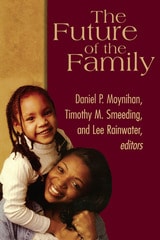
The Future of the Family
Daniel Patrick Moynihan
Russell Sage Foundation, 2004
High rates of divorce, single-parenthood, and nonmarital cohabitation are forcing Americans to reexamine their definition of family. This evolving social reality requires public policy to evolve as well. The Future of the Family brings together the top scholars of family policy—headlined by editors Lee Rainwater, Tim Smeeding, and, in his last published work, the late Senator Daniel Patrick Moynihan—to take stock of the state of the family in the United States today and address the ways in which public policy affects the family and vice versa. The volume opens with an assessment of new forms of family, discussing how reduced family income and lower parental involvement can disadvantage children who grow up outside of two-parent households. The book then presents three vastly dissimilar recommendations—each representing a different segment of the political spectrum—for how family policy should adapt to these changes. Child psychologist Wade Horn argues the case of political conservatives that healthy two-parent families are the best way to raise children and therefore should be actively promoted by government initiatives. Conversely, economist Nancy Folbre argues that government's role lies not in prescribing family arrangements but rather in recognizing and fostering the importance of caregivers within all families, conventional or otherwise. Will Marshall and Isabel Sawhill borrow policy prescriptions from the left and the right, arguing for more initiatives that demand personal responsibility from parents, as well as for an increase in workplace flexibility and the establishment of universal preschool programs. The book follows with commentary by leading policy analysts Samuel Preston, Frank Furstenberg Jr., and Irwin Garfinkel on the merits of the conservative and liberal arguments. Each suggests that marriage promotion alone is not enough to ensure a happy, healthy, and prosperous future for American children who are caught up in the vortex of family change. They agree that government investments in children, however, can promote superior developmental outcomes and even potentially encourage traditional families by enlarging the pool of "marriageable" individuals for the next generation. No government action can reverse trends in family formation or return America to the historic nuclear family model. But understanding social change is an essential step in fashioning effective policy for today's families. With authoritative insight, The Future of the Family broadens and updates our knowledge of how public policy and demography shape one another.
[more]